
Predicting the failure of silicon nanomembranes in burst pressure studies
After years of on again/ off again work – dating all the way back to the earliest days of the NRG – we have finally submitted a manuscript on membrane mechanics. The story of this manuscript is a remarkable one: it was willed into existence by a UR Mechanical Engineering PhD student who developed a strong interest in nanomembranes while working on other things for his PhD (ala Tom Gaborski). We will be forever indebted to this student – Steven Gillmer – and his boss – Jon Ellis. Steve combined data from Dave, JP, Sarah, and Josh W with theory from various sources to create a predictive model of membrane failure.
Here are the two most useful figures in the paper in my opinion ..
 The experiments were done for square membranes of pnc-Si at 67 um on a side and for square NPN membranes of 278 um on a side. The equation describing the central deflection of a square membrane is given by …
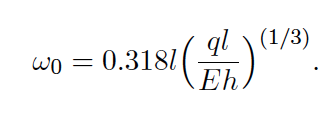 Where q is pressure, l is window size, E is Youngs Modulus and h is thickness. So all other variables being constant, the deflection increases as the 4/3 power of the window size. The ~ 4 fold difference in size between pnc-Si and NPN windows should give a ~ 6 fold increase in deflection for a given pressure and this is roughly what we see. So the smaller window size is why pnc-Si appears to be stronger than NPN in this plot.
  Despite similar deflection under similar pressures, NPN is considerably stronger than pnc-Si in burst pressure tests as we all know. The increased ‘fracture toughness’ of SiN turns out to be an important parameter in explaining this improvement. It is hard to argue with the agreement between theory and experiment. More discussion at NRG.
