
Rotational and translational diffusion of DNA in a nanopore
Small DNA oligomers behave like stiff cylindrical rods. They have both rotational and translational diffusion, and this is of interest when considering how such a rod will diffuse through a nanopore. In this post I briefly consider the effects of rotational and translational diffusion of cylinders of different lengths.
The rotational diffusion coefficient can be obtained by combining the Einstein relation with a rotational drag coefficient of a cylinder in free solution:
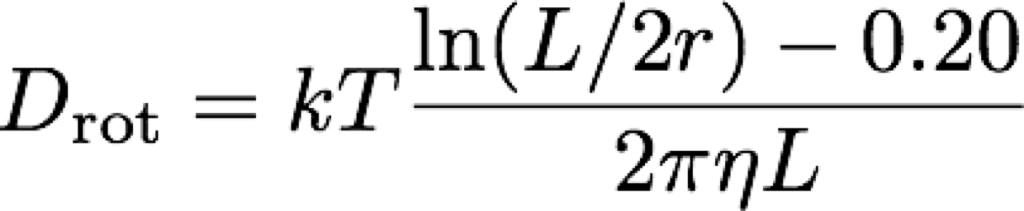
where k is the Boltzmann constant, T the temperature, L the length of the molecule, r the radius of the molecule, and η the viscosity. We compute the average time of rotation (3D case) using the following equation:
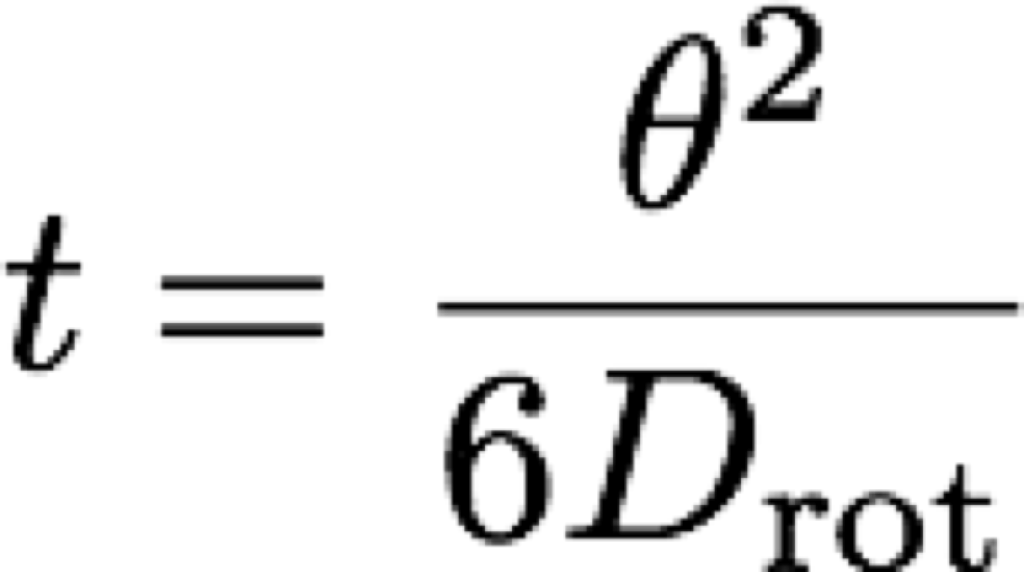
where θ is the angle of rotation in radians.
A similar treatment can be performed for translational diffusion. The translational diffusion coefficient of a cylinder is

and the average time to diffuse a given distance x is

In the following figure I compare the times required to complete a full rotation (2π radians) and to translate the thickness of the membrane (15 nm).
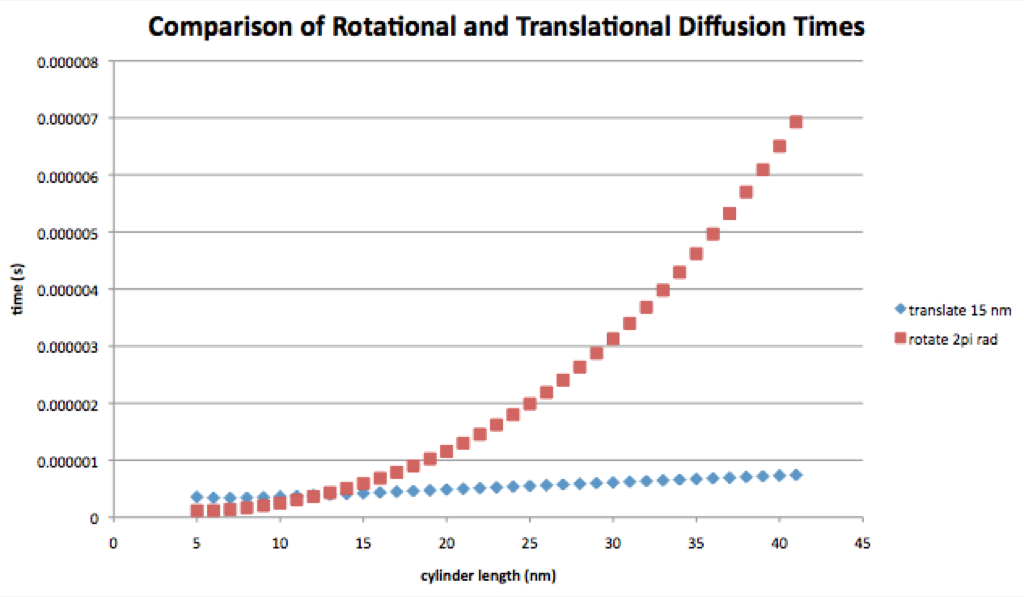
The times are equivalent at approximately 13 nm. For cylinders less than 13 nm, they completely rotate quicker than they translate 15 nm. For cylinders larger than 13 nm, rotation is slow compared to the 15 nm passage through the membrane.
A 13 nm long piece of DNA has 38 base pairs. In our early experiments with Bernhard and Black, only three of the oligonucleotides were smaller than 13 nm.
UPDATE:
Here is a plot of rotational diffusion times for 2 pi radians and translational diffusion times for the molecule to diffuse it’s own length. It looks like these times are more on the same order.

However maybe it is also interesting to look at the molecule translating its entire length in addition to passing the thickness of the membrane. This was the entire molecule passes through the membrane. Here the translation time is longer than the rotation time, but not to a huge extent.
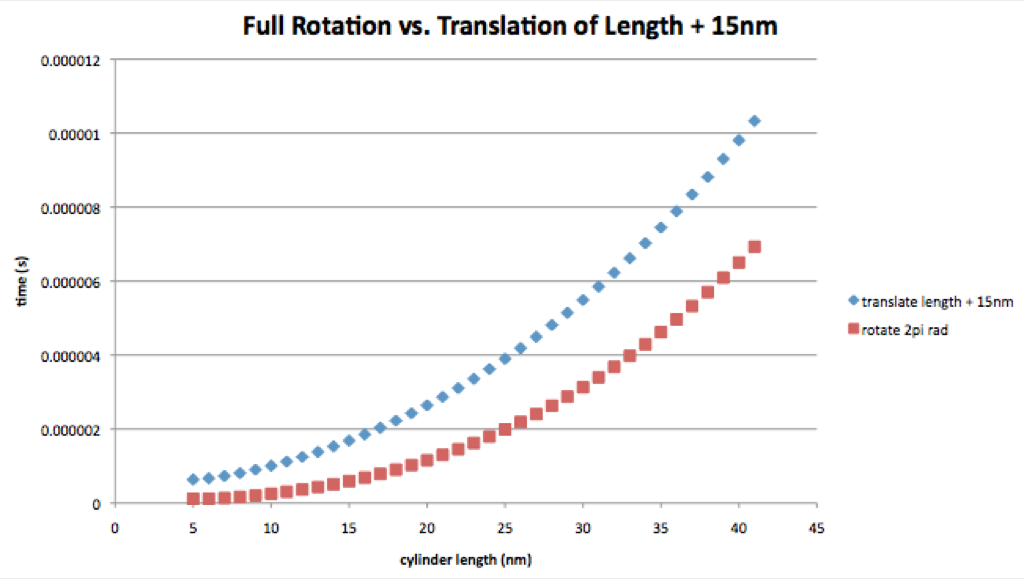
interesting. what is the lesson learned here? it seems to me that small rigid objects will undergo a full rotation before they have time to pass through the membrane. However, the two curves intersect at exactly the membrane thickness- is that a coincidence or not?