Journal Club, Rebecca E.Lane et al, Analysis of exosome purification methods using a model liposome system and tunable resistive pulse sensing
Motivation and Background:
Isolation of exosomes is a critical step for downstream diagnosis and therapeutic applications. Table 1 is a comparison table for four different protocols of exosomes isolation which have been designed to utilize physical properties of these vesicles.
|
Protocol |
Concept |
Comments |
|
Ultracentrifugation |
High speed spins (100,000 ˟ g) to sediment exosomes |
The presence of contaminating cellular and protein debris. Widely cited isolation technique.
|
|
Invitrogen Total Exosome Isolation Kit and ExoSpin Exosome purification Kit |
Sedimentation of exosomes during low speed centrifugation by inducing precipitation with poly-ethylene glycol or similar substances |
Less user intensive than ultracentrifugation. Precipitate non-exosome debris.
|
|
PureExo Exosome Isolation Kit |
isolated based on their buoyant density in viscous fluids, wherein samples are layered onto discontinuous sucrose or iodixanol gradients and subjected to high speed centrifugation (100,000 ˟ g) |
Less prone to capture contaminating cellular debris. Highly user intensive. Not suited for high-throughput applications. |
Exosomes size range is 30-150 nm with an approximate density of 1.10-1.20 g/mL. The size of exosomes in particular has been reported as an important factor for in vivo vesicle behavior and localization, and it has been suggested than exosomes derived from tumor cells may differ in size to those from normal cells. Reports in the literature have also indicated that isolation methods may affect exosomal protein and RNA yield, suggesting exosome integrity and physical properties may be affected by isolation techniques. The motivation of this study is to figure out if isolation technique affect exosome’s size. Due to difficulties of pre-isolation measurements (e.g. size and concentration), they suggested using liposomes as a model vesicle system for evaluation of effect of isolation techniques on physical properties of exosomes.
Methods:
Tunable Repulsive Pulse Sensing (TRPS) were used to characterize these vesicles and isolation techniques, which is a platform capable of single-particle measurements of size and concentration.
Discussion:
Critically liposomes can be characterized before and after isolation to determine the effect of purification on vesicle size distribution and determine the percent recovery of each method.
Exosome Yield:
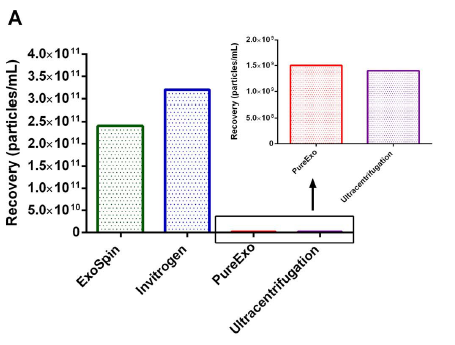
- More user-intensive nature of the PureExo and ultracentrifugation protocols, which could cause an increased sample loss due to handling during the isolation process and result in a lower end yield.
- The ExoSpin and Invitrogen kits may isolate non-exosome debris to a higher degree than the PureExo or ultracentrifugation methods.
Comparison of Exosome and Liposome Size:
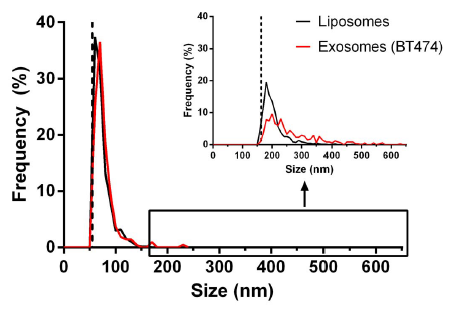
- While, observed no changes in the size distribution of the recovered liposome particles post-processing, we did measure particles larger than the reported 30–150 nm size range in processed exosome samples.
- Measured particles larger than the reported 30–150 nm size range in processed exosome samples without aggregation, suggests these larger particles in exosomes samples most likely represent non-exosome debris which has been co-purified.
 Zeta Potential:
- Processed liposomes had a zeta-potential of 12 mV (61.2 mV), while the processed exosome sample was 18.0 mV (60.5 mV) in PBS 1 0.05% Tween-20.
Post Processing Size Distribution:
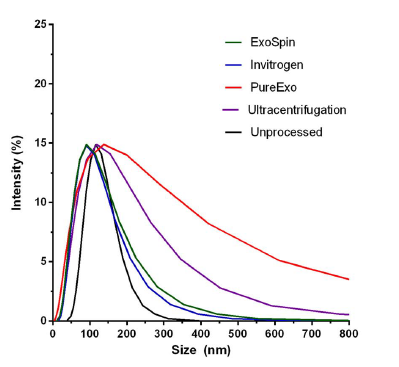
- Both DLS and TRPS data demonstrated that the particle size distribution of processed liposome samples was comparable to that of the unprocessed control
- TRPS single particle analysis system we did not observe any substantial changes in liposome size distribution.
 In conclusion their results demonstrate that the isolation protocols assessed in this study do not substantially alter vesicle size distribution during purification, and are able to robustly isolate both exosomes and synthetic liposomes using three of the four methods investigated. This conclusion is of particular importance in the context of exosome purification and analysis, since the size of exosomes has been reported to be an important factor in in vivo vesicle behavior and localisation, and reports have suggested that exosomes derived from tumour cells may differ in size to those from normal cells.Original Paper: Analysis of exosome purification methods using a model liposome system.