
Fabricating an integrated device for virus-detection.
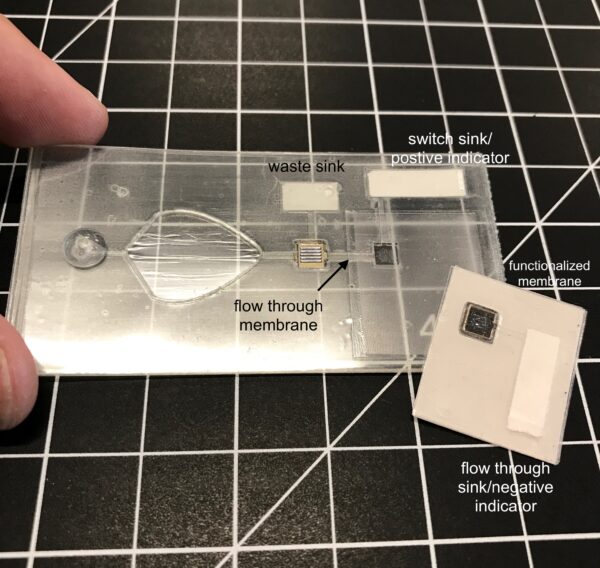
So this is the latest iteration of the thumb-pump device we were working on this summer. As you will see in the diagrams, the idea is to ultimately have saliva go through a filtration step, with a side channel leading to a paper sink for excess/refuse pre-filtrate and a through channel. The latter channel leads to the second/detection membrane. That second membrane is located on a secondary device that is attached to the primary device using PSA. The flow through in this membrane leads to a paper sink/indicator, which contains the sample (it does not spill out of the device) and signals a NEGATIVE output. In case of a switch (positive detection) the sample is directed to a side channel in the primary device that leads to a paper sink/indicator, which contains the sample and signals a POSITIVE output. The reason we have a secondary device is so the functionalized/capture membrane can be added to the device after the device is already built (similar to Aline devices). The first membrane is built-in as the primary device is fabricated.
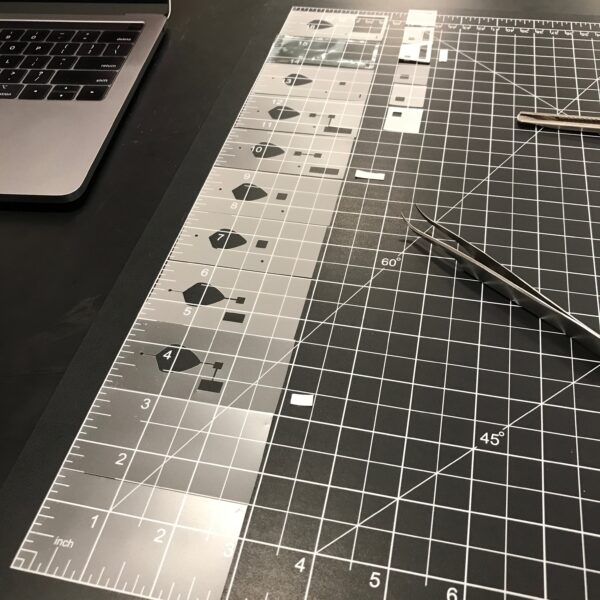
The primary device consists of about 11 layers of film: some is 3 mil PET/EVA, some is 6mil EVA/PET/EVA, one layer of very flexible polypropylene and some filter paper. The secondary device has both kinds of PET/EVA film and paper but also contains two layers of PSA film. The bottom layers allows it to stick to the primary device. The middle layer sticks to the rim of the membrane chip, keeping it in place as it is added after the device is fully built.
For this prototype I used old chips with broken membranes. The thumb pump volume is 150 microliters. My test aimed to verify that liquid can go through the channels as planned, and to give me an idea of the capacity of the sinks.
When I first pipetted in some water (see video IMG_2940), the liquid properly moved into the arrowhead chamber and then THROUGH the 1st membrane. It was good to see that the side channel+sink was not immediately filled. Then I attached the secondary device (see video IMG_2941). When I pressed using my thumb, the water flowed into EVERY channel (see video IMG_2944). It also came out through the PSA “seal”. That it goes into every channel will need attention (the applied pressure+volume is likely too much, but happy to hear your ideas). If you look in slow motion at the flow through negative sink channel you can see that it is partially sealed, offering a lot of resistance, which could explain the flow in other places (that is an easy fix).
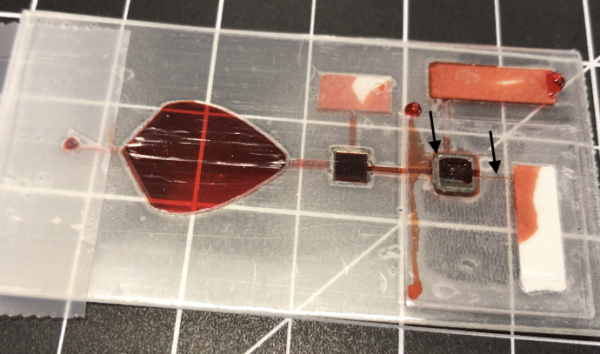
For now my next aim is to fix the leak. I think this will be done by simply adding a gasket layer of the PSA film. Currently there flat edge of the membrane chip is facing directly the top of the primary device, so there is no seal there until it hits the edge. We will see if this solves the problem. I am hoping that the PSA film I am using will give me enough seal. I could perhaps add double sided tape to the primary device to “double” the amount of adhesive (from top AND bottom) to help with sealing.
All in all, it seems like the device should be viable, I just still need to work out volumes and resistances (resistencias, en Español ; )
Did I already say that this is lots of fun? It is taking a while because I am teaching 6 sections this semester, but I will keep at it. Cheers.
Fernando
This looks very close and I like modular approach to the second membrane. I know you’ve solved the leaks and so perhaps it is worth an updated post when you get a chance. Next step should be proof-of-principle with intact membranes and nanoparticles.
Oh .. and I endorse the use of REM as background music for videos.