New clamping bolts and protocol changes achieves 4-hour Dialysis…
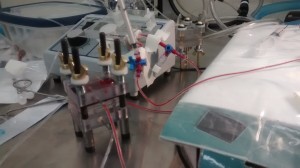
In order to prevent membrane breaking, I rebored the acrylic plates for larger bolts and added compression springs to regulate the clamping force on the chips. I also flushed the devices at the vivarium where the animal experiments take place. There were still assembled in the basement lab but transported dry. I flowed IPA followed by PBS per usual but then the device stayed in place to reduce bubble introduction and membrane tweeking.
RI also brought the device (filled with blood) back to Goergen, pumped Lactated-Ringers through it, and the membranes are still intact the following day. I will continue to fill and flush in the Vivarium for my last two animals of this study.
I have not analysed the blood with the urea assay yet… next week.
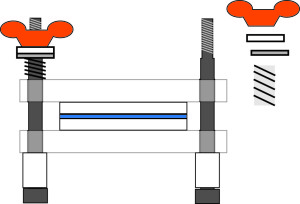
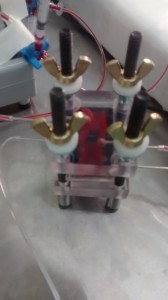
That’s encouraging! If this simple change continues to work, we’ll have learned more than just how to get rat studies to work. What do you think, Jim… An undergraduate to investigate the effect of small-magnitude chip-torquing on membrane strength in burst pressure and shear experiments? 😉