
Nanopore Battery Review
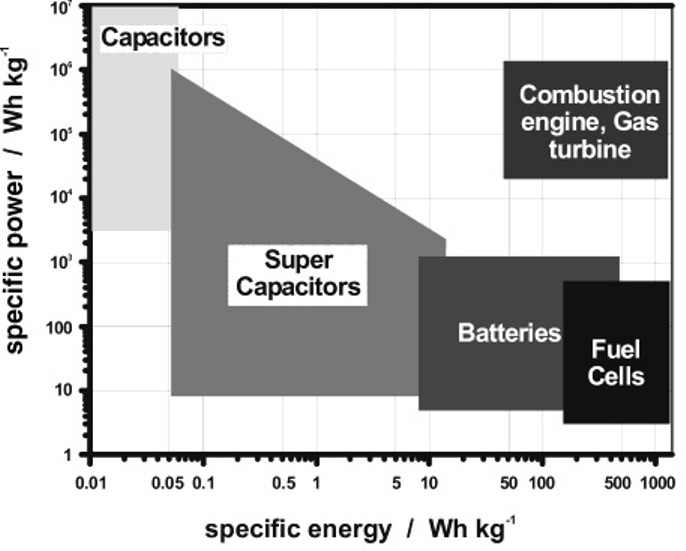
I have long desired to make energy storage devices with our nanomembranes (supercapacitor post), mainly because they would be really great separators, having both excellent charge conduction and physical barrier resistance due to the porosity and material properties of silicon. Other groups have begun to take advantage of the increased surface area inherent in nanoporous thin films for different energy applications.
Paper Review
The authors write the introduction about the various limitations of different nanostructured materials for energy storage. Too thin -> high leakage current. Solid-state electrolyte on alumina template -> poor ionic conductivity. Liquid electrolyte -> poor areal capacity. Looking ahead, the authors note a tradeoff in manufacturing between electrode shape and complicated electrolyte pathways.
The main attraction of the paper is that the authors use an anodized aluminum oxide template (50 microns thick, 250 nm pores, 30% porosity) to create a straightforward liquid electrolyte pathway and a more complicated electrode shape (nanotubes of vanadium oxide). This process attacks the tradeoff with pore areal capacity by introducing large amounts of current collector area coating the inner surfaces of the nanopore. Most of the paper involves characterizing the total electrode shape, capacity, and robustness. All of these properties are afforded by the nanoporous AAO template and the resultant larger surface area of the nanostructured current collector.
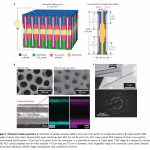
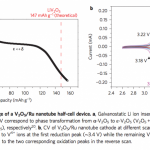
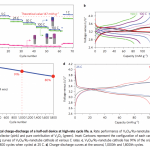
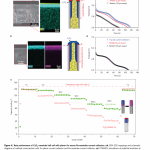
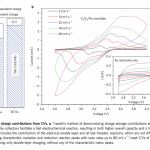
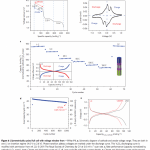
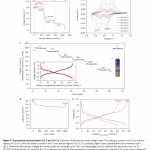
Overall, their device is very promising. It has very scalable manufacturing processes, and potentially could be layered over and over again to reach a usable volumetric capacity, which is not necessarily easy to do. Vehicular energy storage needs about 100 kWh to power a car for 400 miles, with a bare minimum of ~50 kWh to alleviate range anxiety. A laptop battery is about 9,000 mAh. Gravimetrically, their energy storage materials are on the order of 120 mAh/g, but I could not find how much their device actually weighed.

 We are creating materials using the same philosophy, using the nanoporous silicon as a template for other nanostructured materials. Unfortunately the scale of our template is 1000x thinner than what they are using for their battery process. However, we may be able to make other types of energy storage devices which cannot be made with thick templates like used in this paper.
Supercapacitor theory – wikipedia
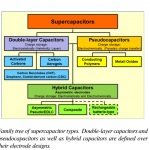
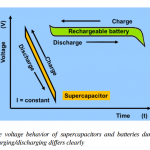
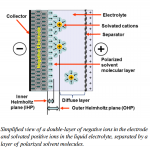
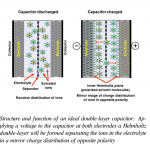
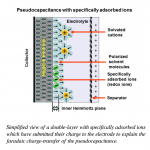
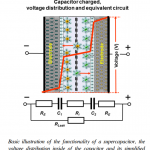
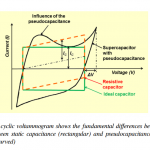
“ The basic principles to obtain a competitive EDLC is to collect all the following performances: high ionic electrolyte conductance, high ionic separator conductance, high electronic separator resistance, high electrode electronic conductance, large electrode surface, low separator and electrodes thickness.”
J.-Electrochem.-Soc.-2012-Laforgue-A929-36
We can achieve many of the desirable parameters with pnc-Si. We could make a full cell device by sandwiching our pnc-Si membranes with carbon nanotubes. It should be very stable, with low ESR.

We should be able to lower the self-discharge characteristics of supercapacitors with our membranes, meaning that they can hold on to charge longer and dispense their charge faster. Our membranes would not directly contribute to the energy storage (anodic and cathodic materials would) but would allow the storage mechanism to approach and retain its theoretical storage limits. We may be able to improve supercapacitors by using a nanostructured material to create intricate, large surface area capacitors, much like the nanobattery authors created large area current collectors.