Control Experiments for NPN Translocation Project
Just a quick update this time – since my last post I have been doing control experiments to demonstrate the effect of the filters. For the controls I have been using the chips without the nitride cap, since I am running low on the nitride ones (current I have 23 left, 7 with filters already applied). I don’t thin kthe lack of cap will make for any kinetics differences so these should be good control chips for the moment.
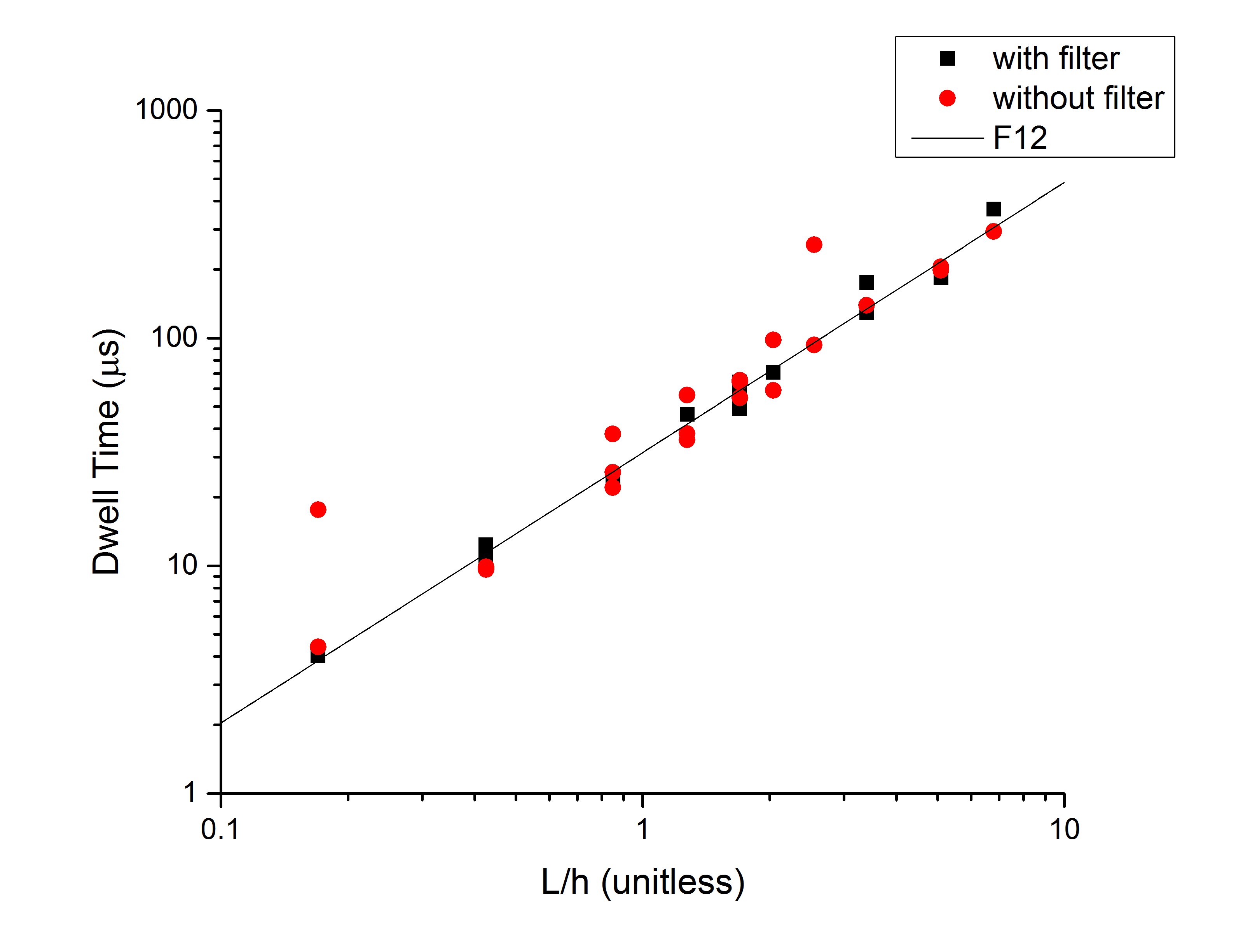
The results are interesting. Below, we see the dwell time scaling with length (using the parameter L/h, the ratio of DNA contour length to gap height). Interestingly, while the average dwell time of the control experiments shows slightly more variation than the case with the filters, the scaling is largely unaffected.
The filters have the most dramatic effect when looking at the standard deviation and the coefficient of variation. While it is evidently possible to get pores without the filter that perform on the level of the filter, generally speaking the fitted curve for the pores with the filter provides a limiting envelope for the control experiments. In a sense, the filter “idealizes” the nanopores, providing minimal standard deviation and coefficient of variation:

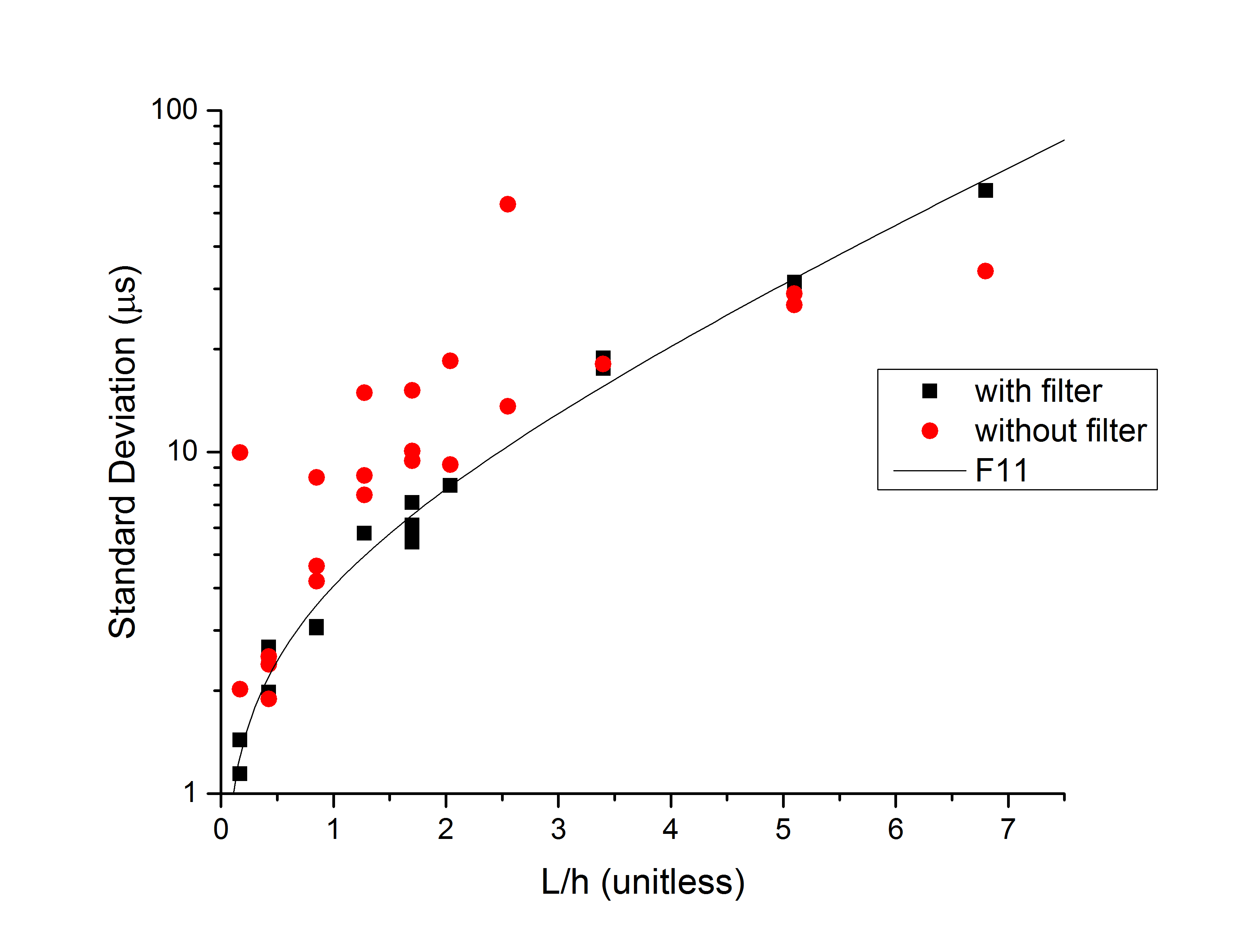
As is evident from the curves, especially the CV curve, the filters really only have a significant effect for  . This is not really surprising, and is consistent with the discussion so far: short molecules can fully enter the gap before being sensed, and any effect of the filter aligning the molecule will at least partially decay before translocation occurs, so the filter effect is diminished for very small molecules. For long ones, it is clear that the filter must eventually stop having an effect, at this seems to occur around
  . Because of multiple NPN threading and the resulting clogs that I have repeatedly observed in this regime, the filters are not useful here anyway, so this noteworthy, but of no consequence to the performance of these devices.
The effect is modest compared to what I was expecting, but it is clearly there. I think we can probably improve on this dramatically by tweaking the NPN pore side distribution. These NPN pores we are using here are very large (35nm on average) compared to the dimensions that would be necessary to linearize molecules, and the large variation in pore size will contribute to variations in the effects of the filter on folding. I think that using a batch of NPN with ~10nm pores and higher porosity has the potential to amplify this effect significantly. Can you comment on the feasibility of making such a membrane?
Further playing with folding distributions has shown no clear patterns. I suspect this is due to the large variation in the sizes of the ~10 or so NPN pores that are active in the process (see my last blog post). I have shelved this avenue of inquiry for the moment, and we can revisit it when we decide what direction to go after this sub-project is concluded. I don’t think it’s necessary for our message, anyway. I had intended to use it as proof that the NPN membrane was there, but I think the control experiments above demonstrate that fact conclusively without needing additional proof.
As for NPN filters affecting lifetime, I don’t think we can make that claim just yet. Some of the control experiments yielded literally millions of translocation events spanning 5 or more different sample sizes over the course of multiple days. I think the new record is something like 350,000 events for a single molecular size (and so now I have to break a million on principle, stay tuned).
You’ll notice that I’ve dropped a few points from previous iterations. One was 50-bp dsDNA (x=0.085) and another was 5000-bp (x=8.5). The small oine was dropped because the dwell times were too short for a robust fit and different fitting approaches were giving me different results. The 5000bp point was dropped because the effects of tangling in the NPN were so dramatica that it was impossible to distinguish the untangled translocations. I don’t think either point is necessary as they are well outside the region of operation for these devices.
Sometime in the next couple of months are lab has to move to a new building. Since that will be very disruptive, I have focused on gathering as much data as possible instead of writing papers. Please let me know in the comments what other experiments you would like to see done, if some part of the curve needs more resolution, etc. The sooner I get it done the less likely it is to be disrupted by the move. Let me know your thoughts and suggestions.
Ah those blasted controls. What is an alternative theory for the large number of events? Is the oxide partly responsible? I can’t comment on the need for more resolution in the data but I’m very interested in the evolving narrative for a manuscript. Are we going to need to move to the smaller pore NPN to get a high impact paper?
I also wanted to comment on the ‘dirty’ membranes from your last post. Did you pop these out yourself? The difference could be the creation of debris during pop-out. I’m not sure if we trained you on our best techniques in this regard.
Large number of events could be due to event rate. I think the filter does reduce the event rate somewhat, though I need to do some calculations to confirm this. It’s not overly surprising that having a barrier to translocation would reduce the event rate. The rate is still sufficient for good statistics in reasonable times so I don’t think this is in any way detrimental to the narrative. I’m actually very happy with these controls, I think it paints a pretty clear picture of what is going on physically, which is not often the case with nanopores. I think these results are going to be quite high impact.
Debris during pop-out are certainly a possibility. We should do a skype chat soon to discuss.
I will let Vincent comment on this as well, but I think we have a fairly high impact paper already. The way I see this going, we get this first paper out, then we do another one exploring the effect of NPN pore size, and a third one (maybe) exploring the effect of gap height.
It will be possible to get membranes with smaller pore sizes, but they might be thicker than the 50 nm you have worked with so far, by laying on a thin film of silicon dioxide (or metal) that will occlude some of the pore diameter (I can probably get down to 15 nm, while increasing the thickness to 100 nm). The porosity might be difficult; my understanding from SiMPore has been that they want to stick to their NPN process as much as possible, which is the material you are familiar with.
Perhaps we can have a skype call this week or early next week?
I am available for a skype call any time this week except Wednedday afternoon, so let me know what works. I am very interested in the NPN fabrication process and what it is capable of (assuming I’m allowed to know this). If I had a better understanding of what was possible I would have a clearer picture of experimental design going forward for projects beyond this initial one.
Nothing secret about NPN fabrication. Its published: DesOrmeaux, J. P. S., et al. (2014). “Nanoporous silicon nitride membranes fabricated from porous nanocrystalline silicon templates.” Nanoscale 6(18): 10798-10805.
I think you are confirming that the oxide well is responsible for the increased number of events. Does slower event rate = higher number of total events because it reduces the likelihood of two DNAs entering a pore at the same time? Definitely time to talk.
I don’t think the oxide well is responsible for the increased event rate. I can’t think of any physical effect that would cause it to increase event rate. If anything, mild steric hindrance should decrease it.
The event rate is not actually significantly increased compared to other nanopore experiments on a per molar basis. The higher event rate compared to previous experiments is largely due to the use of higher DNA concentrations than I have in the past.
The event rate is lower with the filter (slightly) simply because the filter is an additional barrier to passage.
Slower event rate does not increase total number of events. Even with the event rates I’m seeing here, the chance of two molecules in the pore at the same time is vanishingly small. Even for the largest total number of events, the cumulative total time that the pore has DNA in it is maybe 0.1% – 1% of the total experimental time.
It’s also worth noting that not all the filters have low event rates (the one I’m doing as I type this has an event rate higher than some of the unfiltered controls), and not all the unfiltered ones have high event rates. There is large event rate variability between nanopores naturally, and all I’m saying is that the filter doesn’t really affect that variability the same way it affects dwell time variability.
I think we could reduced the NPN size by ALD at uOttawa and/or do chemical modification of its surface to change the interaction with the passing DNA (e.g. silane PEG coating). That should influence the dwell time more.
The reduction in the spread in the distribution of translocation time is a big deal and that storyline will hopefully allow us to publish in a high impact journal.
I need to review all the data with Kyle (I was away the last two weeks on vacation), but I would like to prepare this work for submission to Nature Nanotech (I have a good feeling about this).
Finally regarding lifetime, I have another student looking at this with chemically modified membranes, so we should have controls to compare to as well.