
Water permeability with %50 EtOH soak, ozone
In an attempt to help wet the pores prior to permeability experiments, I’ve started soaking assembled SepCons in a %50 ethanol solution. Each SepCon is inserted into an eppendorf so that the membrane side is fully submerged. I realized that in my last post, I was soaking multiple samples in a beaker which did not allow me to see if there was an air bubble that kept the EtOH from wetting the membrane completely. By soaking each individual SepCon in an eppendorf I can guarantee that it is in complete contact with the fluid.
The results are promising, especially with samples that were first ozone treated. All experiments were done in the pressure cell unless otherwise noted.
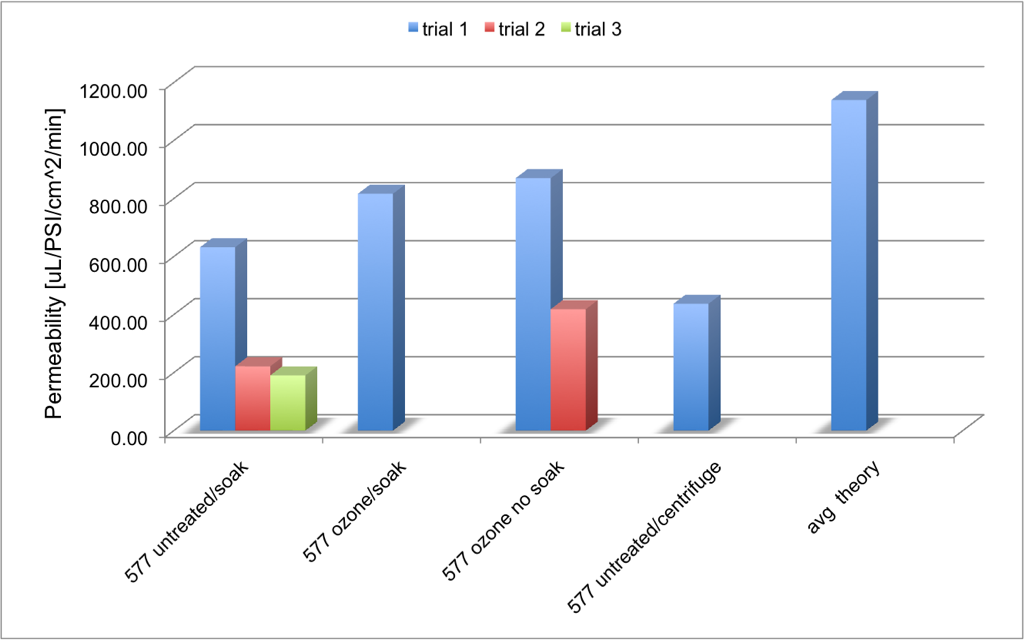
We’re still below theory, but with ozone treatment it’s close. There’s a lot of error since n=2 and the theoretical flow is an average of the inside/outside pore histograms. I’ve noticed that the permeability decreases drastically as I try to re-use samples. We think that plasticides might be leeching off the SepCon tubes. I will soak/sonicate them before use in my next experiments.
It would appear that ozone treating the membranes is sufficient in establishing fluid flow and is more effective than just pre-soaking in ethanol.
This is very interesting. We need to learn more about why the flow plummets in the second and third runs (maybe they are drying?), but you are getting close to the theoretical flow.
I think this data strongly supports the idea that pore wetting properties are just as important as the pore morphologies and should be given just as much attention. Every time flows are lower than expected, everyone keeps asking “what went wrong with production this time?” In many cases, there is nothing wrong with production, especially if the TEM images look good. Instead, the pores are simply not wetting well, so the best approach is to develop processes that improve the wetting of these good-looking membranes.
I would argue that our as-formed material has an intrinsic wetting problem. What allows the pores in some/many of our samples to fill with solution are defects that we don’t consider when we picture the structure of our material. I think that our ideal picture of perfectly straight pores intersecting both surfaces at right angles with atomically sharp corners, is a structure that’s very unfriendly to any solution entering the pores. Luckily, many of our samples have roughness or structural defects that allow solution to wick over these corners and enter the pore. However, sometimes we make nicer sharper pores that look beautiful in TEM, but don’t show very much flow. If we can round over the pores or bind hydrophilic polymers that create a fuzz around the entrances of the pores, I think performance and consistency will substantially improve.
The installation of the YES and ALD systems are timely. Ozone also appears to help, but we could also consider RTP treatment in combination with ozone and/or BOE etching.
Interestingly, pore wetting will affect contact angle as well. There is likely no difference at all in our surface chemistry between samples, but roughness and pore wetting induce typographical interaction with water that could strongly affect contact angle. I think it makes perfect sense that lower contact angles show up for membranes with good transport – pore wetting draws fluid across the surface, lowering the observed contact angle.
Another important point here is that if only a subset of pores are wetting, and we have no idea which subset this is, how do we know what our cutoff is? Our larger pores are often the sharpest looking in the TEM images, so does this mean that none of them are wetting, and therefore not contributing to transport? We are totally blind to this, and it could explain our bizarre nanoparticle separation results, where membranes with nearly identical pore size distributions are showing wildly different size cutoffs – defying all intuition. I don’t think we can assume that our TEM or gas-flow-confirmed pore distributions are necessarily correct for fluidic transport, unless we confirm that all pores are indeed wetting and participating in transport. If our transport is below theory, I’m not sure that I would completely trust the histograms in modeling.
If we can get some PEG-silanes or aminosilanes bound to our membranes with reasonable density, I think we will see some interesting effects. Very exciting!
Chris, you are raising many interesting points that we should, as a group, be discussing intensely. I propose that we devote a good part of one of the upcoming NRG meetings to this- let’s give all the group members enough time to prepare to address your points, and then we focus.
We’ve been down these roads before. We know that membrane wetting characteristics have varied in production – for example when the protective oxide is cleared to different degrees. We’ve passed water in wet/dry formats without any attempt at wetting and then we’ve failed to pass methanol through the membrane at all on different days with different membranes. Historically our rates have been low compared to theory because anything less than perfect wetting will cause us to miss low in the experiments. The NNano manuscript documents dozens of cases where we are close enough to theory for different membranes. Because of the agreement, we assume that we must have achieved perfect wetting. Clearly we are hanging a lot on the theory, but these cases seem to justify us doing that. Its possible that a surface treatment could make the wetting characteristics more consistent, but these will likely change the sieving characteristics of the membrane too.
IF we do confirm that our membrane wetting is a strong function of subtle pore morphology that is not clearly resolved by even TEM (I think our NP separation experiments are strong evidence – can anyone look at the TEMs and understand these separations?), I don’t think this is something that our core production process will be able to consistently address. I think the best that we can hope for in our core fabrication process is solid control of pore size, and perhaps the size distribution. Subtle sub-nm wetting geometries will need to be addressed with subsequent operations on the membranes – deposition, etching, oxidation, annealing, etc, and we have barely explored this parameter space thus far.