Hemo-Dialysis Channel Flow Characterization
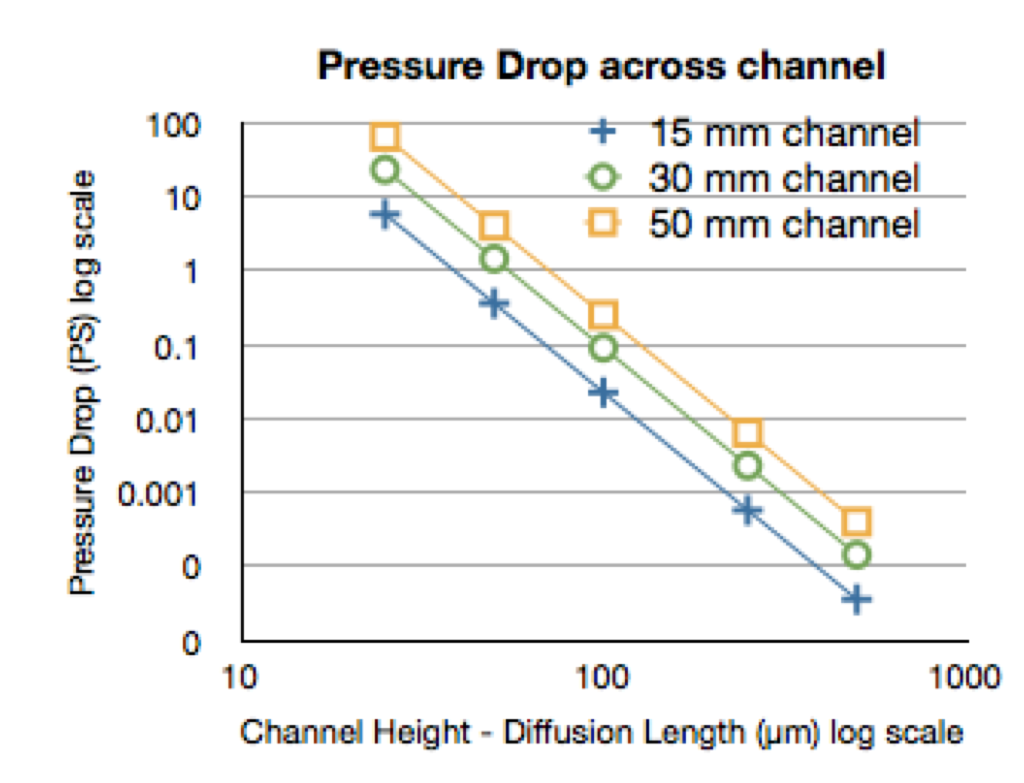
Dialysis Rate: 10 mL/min, Péclet Number: 1, Membrane Width: 700 µm, Channels per chip: 17
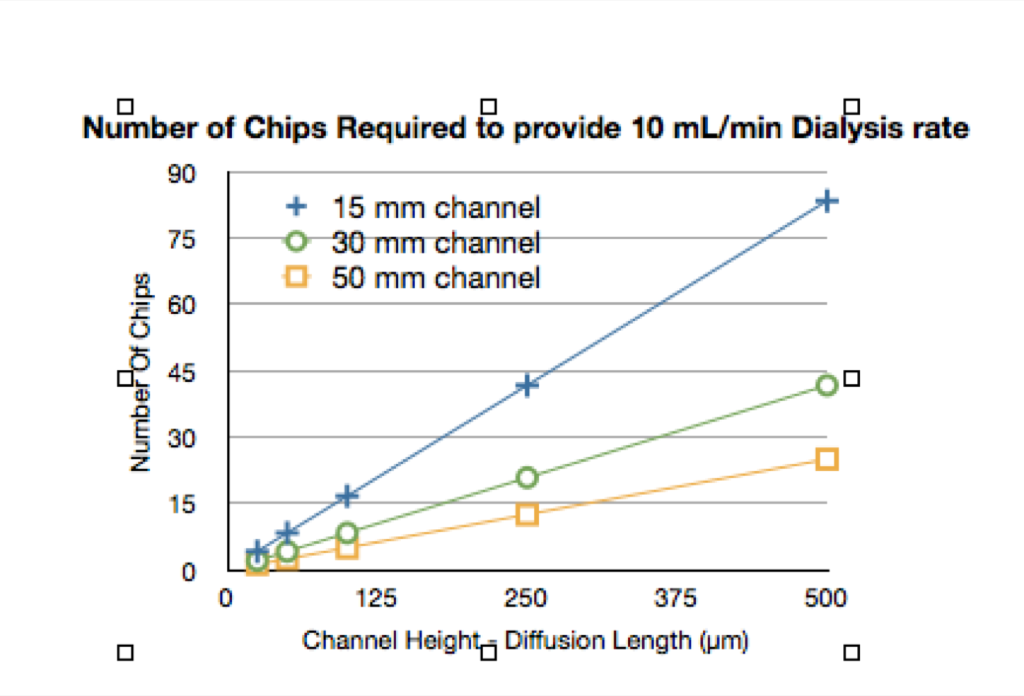

Péclet number
Pe ∝ H
Pe ∝ 1/L
Pressure Drop, P
P ∝ 1/H3
P ∝ L
Dialysis Rate: 10 mL/min, Péclet Number: 1, Membrane Width: 700 µm, Channels per chip: 17
Péclet number
Pe ∝ H
Pe ∝ 1/L
Pressure Drop, P
P ∝ 1/H3
P ∝ L
I’ve been working recently with amyloid-beta (AB) provided to me by some people in Brad Nilsson’s lab. These experiments are related to the HMM diffusion experiments for our collaboration with Harold Smith. Basically, AB fibrils are very long (microns) and we are looking for ways to either prevent their aggregation from smaller peptides/oligos, or to…
Phase II submission August 1, 2016 or January 30, 2017 UR Tasks – Biocompatibility by Feb. 1 2016 Channel design optimization by November 2015
We’ve known for some time that the sieving coefficient of our membranes changes over time. The reason for this is that at the start of the separation the concentration just above the membrane is the same as the bulk concentration, but as more and more fluid begins to pass through the membrane we get concentration polarization, and the membrane…
A study of membrane deflection has been conducted using the Veeco Wyco optical profiler. This is the first time the Veeco has been used to obtain quantitative data describing membrane deflection. This type of analysis will be useful for several reasons: –It will provide a numerical measure of maximum deflection and deflection vs. position for…
While experimental results are still forthcoming, I thought I’d make a post about the nature of the model I’ve constructed for ECMO. This model is the one that my experiments are seeking to validate; so to be clear, this model is founded entirely in theory for now. ECMO shares some obvious similarities with hemodialysis — blood…
Background For the in vitro portion of our dialysis project here at UR, we have settled on using two major experiments to test our devices for eventual transition to an in vivo model. These experiments include a single pass system using multiple syringe pumps to observe the effects of fouling on our membrane as well…