
Separation Repeats
I wanted to have 3 repeats of the previous salt-tuned separations. I’ve gone through and performed the densitometry on a couple more gels and compiled the results.
100mM:
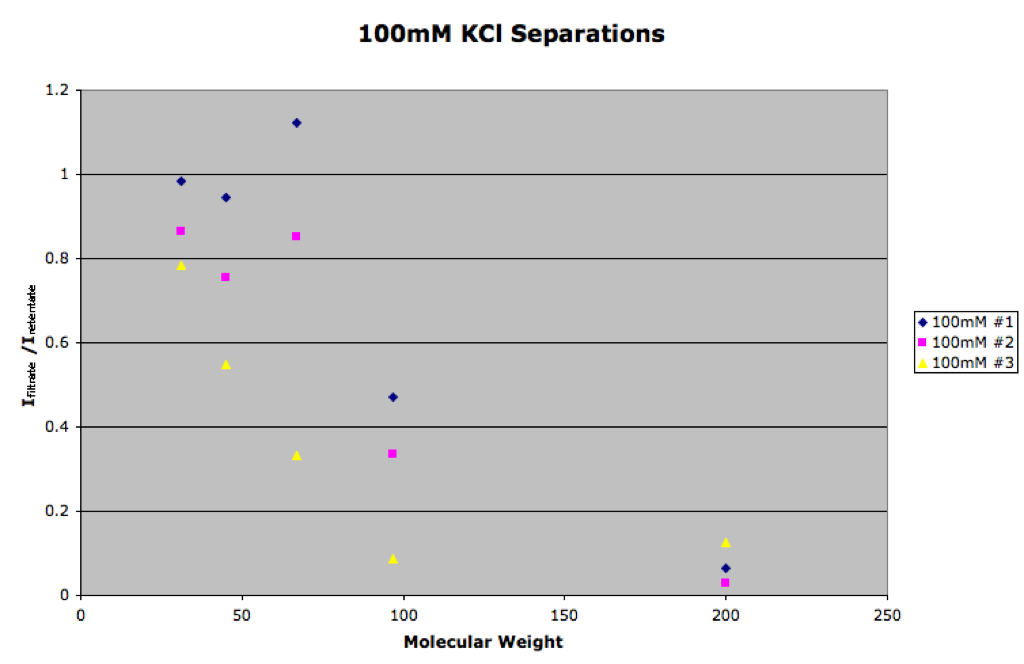
The first two experiments were from the two experiments set up on the same day. The third (yellow triangle) was set up a different day and does not to appear to have gone as far as the first two. The next plot show error bars for just the first two experiments (standard deviations).
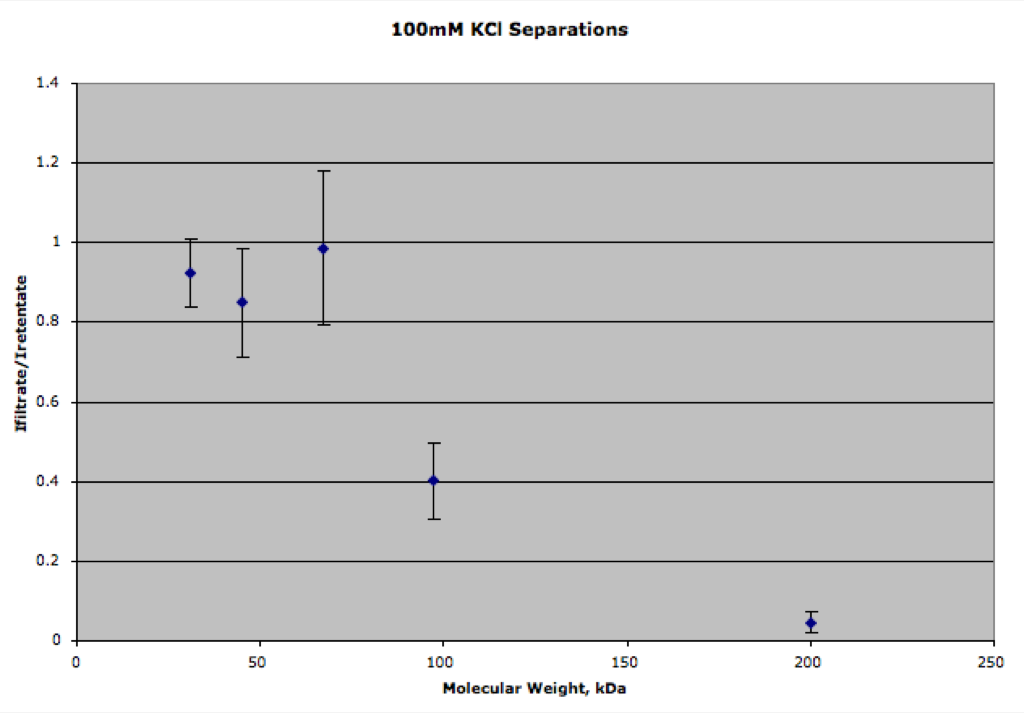
This plot has a similar form to the DNA separations, although not quite as many bands. We may be able to resolve a few more lower molecular weight bands with a 12% gel.
One other thing we wanted to try was see if we could add up retentate and filtrate and observe if there was any loss from the starting sample. Unfortunately I’m running into the following problem:

In all cases, the retentate has the same intensity as the starting sample (at least within the noise). There is no depletion of the retentate in these experiments. However there is an obvious increase in the filtrate to the point where it also is at the same intensity as the starting sample. This means the summation of retentate and filtrate is way higher than the starting sample.
My take on this is that the dynamic range of silver staining is not very large. I’ve stained it so I see the filtrate, but it is possible that both starting sample and retentate are already maxxed out. One way to solve this is to dilute the retentate and starting sample by a known factor and multiply the new intensity by that factor. I may also be able to get away with a coomassie stained gel if I concentrate my samples slightly.
10mM:
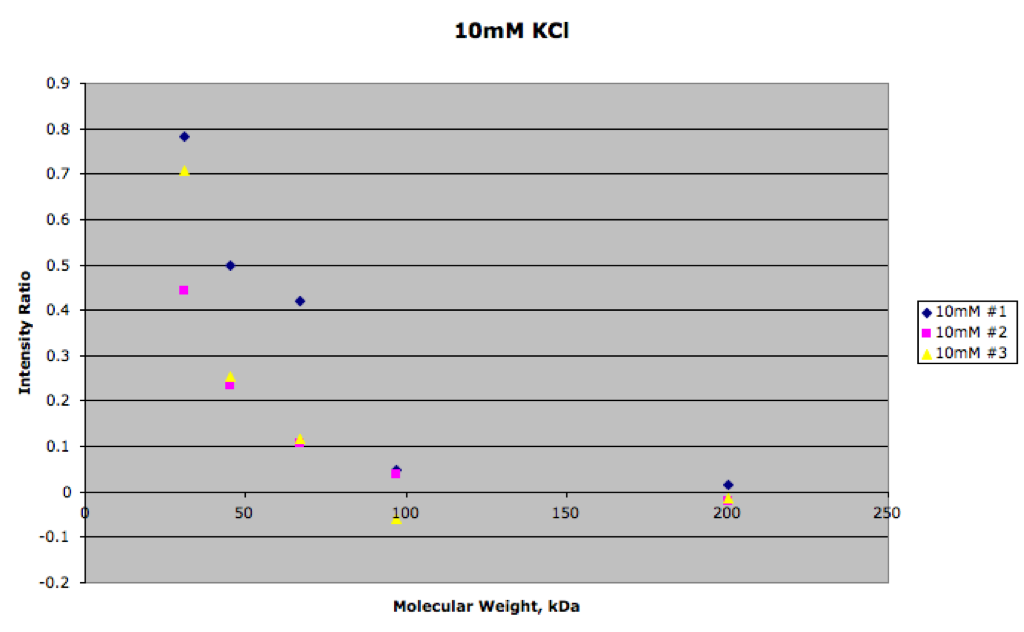
Here are the set of three samples for the 10mM KCl separations. In this case the first sample (blue diamonds) was performed on one day, while the other two on a different day. I tried to keep setups as similar as possible.
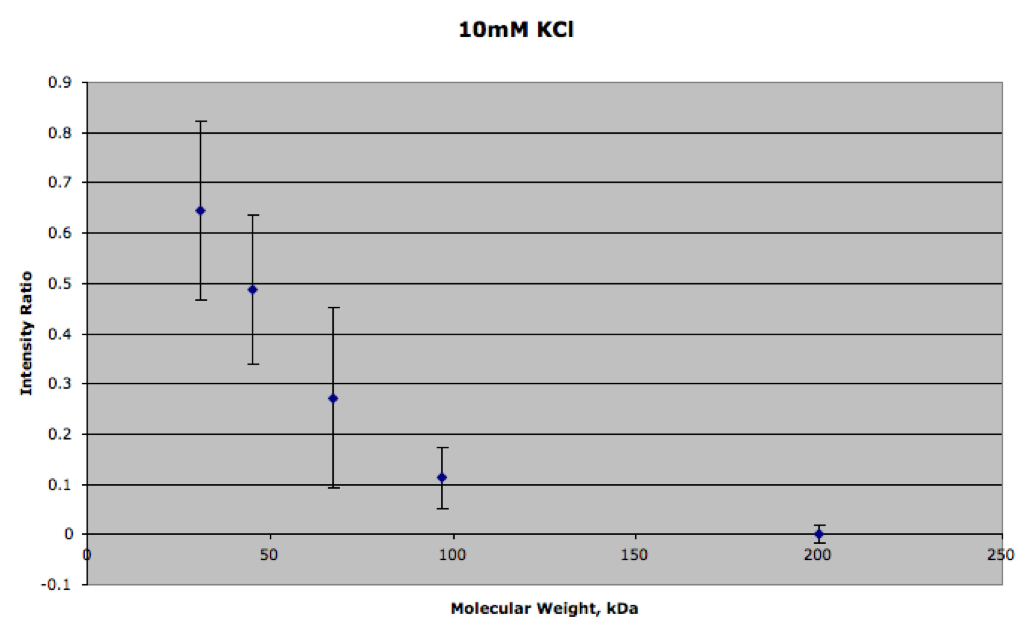
Here are error bars (standard deviations) for all three runs. There’s quite a bit of error in these experiments. Again, we have the same problems as above with the retentate having the same intensity as the starting sample.