
Charged based separation theory
Diffusion based separation theory uses a hindrance model to explain how the pores affect the diffusion of molecules of different sizes. The simplest and most well known hindrance model is given by the Renkin Equation:

where Dm is the diffusion coefficient within the membrane, D0 the free diffusion coefficient, and α the ratio of molecule size to pore size. The first term on the right hand side ( (1-α)2 ) contains solely the geometric constraints of fitting into the pore, and is often referred to as the partition coefficient Φ. The second term is the semi-empiricle contribution of friction as the molecule diffuses through the pore.
In the presence of electrostatic effects, Φ is not just the geometric contribution, but the following function:

where β is a non-dimensional unit of position over which the partition coefficient is integrated. In the absence of electrostatic contributions, this integral simplifies to Φ=(1-α)2 as we see in Renkin’s equation.
The question is then how to represent the energy E in the system with a molecule within a pore. Smith and Deen (smith(deen)JcolloidInterfSci82) wrote an analysis of this problem for spherical colloids in an infinitely long pore. There are three types of models within their analysis: solid sphere w/ a constant surface charge, solid sphere w/ a constant surface potential, porous sphere w/ a uniform volumetric charge density. For my analysis, I will approximate our colloidal molecules as solid sphere w/ constant surface charge (this may be a point of further discussion).
For the solid sphere with constant surface charge, the energy E can be determined from a dimensionless free energy, ΔG, by

where Rp is the pore radius, ε the permittivity of free space time the dielectric constant, R the gas constant, T the temperature, and F Faraday’s constant. The free energy is satisfied by

where τ is the pore size normalized by the Debye length (this is how you get the effects of concentration), I0 and I1 are modified Bessel functions of the first kind of order 0 and 1, σs is the charge density of the colloidal sphere, σc the charge density of the cylindrical pore, and Λ is the ratio of dielectric constant of the material surrounding the pore to that of the solvent, and can be estimated by

In the preceding equation, K represents a modified Bessel function of the second kind and the series converges after a few terms.
Since we are able to measure zeta potentials in dilute solutions, we can estimate the charge densities with the following two equations
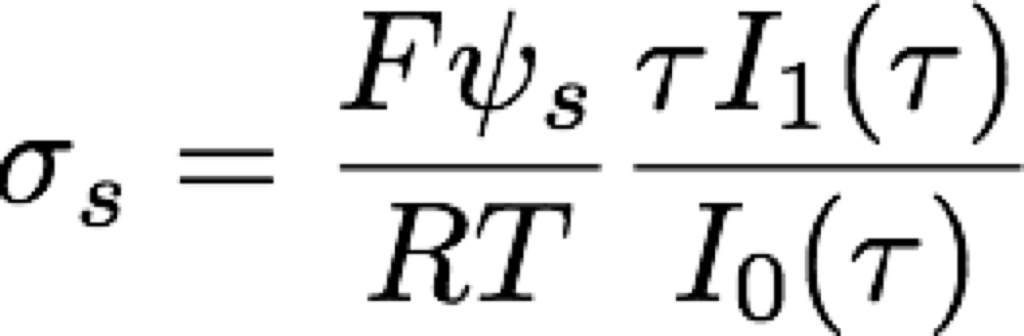
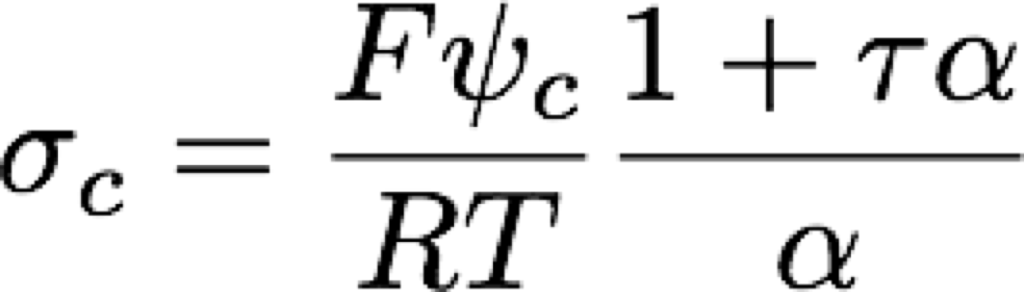
ψs and ψc are the surface potentials of the sphere and cylinder, and I have substituted the zeta potential in their place (another point of discussion).
I numerically integrated these combined equations using a Simpson’s rule program I wrote in MATLAB and have plotted out the following partition coefficient curves for values of α using zeta potentials of both surface and colloid of -10mV and a 50 nm pore.
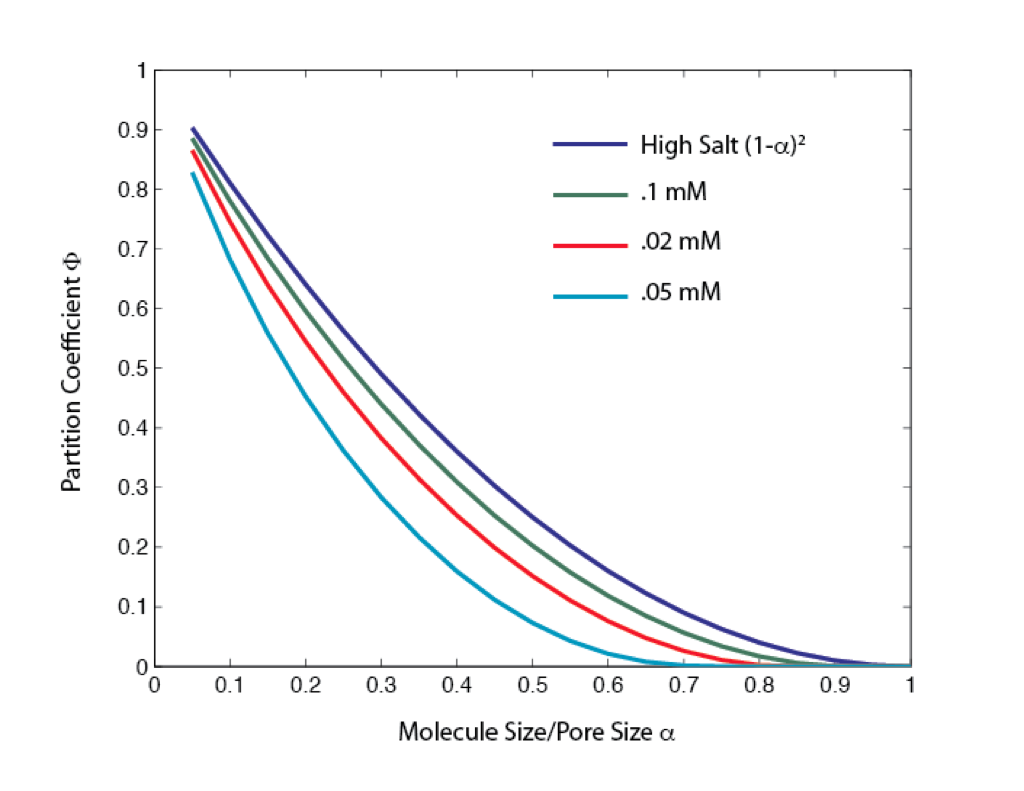
As you can see, the reduction in salt creates a reduces the partition coefficient. This means the molecules can’t fit as easily into the pores at lower salt concentrations because of the increased repulsion by the surface charges.
Now we can take this analysis and add to my original diffusion analysis, i.e. include the frictional terms of the hindrance and perform over an entire pore distribution. If the assumptions (zeta potential, constant surface charge) are correct, we may be able to use this to compare to experiments.
This is very helpful. I often forget that there are pore entrance effects in the Renkin-like equations. It makes sense to include the electrostatic repulsion effects here. I’ll need those discussions you refer to in order to understand the details, but I’m glad you found this.
You need to fix the Renkin equation
What is the exact implication of this? which ones of your results or someone else’s results in the group will be affected by this? and what does Jim mean by “fix the Renkin equation”?
This basically means that at low salt concentrations, the membrane presents more hindrance. We’ve seen this before in our low salt separations featured in the nature paper, although we didn’t delve into the process that fully. I hope to get out a paper on charged based separations that includes some of this analysis.
Jim says fix the Renkin equation because it had a typo. It’s correct now.