
Negative Adsorption Assay
The Tecan Nanoquant plate is amazing. For those of you who are unaware, we were able to demo a quartz plate that enabled absorbance measurements with only 2ul drops. It took a little bit for me to figure it out, but it really is a great tool for this kind of study.
The ultra low volumes and the fact that the plate was quartz allowed me to tweak the study a little bit. If you recall I was previously using the Bradford assay to measure protein concentration. For a handful of reasons, this lead to many errors and a poor estimation of the concentrations. Here is my new method:
- Apply 10ul of .1mg/mL protein to sample.
- Allow to incubate for 20min.
- Remove two 2ul samples (for duplicates) and pipette onto Nanoquant plate.
- Measure absorbance at 280nm.
- Use Beer’s Law to calculate concentration.
This turns out to be very accurate, with my stock .1mg/mL solution coming out to be .089mg/mL. Here I plot the concentration results from a variety of surfaces.
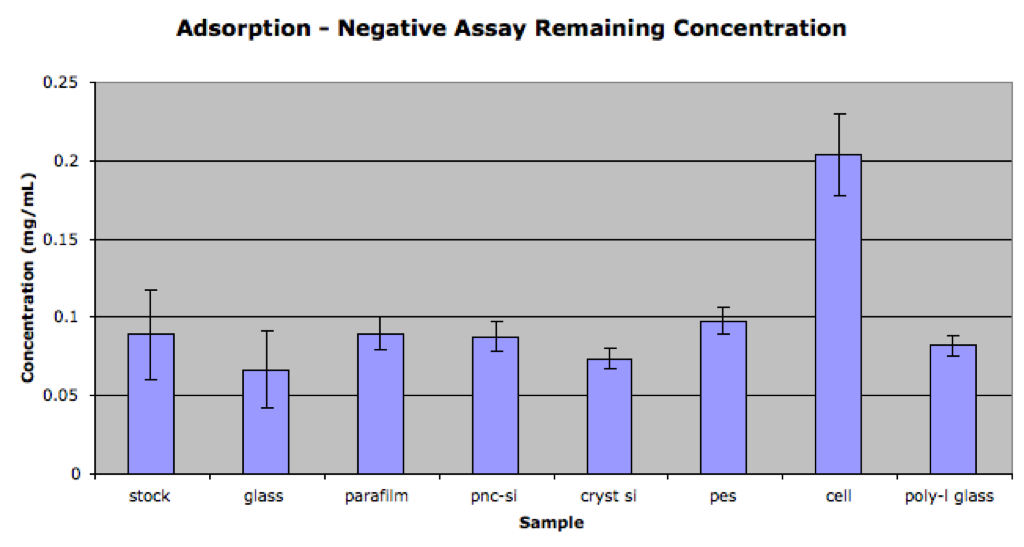
My observations:
- pnc-Si does not adsorb much protein, while glass and the backside crystalline Si adsorb more (whether or not this is statistically significant I’m not sure yet).
- PES and Cellulose membrane materials actually increase in concentration. Same method and setups were used for all samples so it’s not evaporation. Here’s what I think is happening – Cellulose is very hydrophilic and really draws in the water. However the cutoff is 30kD, so that albumin is not going to go through and will probably increase the concentration of the remaining drop. PES does this a little and it also has a cutoff of 30kD.
- I trust the results from this study much more than the previous Bradford results because of the generally low error in measuring stocks and glass substrates, which I wasn’t previously able to achieve.
