
Membrane stability in cell culture: various treatment conditions
Four different post-production treatments with the objective of improving membrane stability in culture were run last week on W615, a pinholed wafer laden with the circular features we have been seeing recently. I ran four different conditions for cell culture:
- no treatment (n=3)
- UV/ozone for 5 minutes at room temperature (n=4)
- RTP in Ar for 5 minutes at 800C (n=4)
- RTP in O2 for 5 minutes at 800C (n=1)
Only 1 RTP in O2 sample was ran in cell culture because 9 of 10 membranes failed in normal handling. This failure is a real problem with some wafers, so I thought I would show the stats for this experiment. Percentage failure in handling in starting the experiment was as follows:
- no treatment: 10%
- UV/ozone for 5 minutes at room temperature: 33%
- RTP in Ar for 5 minutes at 800C: 0%
- RTP in O2 for 5 minutes at 800C: 90%
This failure of RTP in O2 samples is prohibitive; to increase mechanical strength Dave is going to RTP samples in Ar at 800C with a brief puff of O2. From my understanding O2 during RTP consumes the membranes to make the oxide, this puff should reduce Si consumption while adding an oxide layer.
Discoloration without cells was run for each condition (n=2) and is shown below.
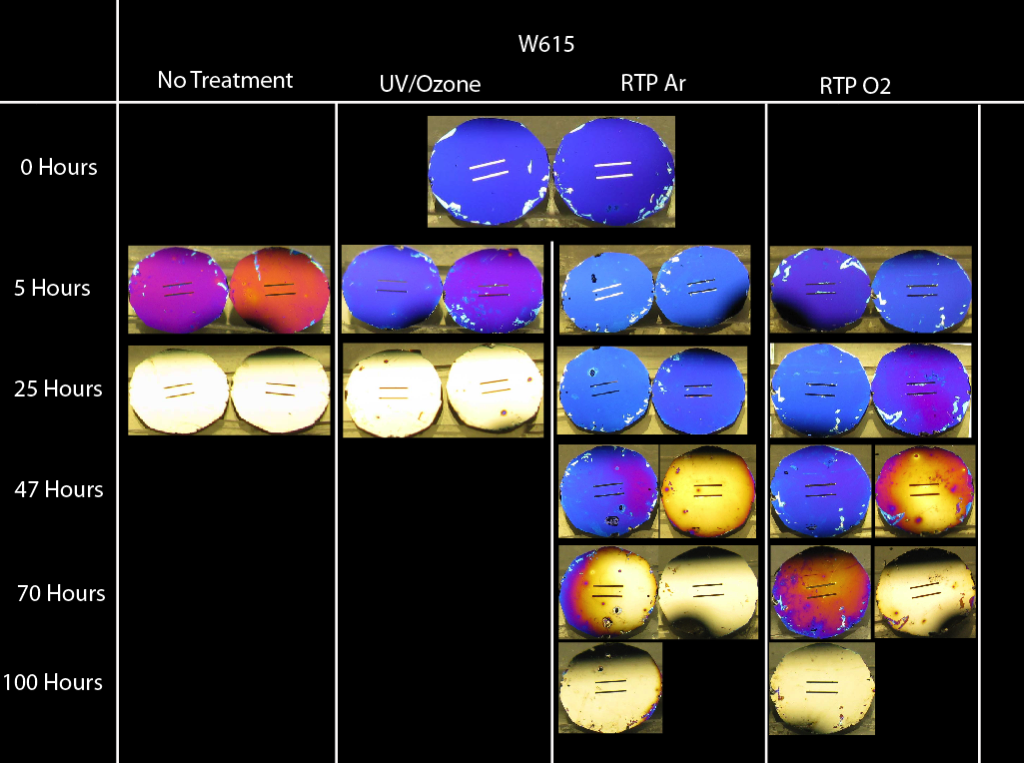
As expected no treatment discolored quickly, as did UV/ozone though I had no expectations for UV/ozone to survive. RTP in Ar and O2 followed the same trend, discoloring after about 2 days. Previously Anant showed RTP in O2 discolor more slowly than RTP in Ar. However it looks like the RTP in Ar and O2 samples may have been mixed up.
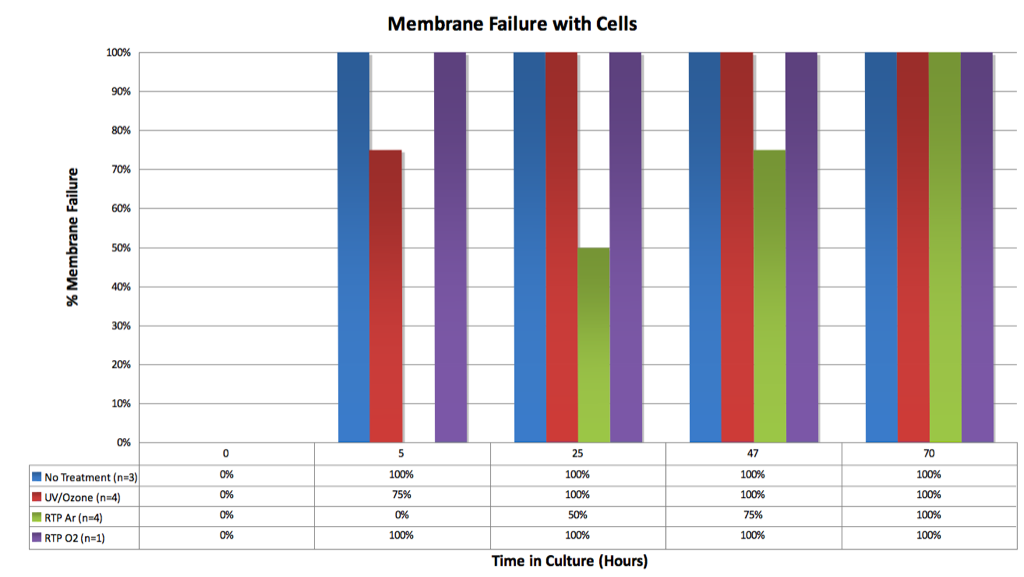
After 5 hours, failure of non-treated and RTP in O2 treated samples was complete. 3 of 4 UV/ozone samples failed by 5 hours, with complete failure within 25 hours. Membrane survival of RTP in Ar samples was best, with failure starting at 25 hours and completing by 70 hours.
In conclusion RTP in Ar is the best treatment of the 4 tested here, though they do not survive long enough. Additionally RTP in O2 samples are very difficult to handle, hopefully RTP in Ar with a puff of O2 will prove beneficial.
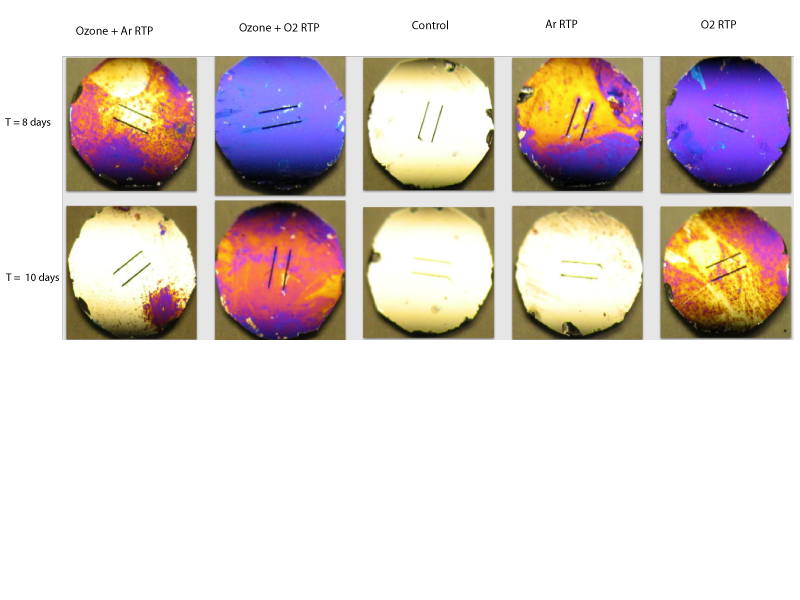
The RTP treated samples have odd colored patterns, while the untreated and ozone samples are more uniform. Is this consistent with your observations? It is an unexpected difference.
Are we ready to try the “carbonization” process yet? Just let us know when you get really desperate – no sure if we are there yet. It may also be worth trying silanization after ozone treatment, since the ozonator was not around when silanization was explored last.
I don’t think we are making a thick enough oxide and we should be adding oxide rather than sacrificing the membrane to make the oxide. We can even use thicker membranes if it improves handling and we can still get pores. We can sacrifice porosity and even suffer some wrinkling for these applications.
The oxide on the RTP-O2 treated samples will be the thickest, yet there is little improvement beyond the Ar annealed samples, so I don’t think oxide is the way to go, even if it were feasible. The fact that the O2 treated samples also have the lowest yield is not a good sign either for thickening up the oxide. Sure, we could thicken up the silicon a lot, but I don’t see how this would be interesting anymore – why not just use a solid oxide film, since the optical properties will be better? It’s pretty clear that we are hitting the limits of this technique for chemical stabilization, so the sooner we start working on alternatives, the better off we will be in the long run. We have plenty of material to play with and a number of alternative processes. Are we afraid of chemical functionalization or is this work going on in the background?