
Adsorption Studies
The following changes were made in this adsorption study:
- The MicroCons/NanoSeps were not spun. We will just characterize the differences between the materials.
- The pnc-Si membranes were assembled into SepCons because of the potential adsorption to the plastic surfaces.
- Mass standards were run on the gel in order to allow the measurement of protein concentration.
- MicroCons/NanoSeps were initially stained with commassie blue, since the last silver stained experiment seemed saturated
Result #1 – MicroCon/NanoSep adsorption with mass standards and stained with commassie blue
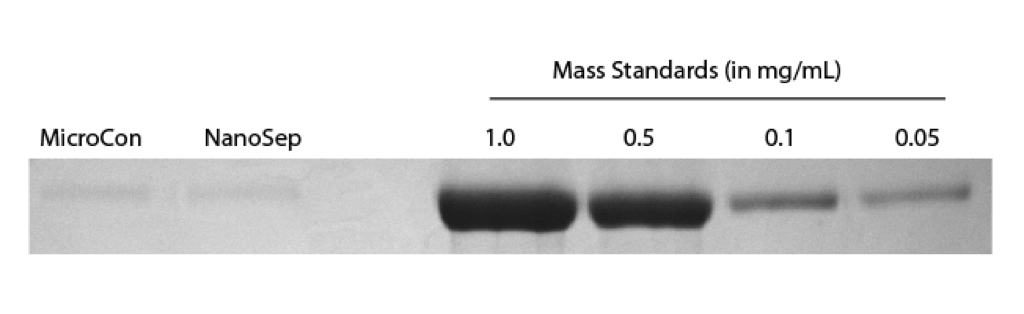
It appears that in a non-spun system, there is less protein adsorbing to the membranes.
Results #2 – MicroCon/NanoSep/SepCon adsorption with mass standards and silver stained.

In this system it looks like the SepCons adsorb as much or more protein. It also appears to be more than the adsorption to pnc-Si chips (although this cannot be verified as the previous adsorption study had no mass standards). Perhaps our plastic is adsorbing a lot of protein. The next step is to release the MicroCon and NanoSep membranes and compare to pnc-Si chips.
Go ahead and quantify to the standard curves so we can evaluate how linear things here.
Non-specific binding is a strong function of concentration, so to be fair, I think you either need to to spin down the sample, or apply a much more concentrated solution initially. I just want to make it clear to everyone that it’s probably not mechanical force driving the protein against the membrane that’s causing more to stick, it’s the very high concentration (after spinning) driving the kinetics of non-specific binding. If there is any drying, that will also promote adhesion.
We really need the new SepCon design that allows samples to be spun down past the EQ limit, and good membranes for those studies…
Would it be valid to try higher concentrations in these passive studies to see if the adsorption increases?
For diffusion studies, you’re fine so long as you match concentrations. For centrifugation studies, Chris’ point makes sense and will make it harder to compare if we are not spinning to similar levels with the two systems. We should probably be satisfied with the diffusion studies for the ‘low hanging’ paper we are trying to craft now.
One more comment … with fluorescence we found that our membranes were far less sticky to proteins than glass. We should probably include glass as a ‘positive control’ to make sure the assay is working as we expect. I’m not sure what a good ‘negative control’ would be. PEG-treated glass would work.