I have tinkered with the etch recipe some more, adding Argon to help prevent polymer formation (adding 5% O2 was not enough). The current recipe is 200 mTorr (100 mTorr Ar, 5 mTorr O2, 95 mTorr CHF3) at 120-125 W (6-12 W reflected). The plasma color is initially rosy (Argon), settling into a light purple after a few seconds (Light blue from CHF3 and O2 mix). After 140 seconds of etch using this recipe, the coated (250C, 1-3 A/s, 50nm) MgF2 films remain, while the backside is fragmented and discontinuous.
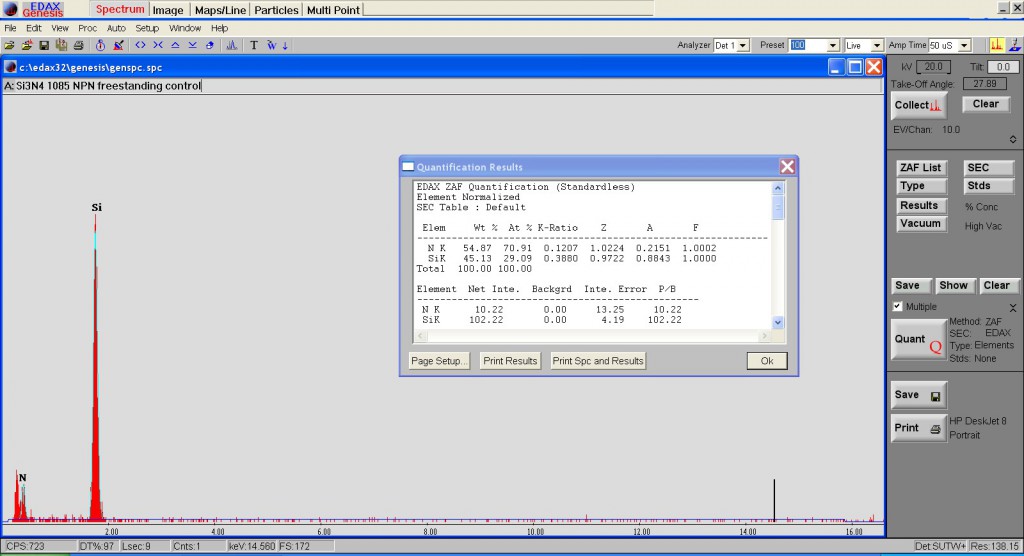
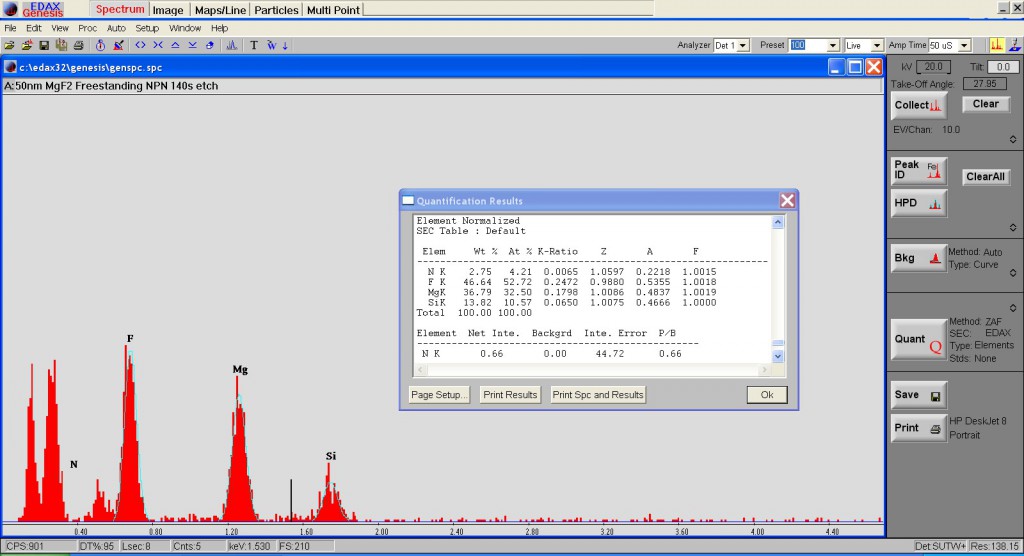
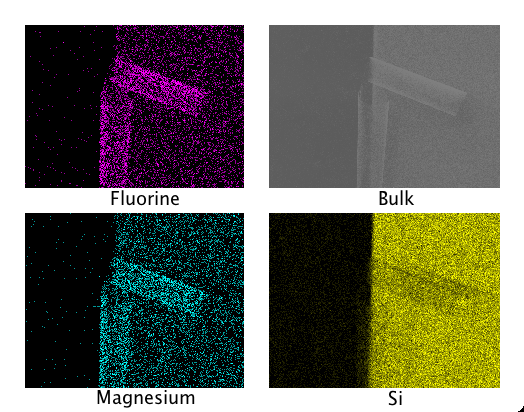
The true composition of these films has yet to be confirmed. Using EDAX on our SEM, I was able to find a decrease in the relative Silicon composition of the etched film, though some signal remains. I hope to get an XPS reading soon to confirm this result.
In the discontinuous film state, the etched free-standing membranes have survived for 48+ hours. The burst pressure for these films (SEPCON format) were 1.5 and 1 psi, much weaker than what we are used to having from nitride alone (thermal processing after deposition to densify the films may help in the future).
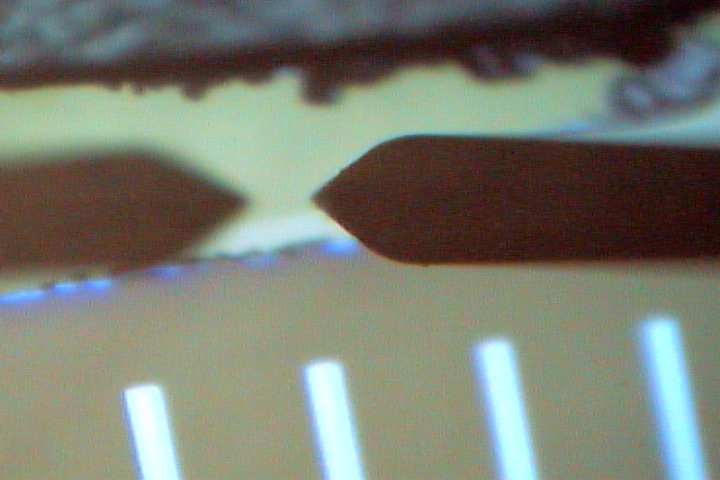
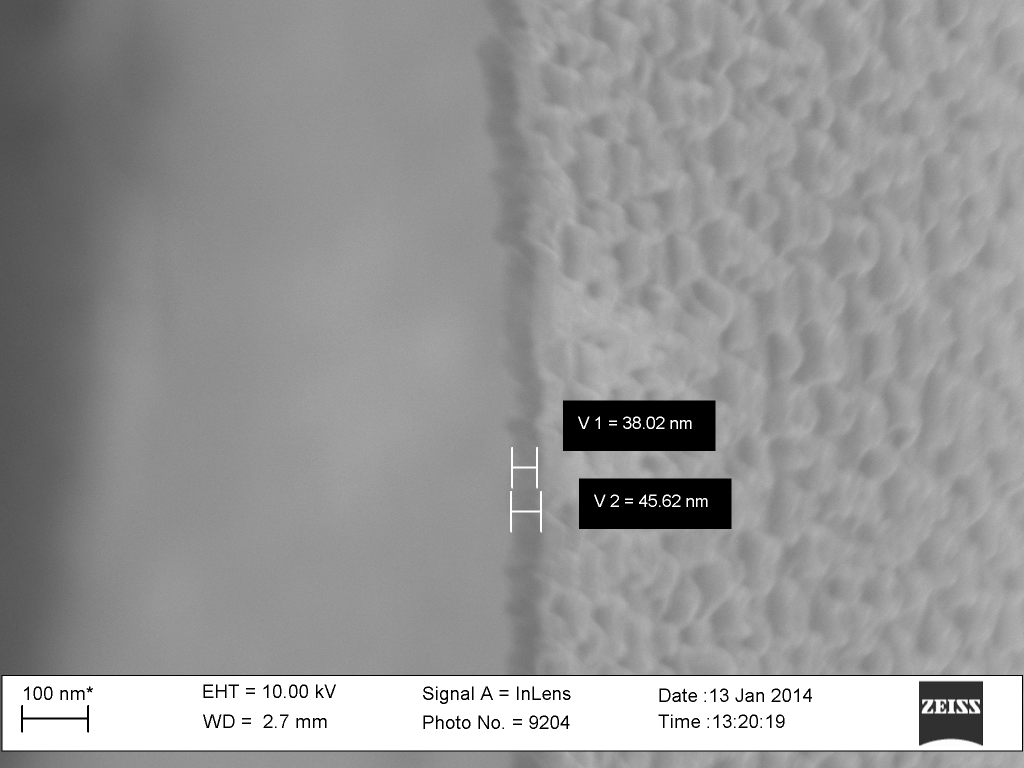
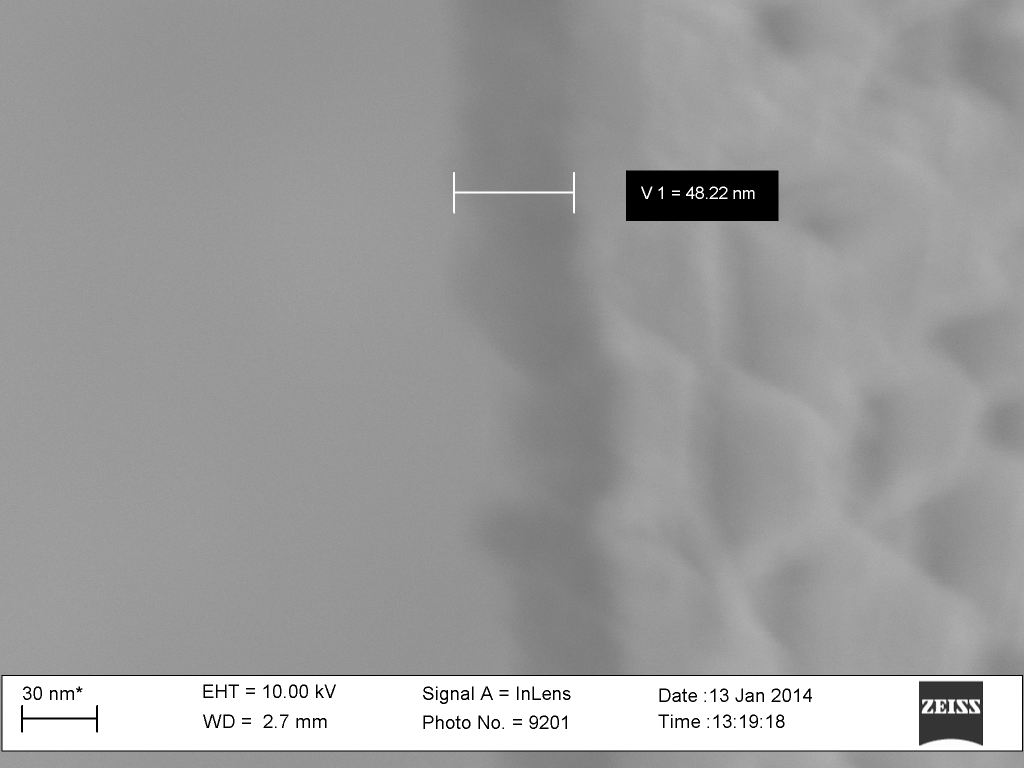
Step height on 50nm MgF2 film (kapton tape occludes deposition surface)
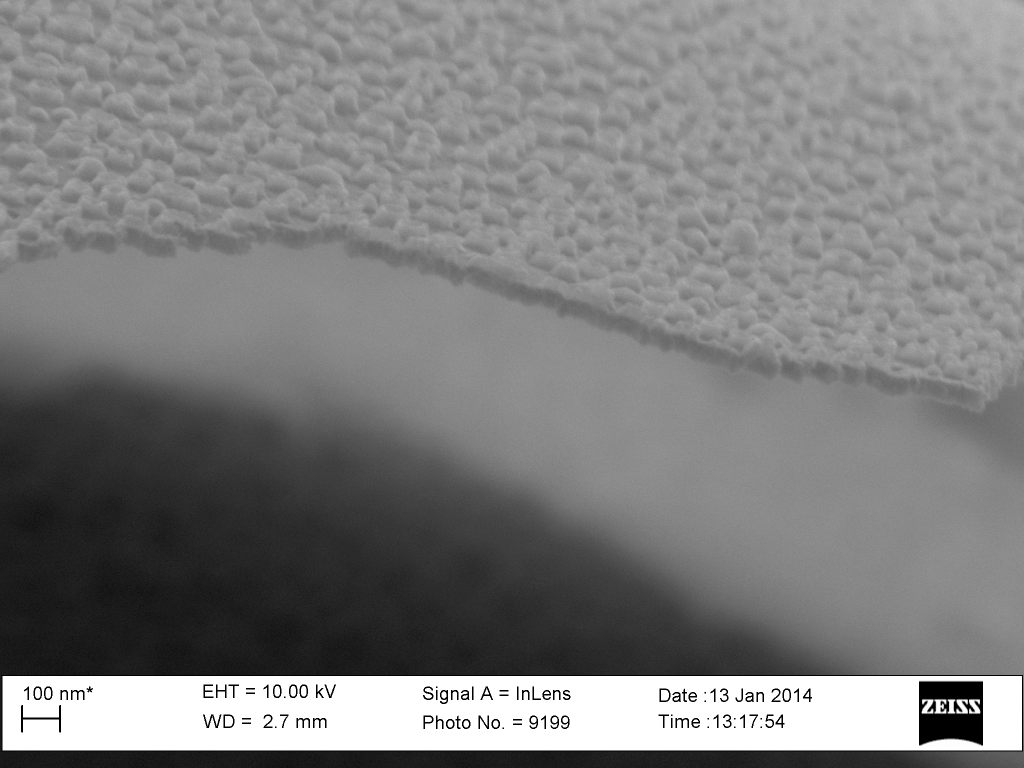
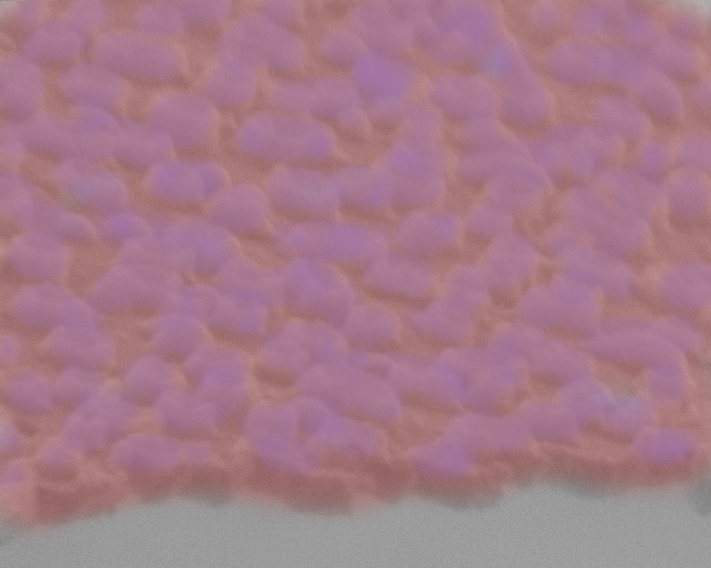
Sample 40, 50nm MgF2, 140s Ar+CHF3+O2 etch, curling up from freestanding region. The dark region is the bulk. The top face would be where the silicon nitride has been etched (backside)Sample 40, 50nm MgF2, 140s Ar+CHF3+O2 etch, curling up from freestanding region. The dark region is the bulk. The top face would be where the silicon nitride has been etched (backside). The film appears discontinuous, with little volcano structures remaining. Ideally, we would have none of these structures remaining with a more complete etch.Is the etched Film Pure MgF2?Or is the remaining film scummed up with Si3N4 volcano structures around the pore?
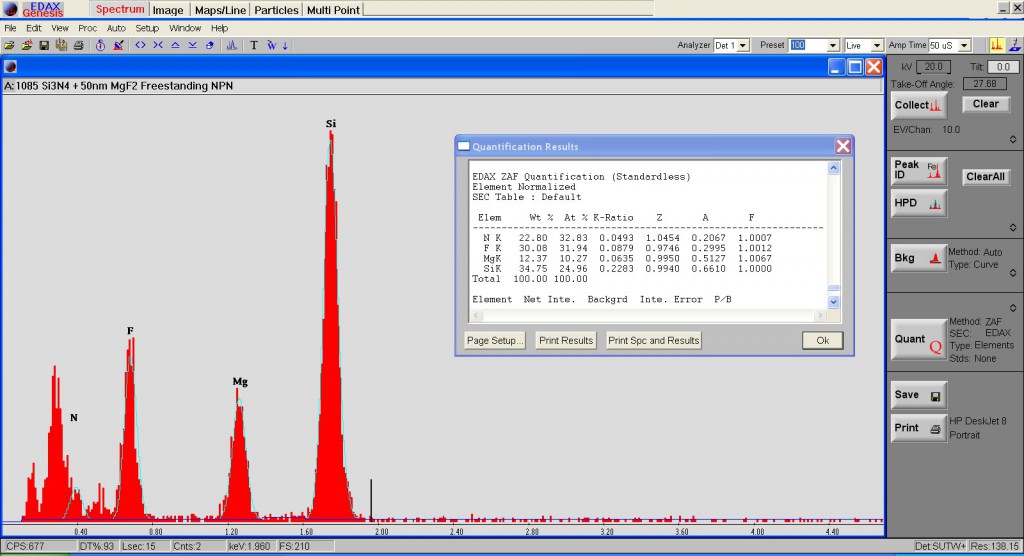
Control 50nm NPN EDAX measurement. Pure Si3N4 is expected.50nm NPN with 50nm of MgF2. This film has not been etched.140s Etched MgF2 membrane. Little silicon remains in the signal (85% MgF2). The larger peaks on the left are the Carbon background.I tried measuring another etched film with a different holder (Al). Again, the silicon signal remains. This sample had 120s etch (compared to 140s).This sample had 180s of etch, but no signal is coming out of the membrane? Clearly a freestanding region under SEM, and a measurement on the sidewalls of the chip confirm the EDAX detector’s functioning.
Sample 40, 50nm MgF2, 140s Ar+CHF3+O2 etch, curling up from freestanding region. Film thickness of MgF2 film is preserved.
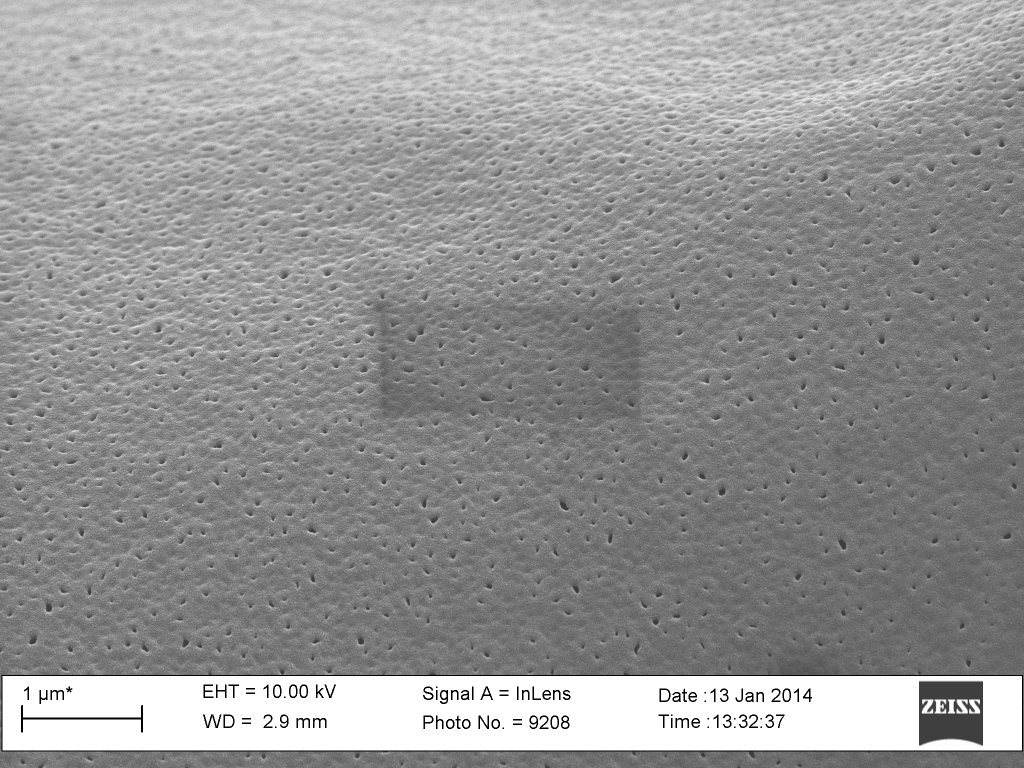
Sample 40, 50nm MgF2, 140s Ar+CHF3+O2 etch, curling up from freestanding region. Crossection shows the thickness of the MgF2 film remains the same.Sample 40, 50nm MgF2, 140s Ar+CHF3+O2 etch, curling down in freestanding region. MgF2 surface appears much smoother, with through pores apparent.
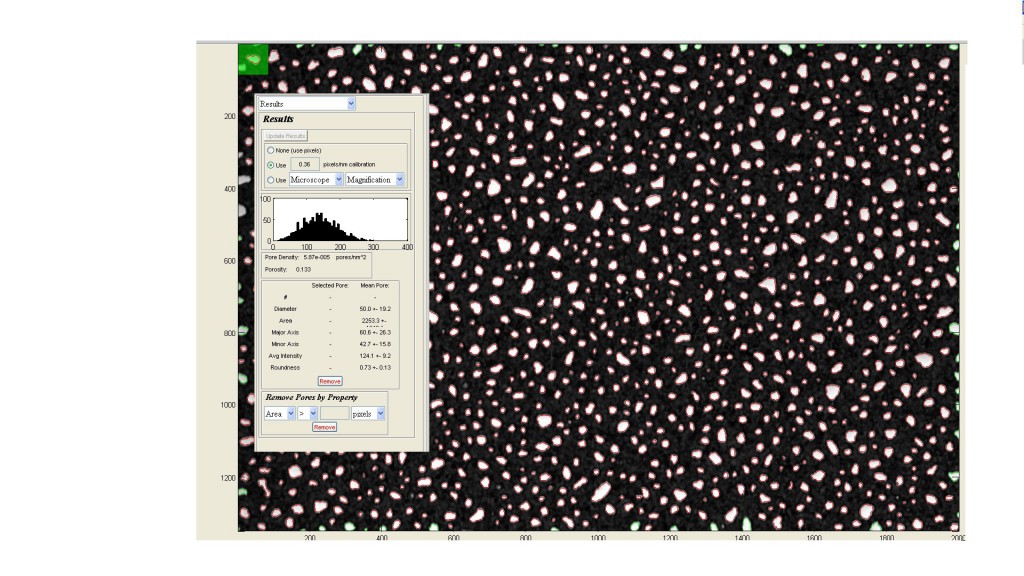
Sample 47, 180s etch SEM mode.Sample 47, 180s etch, TEM mode.
47 – Pore Histogram
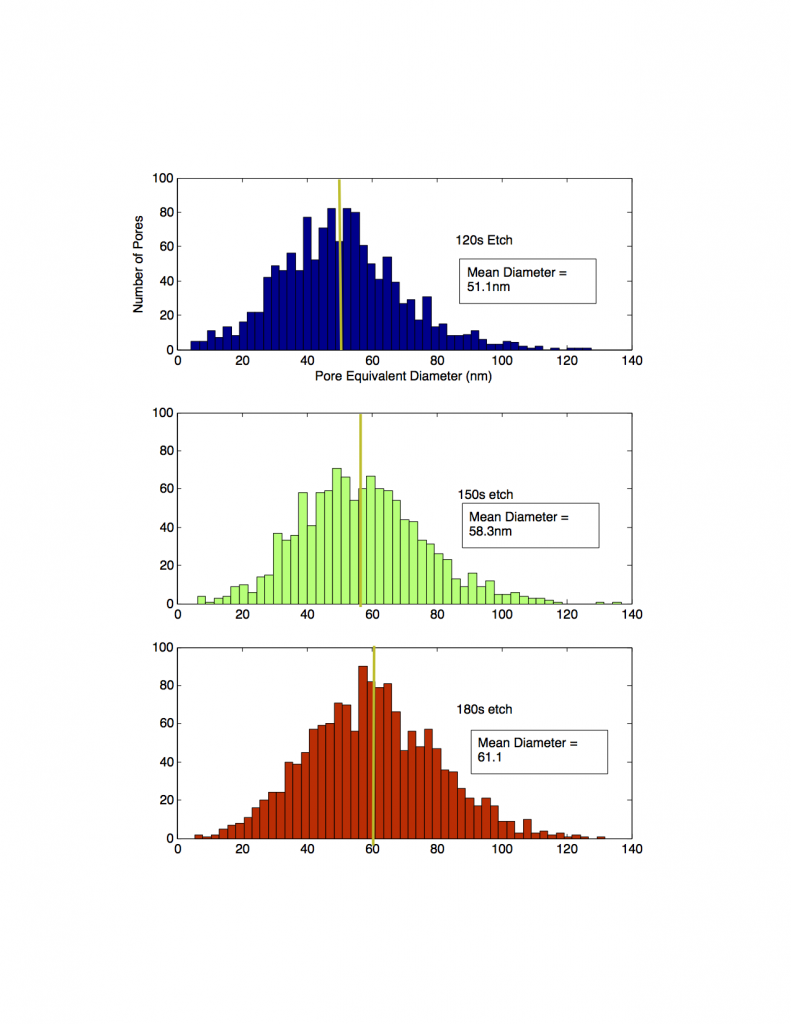
Pore Histograms from samples 45, 46, and 47. Sample 45= 150s, 46=120s, 47=180s. Etching longer appears to blow out the pores somewhat, though the resistance is fairly high for 60s of additional etch time.
As seen in prior NRG post, ozone treated samples recover over about 24 hours. However, recent experiments at Gaborski Lab show high variability when using the Corona wand to treat samples with ozone. The goal of this experiment was to determine the contact angles of PDMS samples when exposed to ozone treatment. PDMS samples were…
To continue our spreading and proliferation experiments on various topographical features and stiffness, I repeated the HUVEC experiments I had done before due to a possible artificial bias that we think is a result of high seeding. To enusre accuracy, I repeated the experiment and added another plate to test the HUVECs on substrates of…
Link to BioRxiv paper The extracellular matrix in vivo is composed of fibers arranged with varying degrees of alignment in different directions. The extent of alignment (anisotropy) and the directionality of fibers are an indicator of breast cancer metastasis, influence T-cell motility, and guide endothelial cell alignment. Similar to the existence of chemical gradients and…
Paper for Friday’s Journal Club … Watch this space for a summary and analysis. Pensabene(Hofmeister)ACSAMI16 Synopsis 2um(?) pores in 100 nm thick PLLA. Very, very low porosity. Fabricated with a PVA microneedle mold produced with femto second laser. Microfluidic device integration Claims about cell (HUVEC) viability and growth are poorly supported. Cells are essentially on…
Nair(Geim)Science12 Supplement Laminates of GO from 0.1 to 10 um thick on copper foil with an etched hole of 1 cm. Casually mentions >1.5 psi applied to materials < 1 um thick over 1 cm diameter hole. This seems to suggests a strong burst pressure but with no real data or experimental details, this is…