Quality System Update (June ’25)
Status of the Quality System Team – June 27, 2025 Quality System Update – 27 June 2025
Status of the Quality System Team – June 27, 2025 Quality System Update – 27 June 2025
Work in progress … **************** T cell–Engaging Immunotherapies Pose a Predictable but Complex RiskT cell–engaging bispecific antibodies (BsAbs), particularly those targeting CD3 and a tumor-associated antigen, have emerged as a powerful class of immunotherapies. These agents leverage endogenous T cells to induce targeted tumor cell death, often achieving deep and durable responses in hematologic malignancies….
Since the last TraCe-bMPS update in April, we continued to explore different conditions to optimize the μSiM hVasc-SkM systems to obtain stable results. Enhanced imaging for PDMS beams with Rhodamine staining Previously we established a MATLAB program that detects the border of the PDMS beams and converts the movement of the PDMS beam from myobundle…
The 2025 Rochester MPS Day Summary provides an overview of the event, highlighting registration details, participant feedback, and suggestions for future improvements. The event had a total of 130 registrations, with 88 in-person and 26 virtual attendees. Participants represented various organizations, including the University of Rochester, RIT, Duke, NIH/NCATS, and several industry partners. Feedback indicated that…
CRE_Bispecific_Antibody_CRS_and_ICANS_Neurotoxicity_Guidance_Feb2024 51899285fnl_Immunotoxic Potential of PharmaceuticalsWe are considering Bispecific T cell engagers (BiTEs) [1] as an alternative to a CAR T driven cytokine release as an immunotherapy focused DDT. BiTEs are monoclonal antibodies engineered to have one arm that recognizes a T Cell surface antigen and another that recognizes a tumor antigen. There are number of…
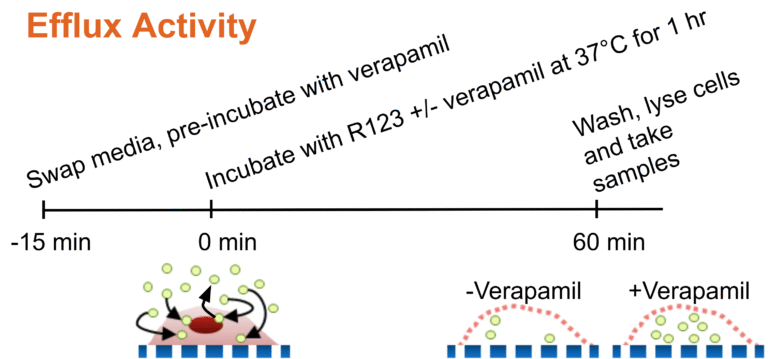
Introduction During the January TraCe-bMPS progress meeting, Jon Flax presented some interesting findings in the iPSC-derived extended endothelial culture method brain microvascular endothelial cell-like cells (EECM-BMECs, hereafter referred to as BMECs) [1]. While these BMECs tended to have high expression of most transmembrane transport proteins, they had relatively low expression of p-glycoprotein (ABCB1/MDR1) (Figure 1)….
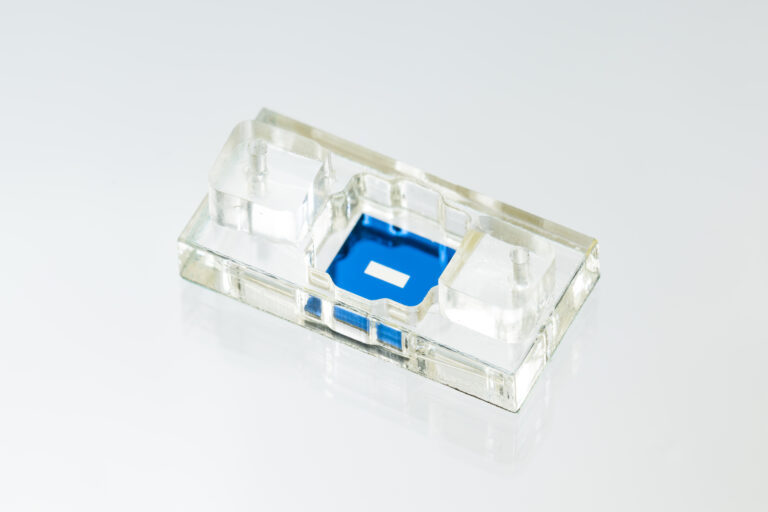
Introduction The modular µSiM device allows for active flow and continuous monitoring, but the acrylic-needle interface may experience incomplete sealing over longitudinal studies, so the need for an adaptable and intuitive approach for leak-free bottom-channel flow arose. Jordan Jones, Ahmet Gurcan, and Kevin Ling adapted the flow inserts to develop Flow Bumpers, a PDMS-adhesive component…

Introduction Our goal was to develop a COMSOL model for the bottom channel of the µSiM that can be accessed and easily used by anyone with a COMSOL license. Previously developed simulations for the µSiM rely on the CAD import module, which can introduce unnecessary complications with regards to accessibility and ease-of-use, particularly to expand…
The μSiM Vasc-SkM Microphysiological development can be separated into 4 parts: Media tuning for integrated culture Force sensing element setup Assembly of the μSiM Vasc-SkM and setting up the perfusion Transendothelial Electrical Resistance (TEER) measurement of the Vast component Work has been done on the first 2 parts. Media tuning for integrated culture In order…
The following site may be useful to draw to people’s attention when specifying objectives on the Etaluma: https://www.microscope.healthcare.nikon.com/microtools/resolution-calculator/#Focus I have configured a custom resolution calculation using the sensor data supplied by Etaluma, here exemplified at 10x/0.3NA: To take account of the shorter tube lens (which gives ¼ magnification expected cf Nikon 200mm tube) I have…