
Nanomembranes in Potassium Ion Selective Electrodes for use as a Portable Point of Care Device
Overview
Analysis of blood has long proven to provide insight into the health of the respective patient. Arduously researched, many components of blood have arisen as markers of health. These include various biomarkers such as proteins, antibodies, and cell derived vesicles, but also include ion concentrations. While the library of markers is vast and continuously growing, the instrumentation available to measure these markers has remained restricted to laboratory settings and are often expensive. In addition, most tests require strenuous and time consuming processing that delay results for patients. Combined, these issues mean that at best blood analysis is done using a large amount of time, money, and equipment and is restricted to facilities that are properly equipped. In an effort to ameliorate these problems, I am currently working to develop a device using our membranes as an Ion Selective Electrode (ISE). Done properly, such a device would be inexpensive, small and portable, accurate, and have quick response times, overall fulfilling a need in trauma medicine for a Point of Care (POC) device of this stature.
Ion Selective Electrodes
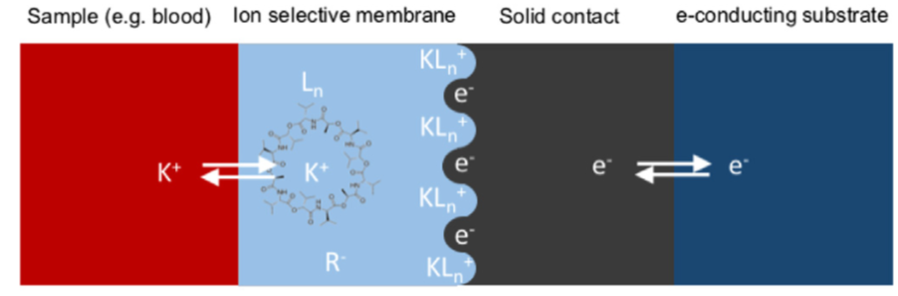
ISEs are devices that measure the activity of a specific ion and convert this into an electric potential. First discovered as pH probes with glass electrodes, ISEs have developed over the years with great interest to include glass, crystalline, and polymeric ion exchange resin electrodes. The material used depends on its ability to select for specific ions, with each material allowing a certain amount of adaptability with added components. ISEs can be divided into two major categories; liquid contact (Figure 1) and solid contact (Figure 2). Both types of electrodes work off of the same process, differing only in their interface being either metal-liquid contact or a metal-solid contact respectively. The process begins as targeted ions diffuse across the ion selective membrane following a diffusive force within the membrane from the side with a higher concentration to the side with a lower concentration of the target ion. This causes a build up of positive or negative charge within the membrane which garners a corresponding opposite charge to build on the outside of the membrane. This generates an electrical potential difference through the membrane, causing the diffusion of target ions to decrease up until the point where the ion concentrations are balanced by the electric field within the membrane. Once this process reaches equilibrium, the resulting potential difference is the membrane potential at that ion concentration. In comparison the reference element, often Ag/AgCl, reacts to the build up of a positive charge by neutralizing its negative ions. Ultimately this causes positive ions within the ISE to flow back into the sample until an equilibrium is reached. Potentiometric measurements such as these require a reference because the potential of the system without one is unstable. Both types of ISEs suffer from low durability and therefore have short lifetimes. They also have limits to their detecting abilities, often due to interference from either ions at their upper limit or leaching of their components at lower limits. The biggest difference between the two is the ability of solid state ISEs to scale down. Liquid state ISEs are difficult to scale down, suggesting that solid state ISEs are the way to portable device creation.

Potassium as a Biomarker
As a biomarker, potassium presents many opportunities for a device of this design. At this time there are no portable devices that can measure potassium ion concentrations at all. The laboratory devices that are available are expensive and have slow response times to potassium sensing. Together this results in a patient having a delay in care and diagnosis which decreases patient survivability of a life threatening event. Potassium is an important marker as it is indicative of various kidney diseases, Type 1 Diabetes, red blood cell lysis (often due to injury), and various brain diseases. Having the ability to determine an individuals potassium concentration would therefore help to preliminarily diagnose one of these issues. As a POC device to an Emergency Medical Technician (EMT), this information would help to guide patient care and patient transport drastically increasing the odds of survival for the patient. As aforementioned, this would only be helpful if it could be done quickly, accurately, and in a portable fashion. This requires an ISE to be able to selectively pick potassium ions out of the complex composition of whole blood without further processing.
Valinomycin
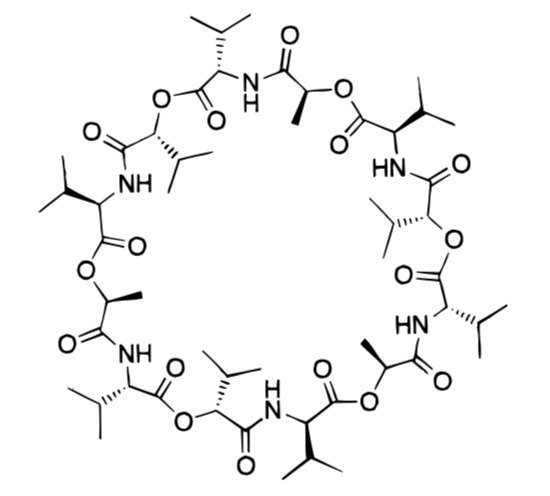
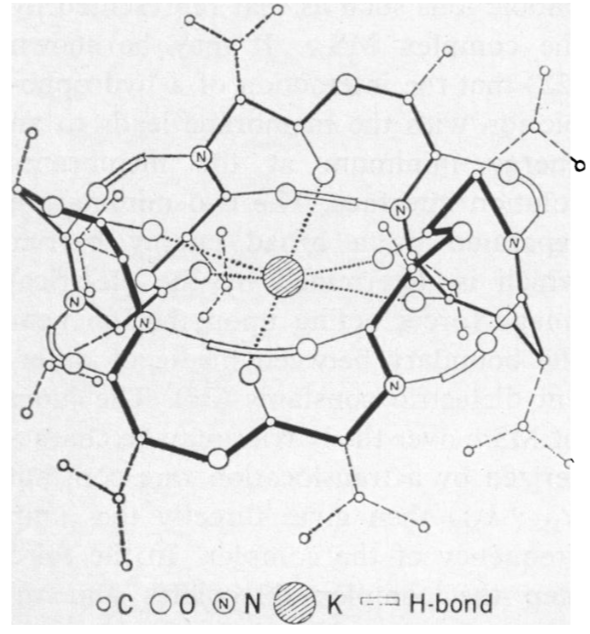
The ability of an ISE to choose for a specific target ion over any other ion is mainly attributed to its ionophore. An ionophore is a species that is able to reversibly bind an ion. In the case of potassium, one of the best and most well renowned ionophores is found in the molecule Valinomycin. Valinomycin is a dodecadepsipeptide, or a 12 member ring made up of alternating amino acids and esters D-alpha-hydroxyisovaleric acid and L-lactic acid shown below in Figure 3. It is a naturally occurring molecule that comes from Streptomyces strains S. tsusimaenis and S. fulvissimus and is highly flexible due to its varying constituents. The carbonyl groups throughout the molecule allow it to be polar and attach to metal ions, but the isopropyl and methyl groups also make the molecule soluble in nonpolar solvents. It carries a neutral charge and very selectively binds to potassium ions. Due to the shape and size of the molecule, the ring center is the perfect size to allow potassium ions to enter and create ionic bonds with the hydroxyl groups. Any other ions in solution pass through the molecule unabated. Additionally, this interaction is energetically favorable as the energy of releasing the potassium ion by a water molecule is similar to that of the energy needed for Valinomycin to bond to it. Shown in Figure 4, when potassium is bound to Valinomycin the structure becomes rigid. For these reasons, Valinomycin is the ionophore that is often integrated into a polymer matrix to be used as an ISE for potassium.
Polymer Ion Exchange Resin ISE
In terms of flexibility, polymer ion exchange resin ISEs provide the most with systems having the ability to be used for many different target ions depending on their components. This type of ISE has four main components: the polymer matrix, a plasticizer, a lipophilic salt, and an ionophore. The polymer matrix serves as the media through which the process of detecting and sensing a target ion occurs. It is important that when choosing a polymer for an ISE, it has a Transition Glass Temperature (Tg) below room temperature. If it does not, the resin will not be liquid enough and diffusion across the membrane will not readily occur. In most cases, it is challenging to find a polymer that has a Tg below room temperature that is suitable for this type of application. Because of this, most often a polymer will be chosen which has the ability to be used in an ISE, and a plasticizer will be added to it. The purpose of a plasticizer in a polymer ion exchange resin ISE is to lower the Tg of the polymer matrix below room temperature. This effectively makes the polymer matrix a viscous liquid, thus allowing ions and ionophores to diffuse across it. Lipophilic salts are necessary for an ISE of this type that uses a neutral ionophore. These salts must be lipophilic so that they dissolve in the polymer matrix. Once dissolved, both positive and negative sites are available within the membrane. In the case of a potassium ISE, lipophilic salts are added to provide anionic sites in the polymer matrix. These sites attract positively charged potassium ions to the membrane to get transferred by ionophores in the membrane. Ionophores act as the selective species in the ISE and selectively attach to ions as discussed earlier. Altogether these four components create an ISE which can successfully select potassium ions out of complex samples.
Mechanism of Transfer
With the components described above, Valinomycin acts through the mechanism shown in Figure 5 with each steps rates shown as k values respectively. Throughout the entire mechanism, Valinomycin is always attached to one side of the membrane. The left side of the mechanism represents the sample side of the membrane (N’) and the right side of the mechanism represents the inner side of the membrane (N”). Starting at the lower left hand corner, N’s is Valinomycin sitting with no potassium attached to it and not in a conformation to do so. N’*s is Valinomycin in a conformation to accept a potassium ion, but still with no potassium attached to it. N’i-s sees the introduction of the ion, and represents the Valinomycin in a loose complex with a potassium ion. N’is represents a complete complex of Valinomycin with a potassium ion. From there, the complex diffuses across the membrane to the other side where it goes through the same 4 step process in reverse to release the potassium ion that is bound to it. This entire process is carried out by one Valinomycin molecule, but is replicated by many more until equilibrium in the system is reached.

Device Design
To integrate Valinomycin into an ISE, traditional materials are going to be used with the addition of our membranes as the key to their success. The materials to make the polymer ion exchange resin will be Polyvinyl Chloride (PVC) as the polymer matrix, Dioctyl Sebacate (DOS) as the plasticizer, Potassium Tetraphenylborate (KBPh4) as the lipophilic salt, and Valinomycin as the ionophore. To take advantage of the nanometer thickness of our membranes, I am going to try to integrate this polymer resin into the pores of the membranes. This will allow for very fast sensing times and easy miniaturization of the sensor. The end goal of this research is to develop a disposable one time use cartridge that could be used with a device similar to a glucometer. Successful implementation of this device could pave the way for the integration of other biomarker targets into the system, potentially increasing the survivability and or detection rates of many other diseases.
Summary
Overall, blood analysis is currently restricted to expensive and time consuming instruments and processes. With no POC devices available to measure potassium ion concentrations, there is a huge market for such a device. Using traditional membrane components, the integration of a polymer resin ISE using our membranes has the potential to solve many of the problems facing modern ISEs. Ultimately this could allow for increased survivability of patients facing kidney failure or increased detection of various other diseases.