
Monolith X-sections
As the title states, these are images from the monolithically fabricated devices used by Kyle and Vincent in Ottawa. These devices were fractured with tweezers, then tilted and metallized with 5 nm of Pt, mounted on carbon tape.
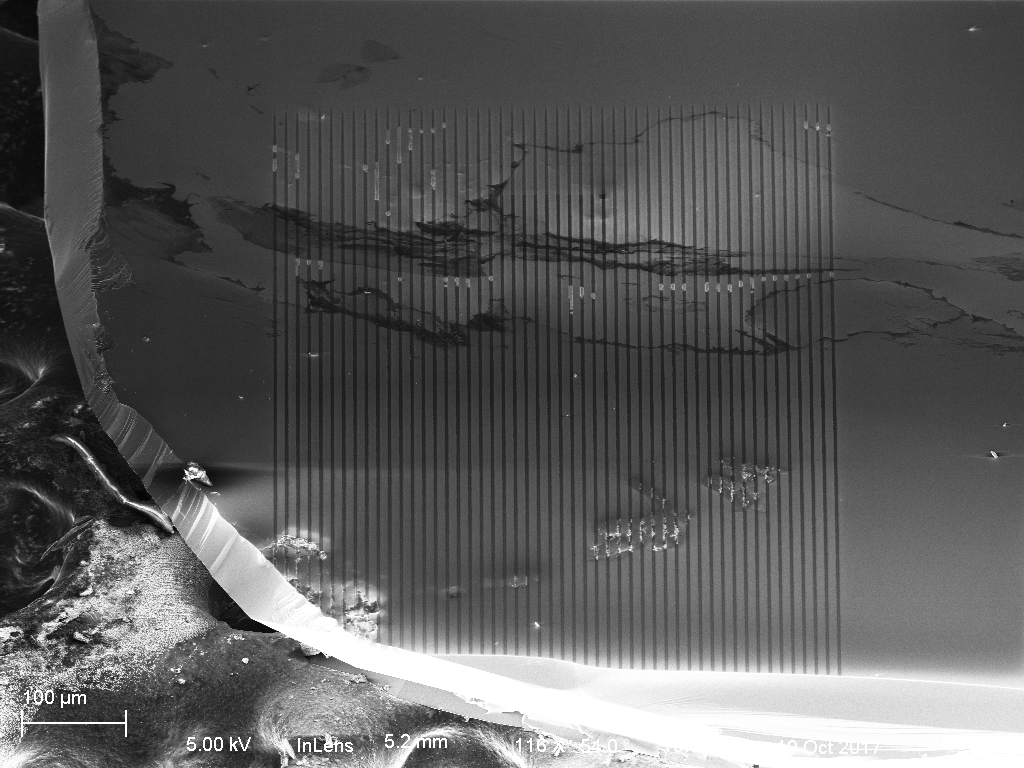

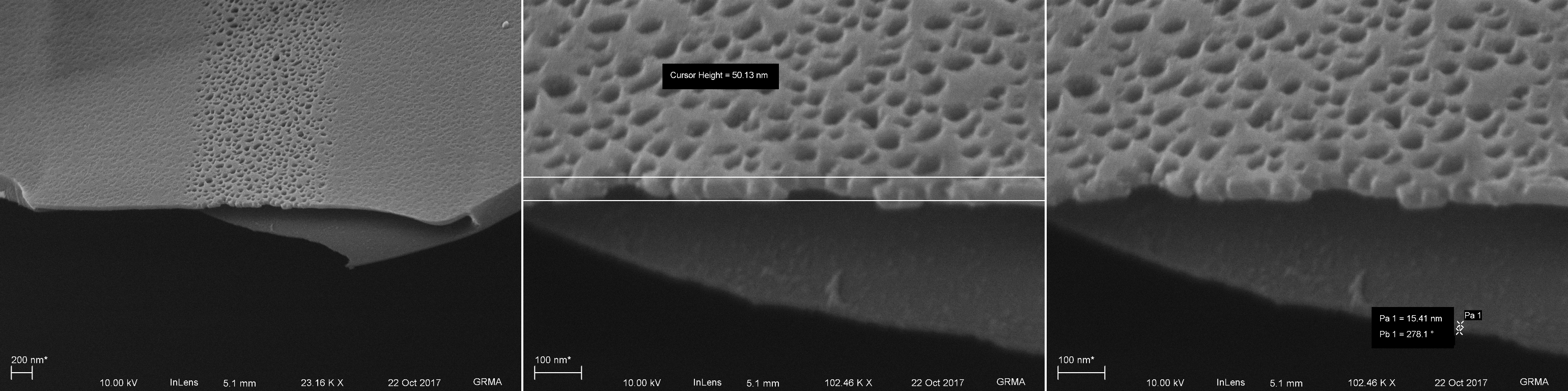
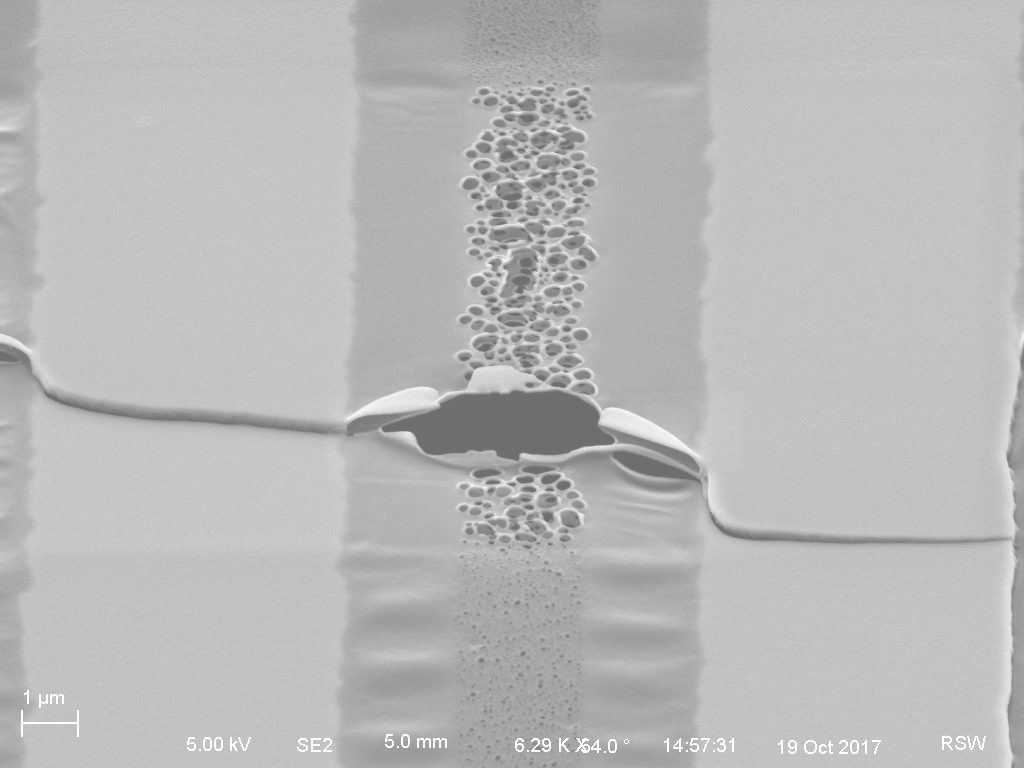
As the title states, these are images from the monolithically fabricated devices used by Kyle and Vincent in Ottawa. These devices were fractured with tweezers, then tilted and metallized with 5 nm of Pt, mounted on carbon tape.
In order to test the sealing of the capillary tubing the PDMS I made a batch of PDMS with a recess in it (from a dime). Once this cured I used the UV Ozone process (@25C) to bond the PDMS to a glass microscope slide. When I arrived this morning the system was fully bound….
I tested four membranes with different porosities today, including one that had been carbonized. Here are the pore size distributions with TEM micrographs. I ozone treated all the samples prior to running the experiments, including the carbonized sc 582. I expected some of the carbon ring to oxidize, which TEM confirms: It would appear that…
Although most previous studies suggest a weakened cell-substrate interaction over porous membranes, there are variations in the observed cell responses, likely due to the use of different cell types, substrate materials, and experimental methods. We are seeking to develop a computational model using the Active Brownian Particle (ABP) approach to study the role of pore…
Introduction The µSiM BBB model is being developed at UR with the goal to understand the impact of sepsis on the brain. Here, we use an EECM-BMEC-like cell (iSPC-derived brain endothelial cells) [1] monoculture model and an EECM-BMEC-like cell and brain pericyte-like cell (BPLC; iSPC-derived brain pericytes) [2] coculture model to optimize the concentration of…
Last week, JP and I resurrected using TEOS as the backside pattern and experimented with using a thermal oxide as the first protective oxide layer (instead of a sputtered oxide). The idea was to see how the reduced stress in the pattern (TEOS) would affect film morphology. The thermal oxide on the frontside was an…
As I am hoping to promote tighter junctions between endothelial cells in my device, I am trying to create an environment that produces shear stress on the endothelial cells. Shear stress up-regulates the pathways that promote tight junctions (Tzima et al 2005, Dejanna et al 2004). The value of the quantity is somewhere around 6…
Thanks for getting these Greg. A few comments: The first montage, you point out the large under etch…this was a known condition that was expected. Its due to the XeF2 gas, which is very isotropic. As for the debris, this is also a known condition, also due to the XeF2, I believe this is due to contaminates in the poly-Si as deposited (at RIT) and because the selectivity of XeF2 is absurdly high, it does not etch at all. I do not think these ‘crumbs’ would interfere with pore formation since they are not continuous, and since the pores are actually enlarging, they probably are being dissolved in the KCl solution (and therefore not plugging the pore).