
Permeability versus porosity, carbonized membranes
I tested four membranes with different porosities today, including one that had been carbonized. Here are the pore size distributions with TEM micrographs.
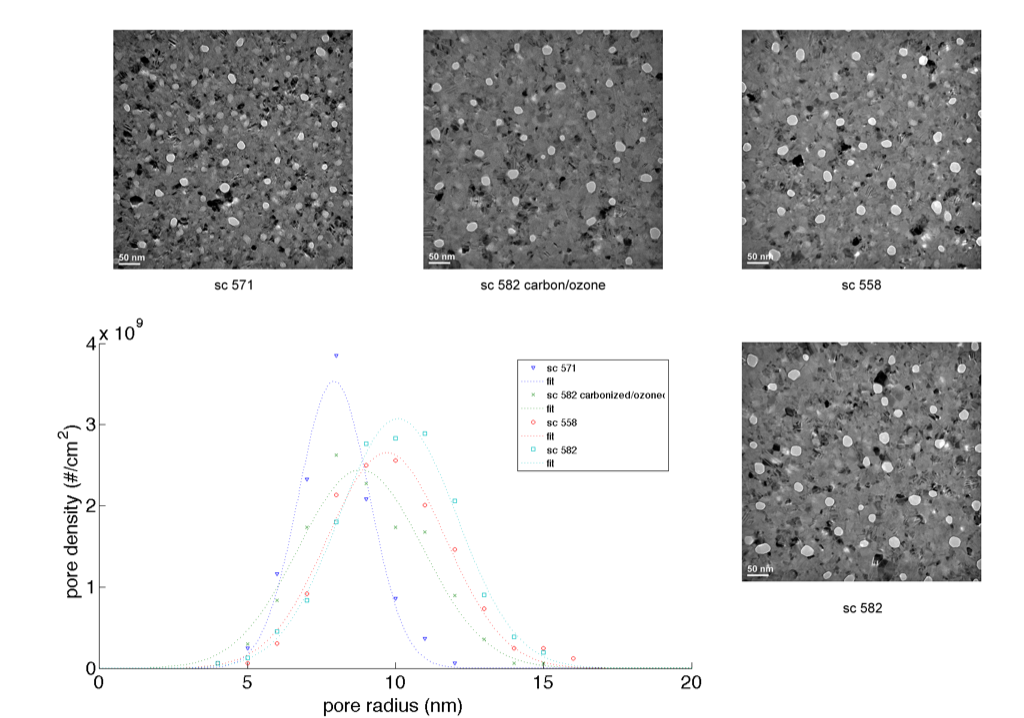
I ozone treated all the samples prior to running the experiments, including the carbonized sc 582. I expected some of the carbon ring to oxidize, which TEM confirms:


It would appear that 10 min of ozone treatment consumes 1-2 nm of carbon deposit. The permeability closely follows theory, within error.

All trials were conducted with the same sample three times (n=3). It’s interesting that the carbonized sample is slightly higher than the prediction, but most likely insignificant when factoring all other sources of error (histogram calculation, exact thickness of sample etc…)
An average theoretical permeability is reported using real histograms from an inner and outer sample.
A note about contact angles
I measured the contact angle of an untreated (76°), ozoned (16°), carbonized (60°), and carbonized/ozoned (22°) chip.

Somewhat counter-intuitive and contradictory to my initial observations, the carbonized sample sample was slightly more hydrophilic that an untreated sample. I looked at Salonen et al. Appl. Surf. Sci. 2004 and found this:
One of the significant differences between the hydrocarbon terminated and thermally-carbonized PSi samples is the change from hydrophobic to hydro- philic. That change was found to correlate with the amount of hydrogen on the surface, but not with the carbon bonding configuration. Furthermore, it is inde- pendent on whether the hydrogen is bonded with carbon or silicon atoms. Also, a quite small amount of hydrogen seems to be enough to keep the surface hydrophobic. This can be seen in Fig. 6, where the humidity uptaken of two samples treated at different temperatures is depicted. The sample treated at 650 C is still hydrophobic and the weight increase due to the humidity uptake is small, viz. similar to the fresh PSi. But, in the sample treated at 730 C the surface is hydrophilic and the humidity uptaken remarkably higher, although the changes in FTIR spectra are quite small. The observation of the sharp change from hydrophobic to hydrophilic was unexpected and the transition temperature higher than would be expected from the FTIR spectra. Although, the hygroscopicity seems to correlate with the hydrogen contents, it could be also arising from the slight graphitization of the surface or formation of nonstoichiometric Si1-xCx compound.
Very nice data. I like how you are now getting such nice agreement with theory.
In addition to being a little higher than theory, the carbonized sample appears to have much lower variability. I would interpret this as an indication that the pores are wetting better, but there’s not enough data to prove it. Do you think this improved consistency is a real effect or a fluke?
Did you try running any of the carbonized samples without ozone treatment? Ozone treatment is likely counter-acting the enhancement that you are trying to observe, since it is breaking C-C bonds and leaving charged defects. If you believe the CNT membrane people, it’s the uncharged ultrasmooth pore wall that creates all the magic. It’s worth adding this data point.