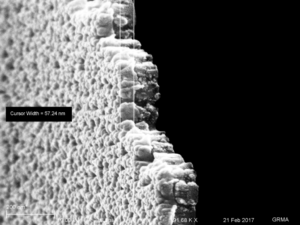
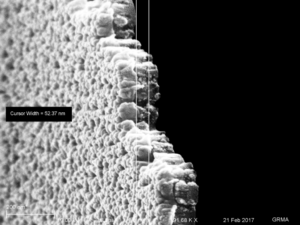
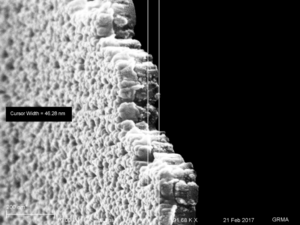
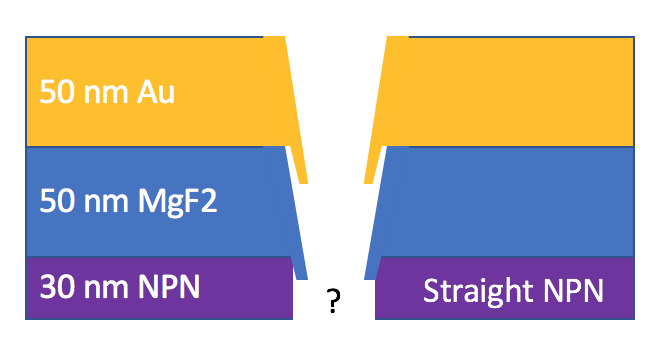
This post is a continuation of the work in Partial Etch RIE Blows out NPN Pores and MgF2 Nanomembrane Fabrication on partially etched NPN substrates. We believe the underlying NPN template influences the shape of our SERS active nanostructures and therefore the SERS properties. In this post, we’ll take a look at some of the structures resulting from partially etching the NPN template, thinning and broadening the template, which will change the shape of the structures that are fabricated upon them.
After the fabrication, each of these membranes were fractured and then coated with 8-9 nm of platinum. I will probably use less next time, as it was occluding my crossections.
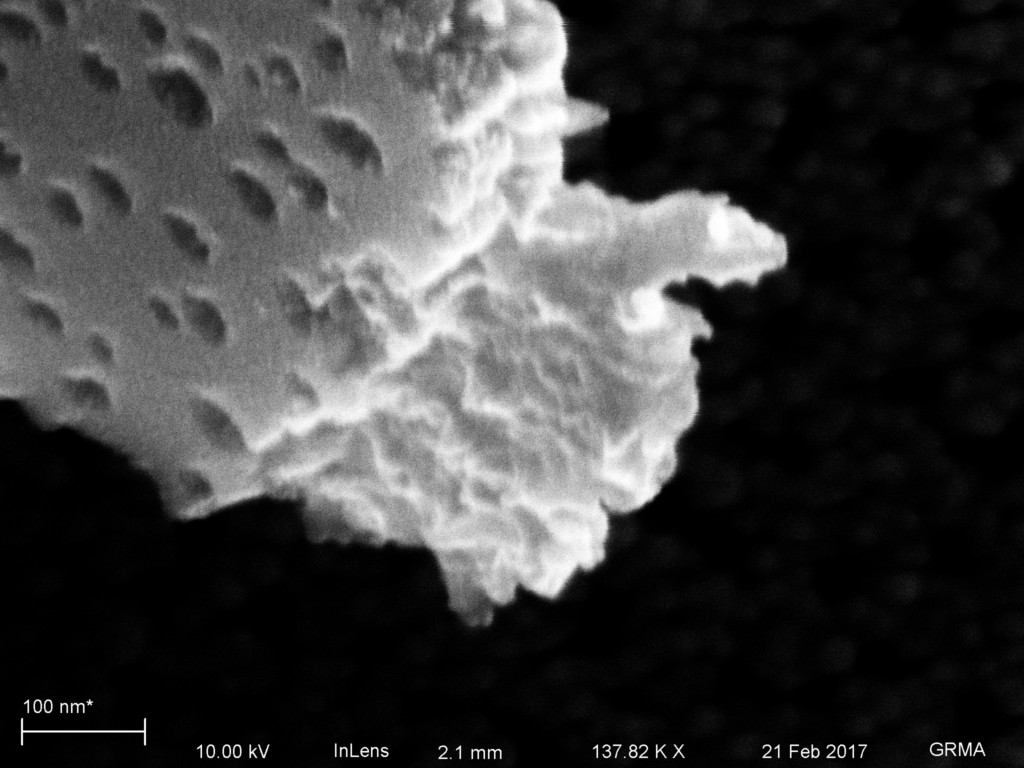
10 s etch viewed from the back. Fractures through the NPN are pretty straight, not conical.
Colorized 10 s etch
20s etch 1236 NPN + MgF2 + Au
We’re not certain to what degree does the partial etched membrane have conical features.
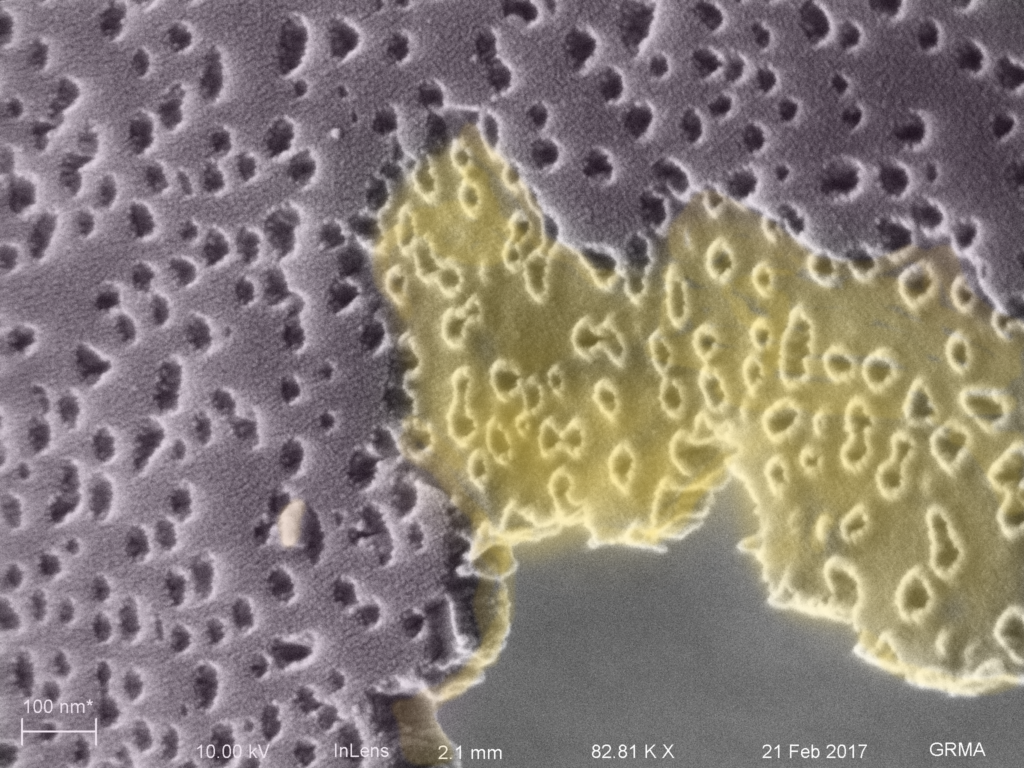
20s etch. The NPN template is thinning. and we can see that the gold has some interesting pointed shapes when peeled away.20 s colorized
30s etch 1236 NPN + Au
Since the much thinned NPN template cannot survive the MgF2 evaporation stress, we coat gold on the thinned NPN directly.30 s etch. Thinned NPN reveals gold volcanoes.30 s etch colorized.Scraping up the gold in the bulk region shows that volcanoes are formed with some porosity. Internally, they may be more pinched than the shape of the volcano indicates.
40 s etch 1236 NPN + Au
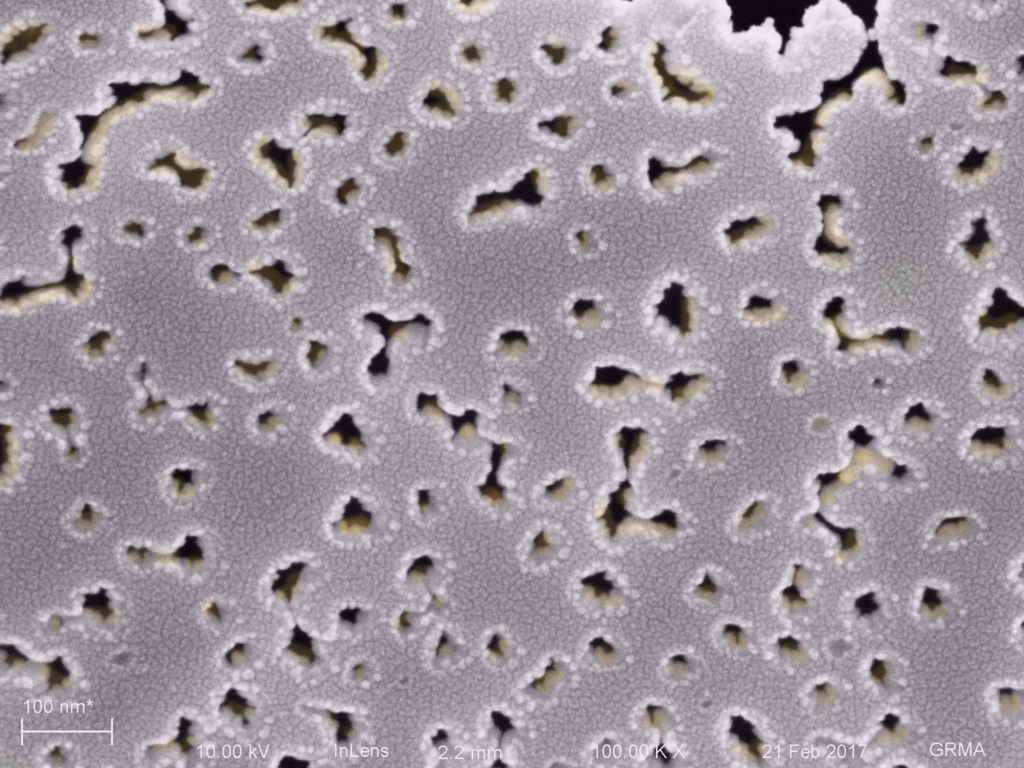
40 s etch. Viewed from the backside, it is clear that the features of the NPN have changed, as more pores have merged together. Thin bits of gold are viewable through the pores, as it comprises most of the film thickness.
40 s colorized
Aerial Image shows a contiguous membrane into the freestanding region (darker).
In my previous post, I mentioned that the EA treated chips showed decreasing contact angles after their storage in water in contrast to gel-pack or vacuum container. However the EA treatment was 4 days old, and I lacked adequate controls. So this time, I chose smaller time durations to understand if this phenomenon can be…
Diffusion of rhodamine was observed through pncSi samples from W620. This was done to compare the porosity of the membranes after RTP treatment. From the following movies (real time = 10 mins) it can be seen that there is no significant difference in diffusion between the samples after they are RTPed, as expected. Now, Henry…
I am trying to deposit metal on the membrane with minimal deposition inside the pores. The image below is an example of how the film quality and thickness change when the sample is positioned at different angles and distances from the source in the same deposition run. The schematic in the corner of each SEM…
Jirachai’s recent post on the formation of Au nanoparticles on the surface of the NPN is very exciting. For one, it is a very dense monolayer of particles. This self assembly mechanism is magnificent whereas if we tried to dry down a layer of particles, we would get a cake layer similar to what Josh…
NRG this coming Tuesday, October 20th, will be dedicated to reviewing progress to-date on our joint NSF-sponsored Phase 1 STTR project. Here is the agenda. • Jamie: Project overview and commercialization aspects • Josh, Bob and Elizabeth: Lift-off of nanoporous silicon nitride • JP: Development of thicker NPN • Tucker: Fluidics and dialyzer devices…
ASAIO /əˈsī ō/ noun American Society of Artificial Internal Organs. There is an associated Journal, “ASAIO Journal”, and a yearly conference for the presentation and discussion of research relating to advances in medical device technology. While the initial focus of the society was on renal devices, the artificial kidney, currently the majority of work by…