
Post-annealing of ITO deposited films
I am trying to create ITO electrodes for my microfluidic device for TEER measurement system. In my previous posts, I have shown that silver/silver chloride electrode, which is most commonly used in most commercial TEER systems, had killed the cells when grown with the electrode. So Greg and I were trying to optimize the recipe for ITO deposition. We deposit ITO by DC magnetron sputtering in a PVD system at room temperature. After the deposition, the substrates need to thermally treated to increase the conductivity of ITO electrodes. In past, we used to simply bake it in oven at around 350 F for an hour. Later we found that this temperature treatment is insufficient for making ITO a good conductor, and harsher thermal treatments need to be imposed to reduce the surface resistivity of the deposited electrodes. Recently I came across this paper, which addresses the exact same issue that we are trying to solve. Authors in this paper RTPed the samples at 600 C for 60 s in a vacuum environment and saw remarkable improvement in the conductivity and the optical transmittance of the electrodes. So i decided to use RTP for my substrates as well.
I used ~180 microns thick coverslips for deposition and deposited around 200-250 nm of ITO at room temperature. I RTPed my samples at 400, 500 and 600 C for 1, 2 and 3 mins. I observed that although borosilicate has 800 C as its softening point, my samples did bend a little at 600 C even for 1 minute. This means that 500 C is the maximum temperature at which the samples can be subjected to. Also the resistance values for 600 C samples were higher than 500 C samples, whereas 400 C samples also had more resistivity than the 500 C samples. This indicates that somehow 500 C is the minima as far as resistivity is considered. At 500 C though, resistivity increased as time for RTP increased, indicating that 60 s is the best and 180 s sample is highest in resistivity.
Summary:
In terms of resistance values: 400 C > 500 C < 600 C
In terms of time of RTP at 500 C: 60 s < 120 s < 180 s
Also 60 s at 500 C < 60 s at 400 C < 180 s at 400 C
Thus I am planning to treat all my samples from here on at 500 C for 1 sec. Just for same of completion, there was a 10 sccm flow of nitrogen during the hold up period.
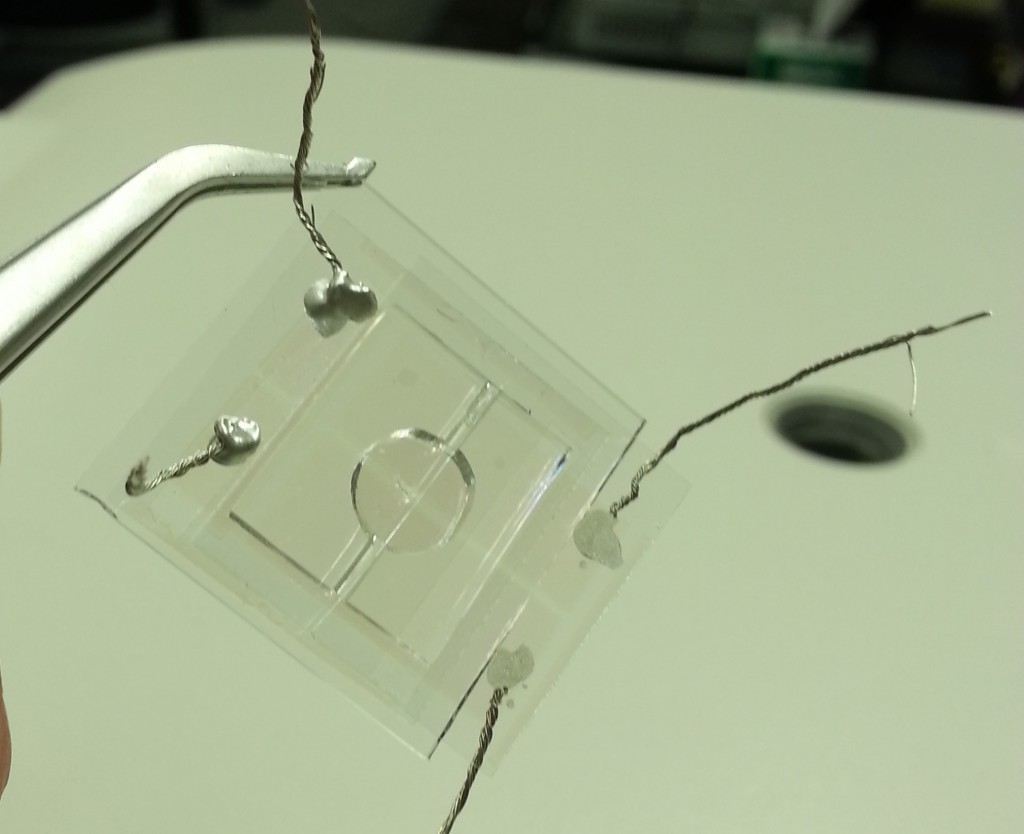
After assembly, the device looks something like this
We need to be careful what materials we put in the RTP. I think indium contamination may be a problem for processing. At a minimum we should have a dedicated susceptor. We should discuss with other users before continuing. Sorry I didn’t catch this sooner.
If we can proceed, I suggest using a different glass such as fused silica. I’ve heard that borosilicate glass has impurities that diffuse into ITO and increase resistivity.
-Josh
Tejas, can you provide the data you recorded from these tests? I know it’s inexact, but the relative resistance measurements are still useful for comparison to past and future tests.
Thanks!- Josh