
Young's modulus of various membranes
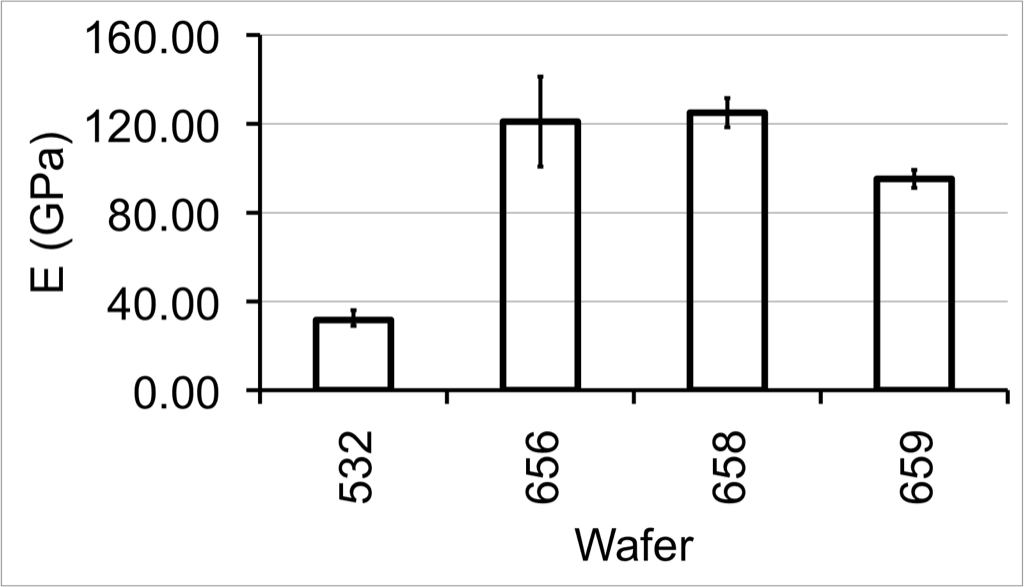
Last week, I calculated the Young’s modulus and residual stress of several different membranes using the pressure-displacement technique. The measurements were performed on at least three different geometries (square and rectangle) and the results were averaged.
| Wafer | Thick. (nm) | Por. (%) | Anneal | Res. Stress (MPa) | Young’s modulus (GPa) |
| 532 | 15 | 2.59 | 1000 sus | 4.17 | 31.67 |
| 656 | 15 | 7 | 1000 | 44 | 121.00 |
| 658 | 15 | 3.14 | 800 sus 5 min | 95.67 | 125.00 |
| 659 | 30 | 2.03 | 1000 | 7.75 | 95.25 |
Here is the data in graphical form:
TEM micrographs:
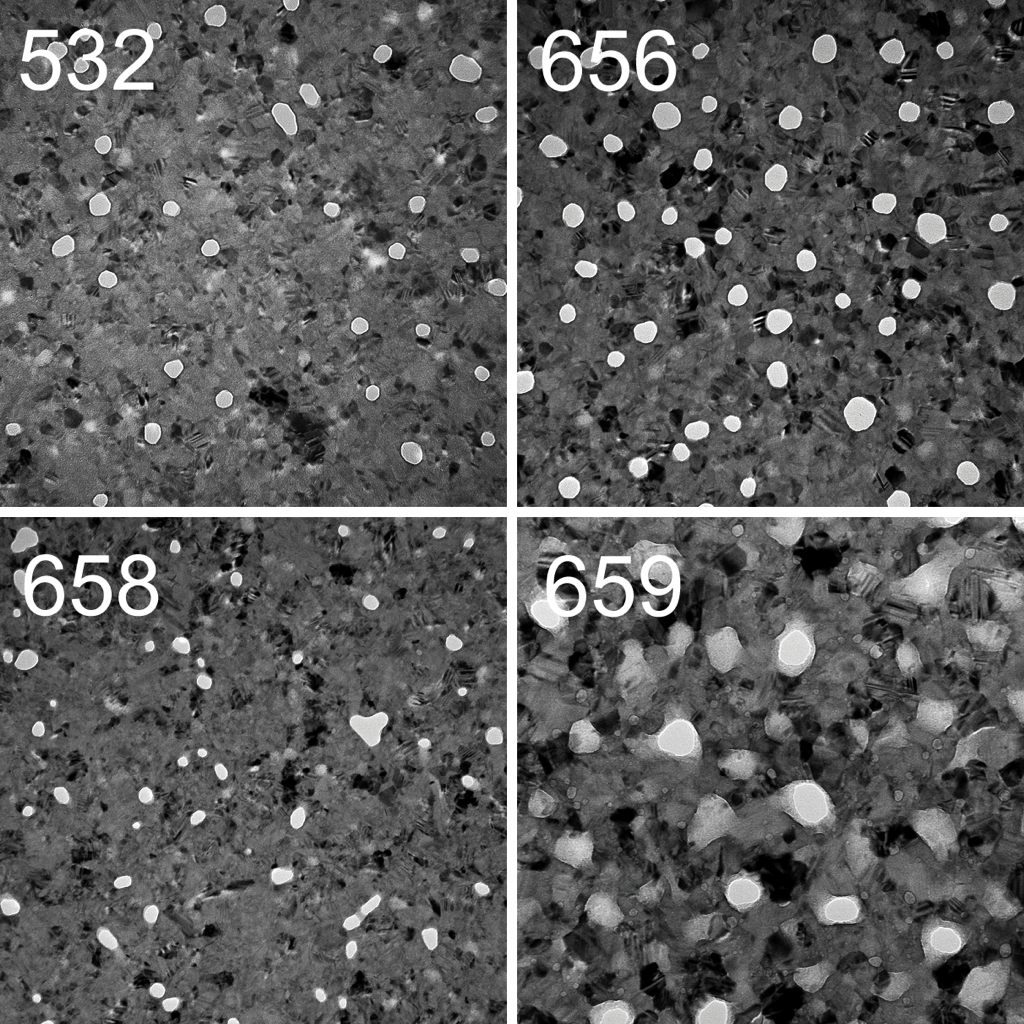
From these results, it seems that the Young’s modulus fluctuates quite a bit from each membrane type and there is no apparent trend with porosity or crystal size. Is there something we are missing?
Wafers 656-659 have a reasonable Young’s mod range (95.25-125.0 GPa). Wafer #532 was fabricated a month earlier. I believe slightly different deposition/anneal conditions may fluctuate the Young’s mod significantly, as seen here.
I wouldn’t attempt to correlate membrane morphology with Young’s mod just yet… repeat more experiments. Try to be as consistent as possible with repeatability.
Need me to fabricate more deflection wafers? Let’s discuss next week.
IT doesn’t seem physical to me that Young’s mod could vary by 4x over these membranes, so it’s important to try and come up with some explanation.
Is there anything odd about the fitting or some assumption that is made in the calculation that is concerning?