
Five-layer structure
In this post, two unique five-layer structures will be discussed. The first five-layer structure is nitride/oxide/silicon/oxide/nitride (NOSON) with the deposition order from bottom to top. In this structure, the silicon film is 25nm while the nitride and oxide are both 15nm. After etching the substrate, the membrane was RTP annealed at 1000C for 1 minute.

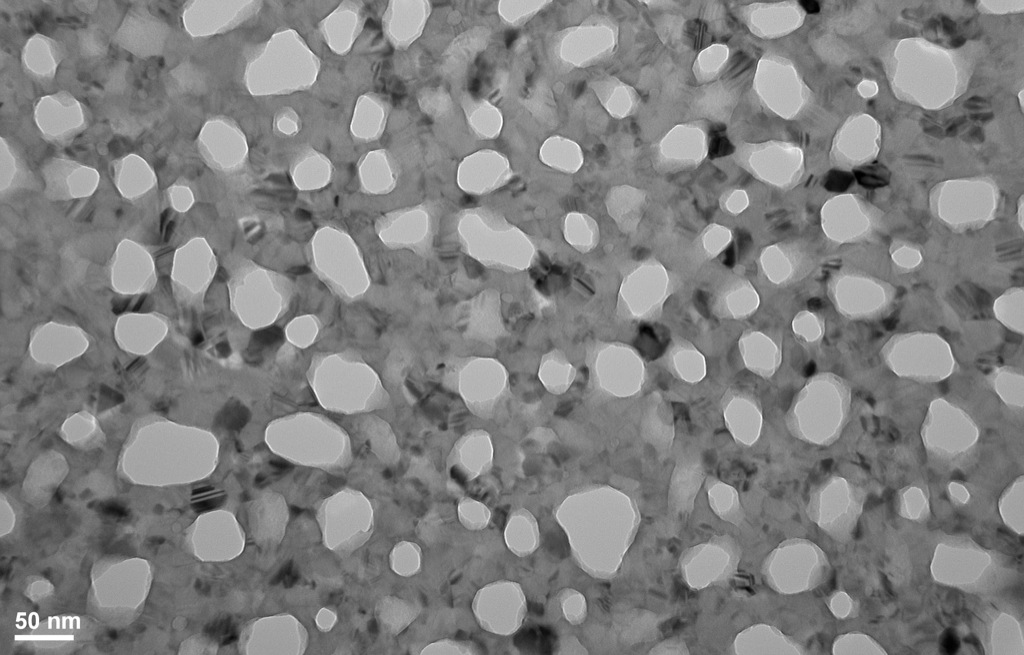
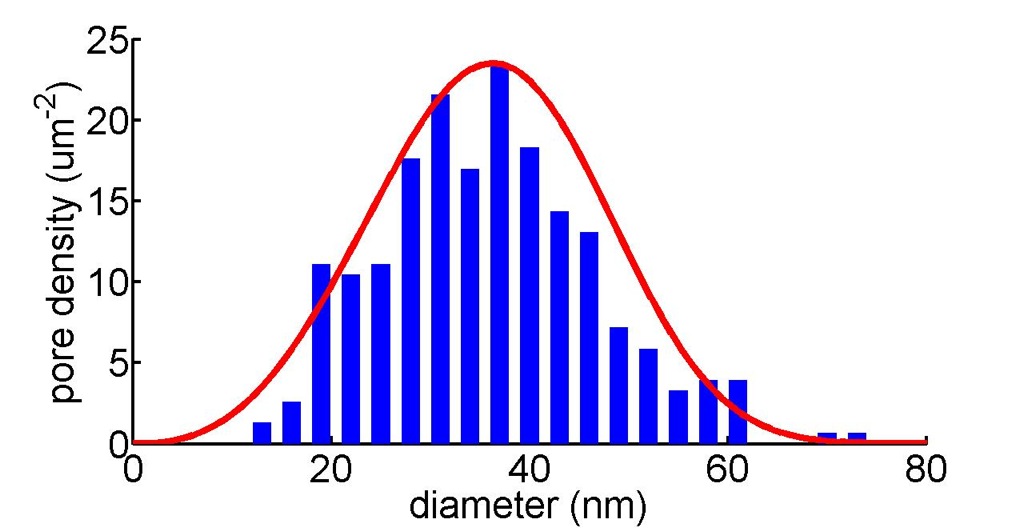
Interestingly, highly dense pores are formed in silicon film in this structure after annealing. The porosity is 20.5% and the average pore diameter is 36.3nm. The pore size cut-off for this membrane is 73nm. Obviously pore size are very high as this annealing temperature.
The second five-layer structure is oxide/nitride/silicon/nitride/oxide. The thickness of each layer is same as the first one. The followings are the TEM images of annealed sample.


The pore density of this sample is not as high as the first one. For this sample, the porosity is 10.8%, the average pore diameter is 23.6nm and the cut-off is 53nm.

Those two structures show very different pore characteristics after annealing. This experiment was originally to verify the interface effects on the pore formation and the result is quite unexpected. Recall that the previous results show that the nitride films enhance the pore formation thus the ONSNO structure were expected to produce bigger pores with high porosity due to the nitride-silicon interfaces. However the result turns to be opposite. Further investigation is needed.