Over the last week or so I’ve taken some lovely SEM pictures with Joe, used the light scatter, and ran some separations on filters I assembled myself. Someone from the Barcikowski lab, Dr. Rehbock, got in touch with me and sent me an updated description of the four samples they’re sending and what they want done with them:
1) 7-10 nm bioconjugated gold colloid with peptide ligands in the supernatant (pH=9); retentate free of ligands
2) Bimodal gold colloids with fractions 7-10 nm and about 20 nm (pH=9); permeate with fraction < 10 nm
I plan to use next week to do some similar separations, ie separating out 5nm gold out of a mix of 5 and 10nm stock, so that when the samples come I can just troubleshoot instead of starting protocols from scratch. The Samples are due to arrive by the end of April.
After assembling some 20nm filters from scratch I used them to separate 5nm, 10nm, 15nm, and 20nm gold. I used the standard curves from my previous experiment to get the percentages.
For the 5nm gold particles, the average dilution was 33% (where 100% was the 1:1 dilution of the stock solution in your drawer)
for 10nm – 41%
15nm – 4%
20nm – 3%
Note that 10% is the cutoff for the machine, so that both the 15nm and 20nm results are noise.
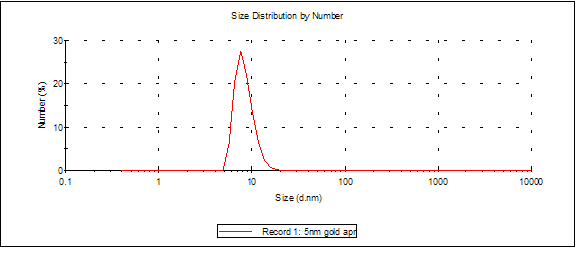
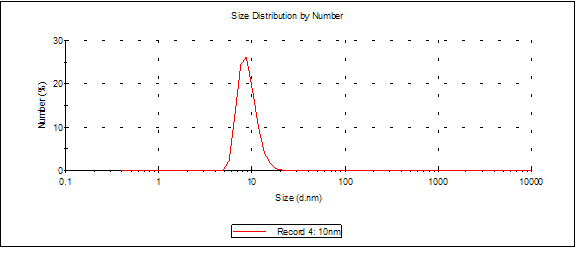
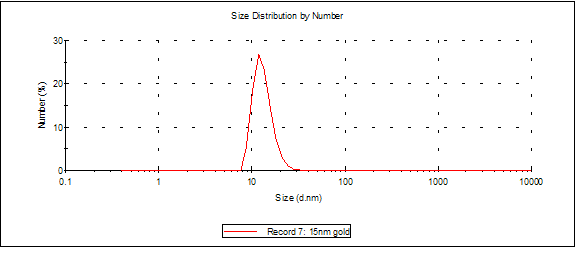
I used the light scatterer on the filtrate of my separations. The results were as follows:
5nm gold had its largest number PSD peak (averaged over three samples) at 9.09nm:
10nm at 8.86nm:
15nm at 13.2nm:
20nm at 22.6nm:
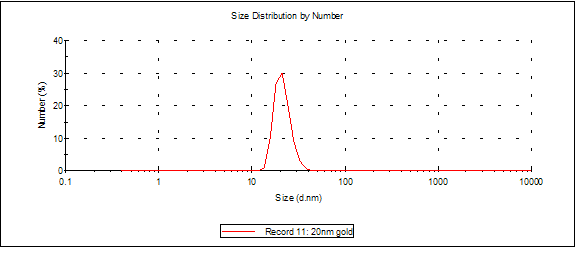
I think this means that the 5nm samples are clumping up preferentially in pairs, but everything else looks fair.
Four representative pictures of my SEM session with Joe are below:
In the field of gas permeance there is a plot called the “Robeson Plot” (the paper that debuted it) that is used to compare the separation behavior of various membranes made of different materials and measured in different systems. An example is pictured: Various literature data for the log permeability of H2 gas versus the…
One of the ongoing efforts with endothelial cell culture on pnc-Si is to confirm that the holes in these cells are actually vacuoles. In my last post, I tried to do this with FITC-Dextran and TMRIA with indefinite results. I ordered some 5-6-carboxytetramethylrhodamine (TAMRA, C-300 from Invitrogen) to do this test again. This rhodamine dye…
Document: Ian’s Presentation Thanks to Ian Krout for the experiment and the writeup, which I have organized here. The purpose of this set-up was to develop a tool to melt plastic particles collected on the silicon nanomembranes membranes. Due to the different melting temperatures of plastic polymers this tool allows users the ability to rapidly…
This is a follow up to my previous post, “Burst Pressure Probability II”. I burst 111, 30nm thick single window pnc-SI TEM chips of ten different window sizes, to measure the burst pressure of chips with varying dimensions. Although area is a major determining factor in the pressure at which the windows break, two different windows of…
Introduction Tissue barriers separate different compartments of body organs. These barriers regulate the absorption of nutrients, maintain homeostasis, and prevent toxins from entering. In vitro models of tissue barriers have been developed to understand human diseases and investigate drug toxicity and effectiveness. In order to investigate cell-cell junctions and barrier maturity created on these models,…
Introduction Risks of extracorporeal membrane oxygenation (ECMO) therapy can be attributed to large membrane areas and blood circuit volumes. These are particularly problematic in neonates with low blood volume. To address this, we are developing a miniaturized prototype microfluidic ECMO using ultrathin highly porous silicone membranes. Hemocompatibility (hemolysis and thrombosis) assessment of geometrical variants of…