Top SiO2 Thickness Experiment
A long time ago, Charles did Asymmetrical Oxide Experiment to test how the asymmetrical oxide affects the pores, see Asymmetrical Oxide Experiment. He deposited three structures, which were 40/15/40, 40/15/20 and 20/15/20. It showed that when the thickness of top oxide decreased from 40nm to 20nm while kept the bottom oxide at 40nm, the porosity increased from 6.2% to 13% and average pore size increased as well. However, when the thickness of bottom oxide decrease from 40nm to 20nm while kept the top oxide at 20nm, no big differences were obtained in terms of porosity and average pore size. It seemed that the top oxide thickness is significant important in controlling porosity and pore size. In the last two weeks, I was working on wafers with even thinner top oxide and tried to connect it with my former agglomeration experiments. I deposited four wafers with 20/15/20, 20/15/15, 20/15/10, and 20/15/05 structures with 5W bias and annealed them at 1000C for 1min with a 100C/s ramp rate. One thing I want to address was about the etching. In order to protect the Si membrane during etching due to very thin top oxide, I redeposited 15nm, 10nm and 5nm oxide on the top to 20/15/05, 20/15/10 and 20/15/15 structures after annealing them. Below are the TEM micrographs, pore distributions, average diameter/porosity plots.
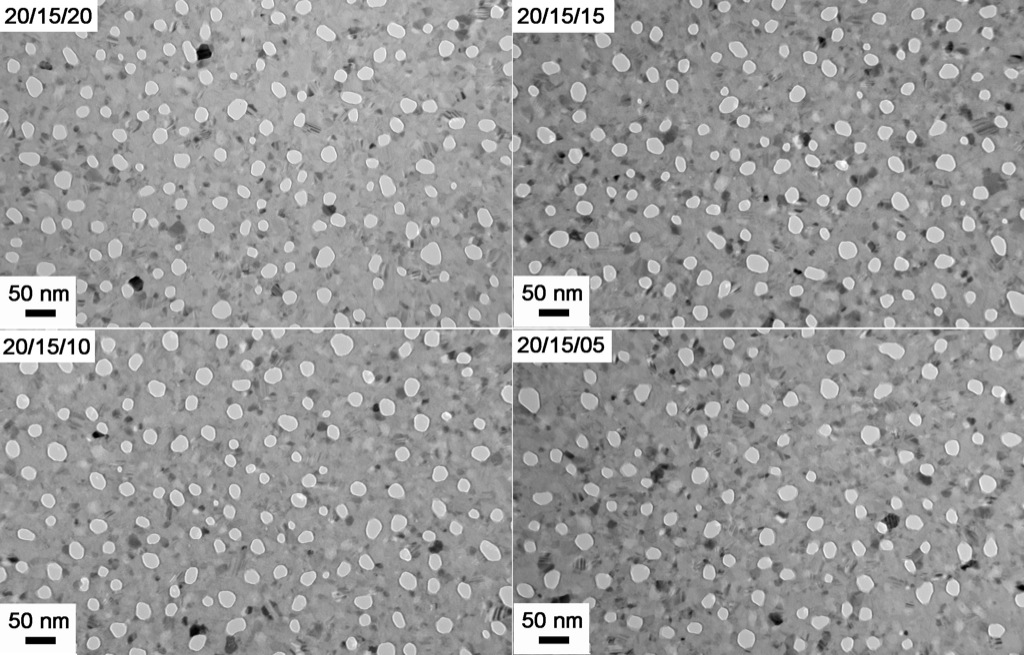
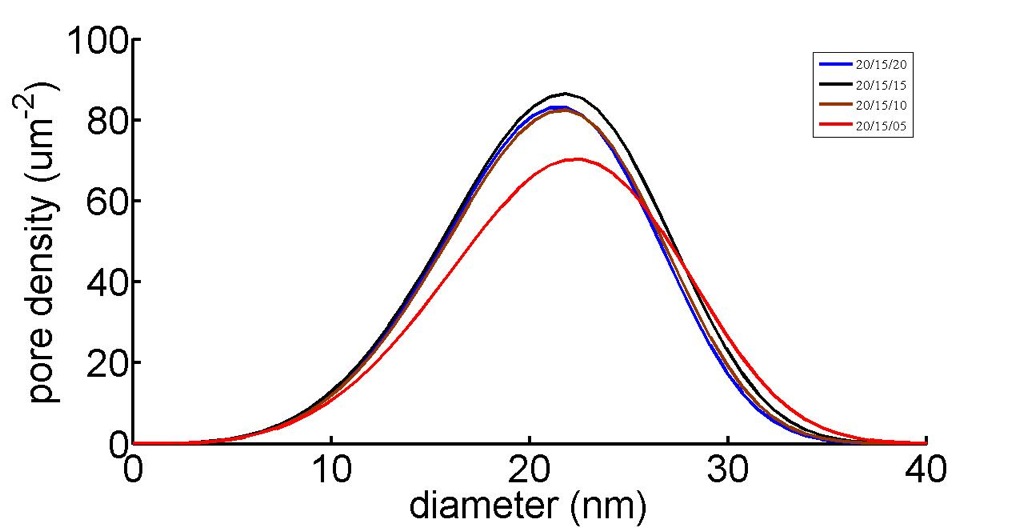


Based on the result, it could be seen that 20/15/05 structure yields relative lower porosity and larger pore size and the other three are almost same in terms of porosity and pore size. It looks not consistent with Charles’s experiment that thinner top oxide would yield higher porosity, however, it gives me a new thought on the “real” effect of the top oxide thickness by combining with the former agglomeration experiments.
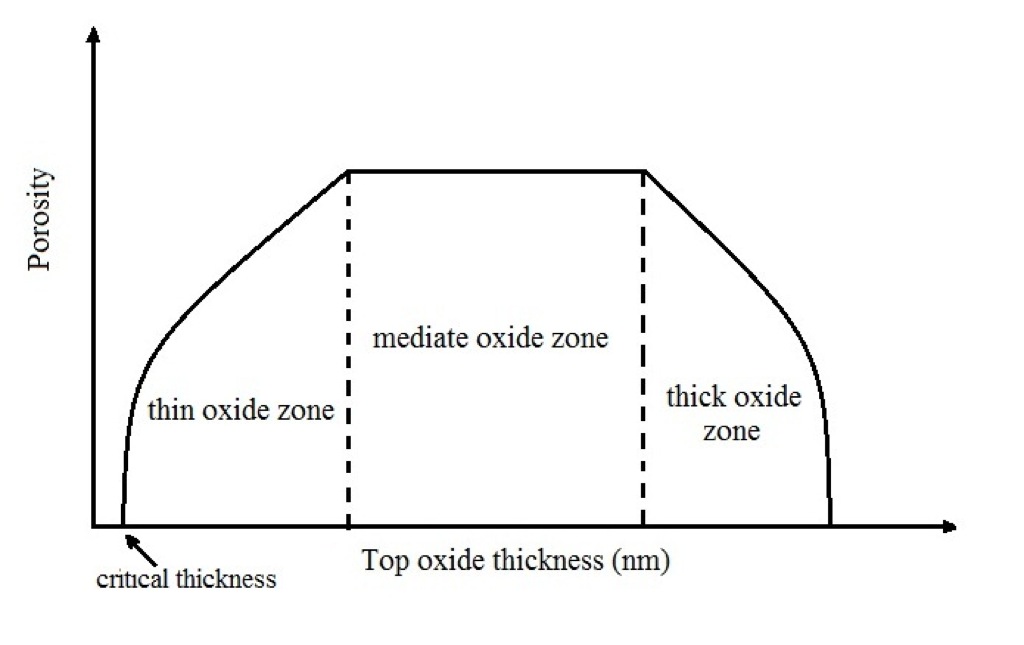
In my thought, there are mainly three zones that the top oxide thickness would affect the pores. The first one is the thin oxide zone. In this zone, the porosity increases with the top oxide thickness.The hypothesis is that thicker top oxide would provide more constrain to Si layer so that Si atoms would not move freely and then more pores are formed during crystallization. That’s why no pores were observed in my agglomeration experiments since Si atoms move freely without any constrain. I also propose a critical top oxide thickness above which pores are formed while below it, agglomeration would take place due to not enough constrain from the top oxide.
The second zone is the mediate oxide thickness in which the porosity and pore size would not change much. In this zone, the different thick top oxide would provide different constrains to Si layer, however, the difference in constrain is not big enough to greatly affect pore formation. As a result, the porosity and pore size would not change very much in this zone.
The third zone is the thick oxide thickness in which the porosity drops quickly with top oxide thickness. It can be imagined that very thick top oxide would generate very strong constrains to the a-Si layer so that less pore could be formed during crystallization. So no pores would be formed when the top oxide thickness increases to some point.
Next step I’m thinking doing the similar experiments on the bottom oxide and form a matrix of the effect of oxide on pores.