Sodium fluorescein standard and transport
The last few Tecan posts have dealt with adjusting gain values to optimize fluorescent standard curves. We now have a general protocol here, and a final standard curve for fluorescein. Here is the background-reduced standard curve for sodium fluorescein (Na-F) that Christine and I obtained. This was done with the gain set to 0.000125%, and I converted %Na-F to uM Na-F. The entire dilution series is linear, and the actual gain is ~ 86-87.

Because the gain for this standard curve is about 10 units higher than our previous standard curves, I worried that the background fluorescence from transwell/Sepcon plastic would be too high to detect transport. So, I set up the typical transport experiment (open circle multiple reads per well, 1000um border) with a Costar transwell, a nailpolished Costar transwell, a nailpolished Sepcon and Na-F and HBSS blanks.
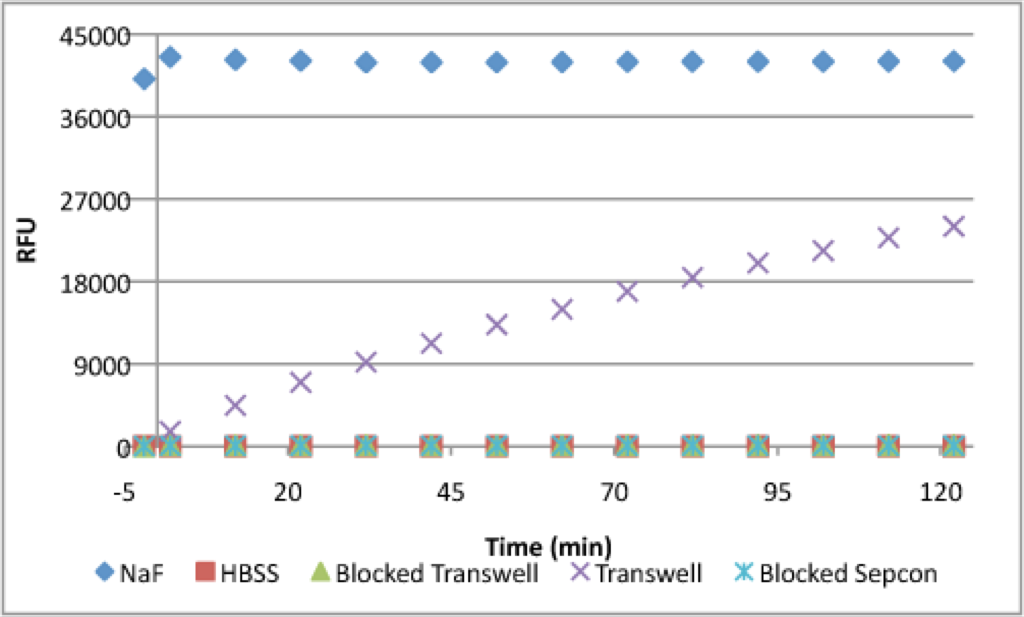
Here is the low RFU data.
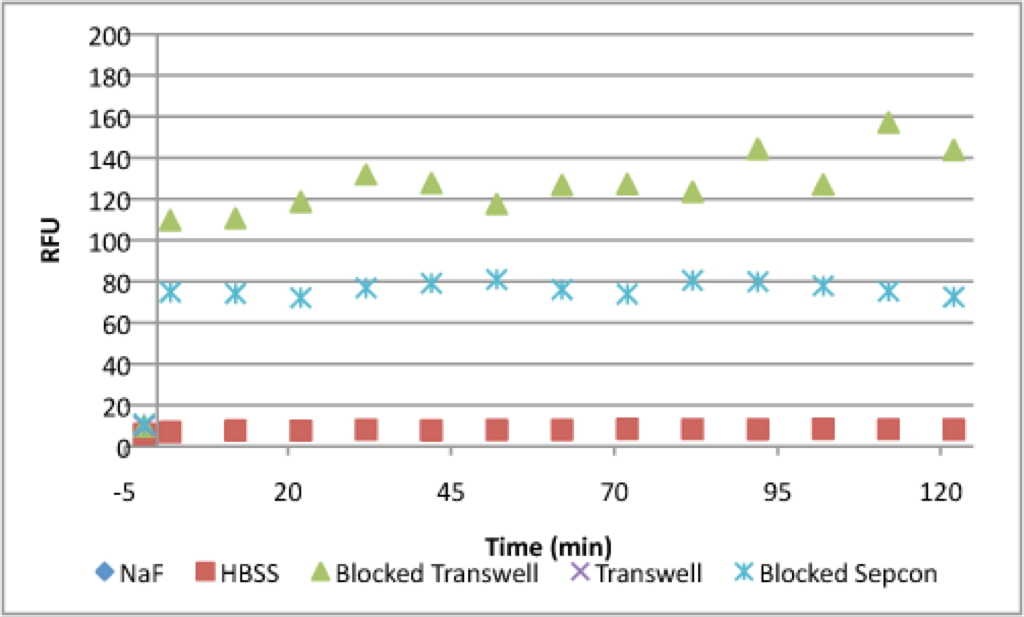
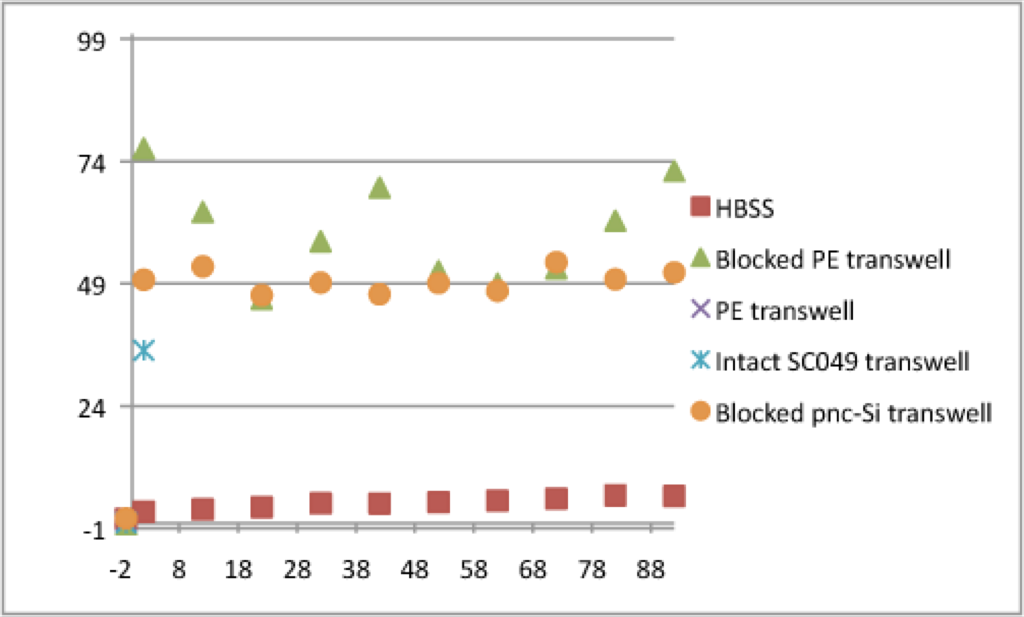
As expected, the fluorescence signal jumped after I added the Na-F to the donor wells at time = 0, but because transport was blocked, the signal stayed fairly steady. I attached the graph from a previous post where the gain was ~ 76. In the new experiment with higher gain, the background fluorescence for both devices was ~ 50% higher but still insignificant compared to the total RFU scale. This shows that the background fluorescence from transwell/Sepcon plastic is not significant with the gain set high enough to obtain a completely linear standard curve.
Data from my previous post (gain ~ 76):