
Updated Rhodamine Dilution
I fixed the graph for the serial dilution of Rhodamine that I did last week and removed all absorbency values that were greater than 1.08 AU. The graph looks much more linear now with an R^2 value of .9517
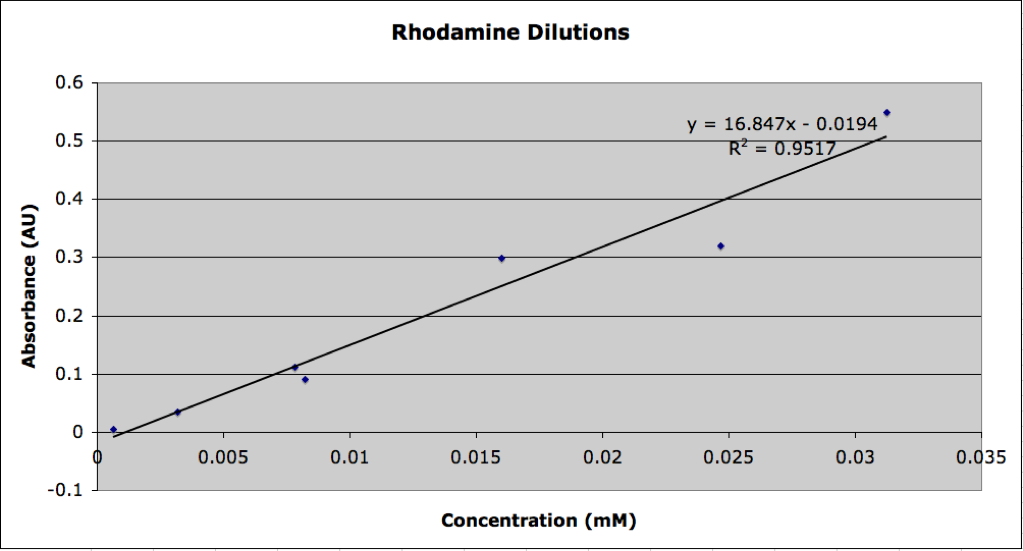
I fixed the graph for the serial dilution of Rhodamine that I did last week and removed all absorbency values that were greater than 1.08 AU. The graph looks much more linear now with an R^2 value of .9517
Introduction Sphingosine-1-phosphate: production and endothelial cell signaling Sphingosine-1-phosphate (S1P) is a bioactive sphingolipid produced through the phosphorylation of sphingosine, a component of the plasma membrane, by SphK1/2. Many cells produce and store S1P, the largest source of which is platelets, due to their high native SphK activity. Erythrocytes and leukocytes are also sources of S1P…
We were targeting a TEOS layer of 300 nm for the SiO2 membrane. The wafers were patterned with ø3 µm pores using S1813 resist (~1.5 µm thick). The target etch time in the Drytek RIE is 4 min 10 s using SF6 and Ar. We will need a thicker resist coating to prevent the RIE…
Hi all, For the past one month I have been working on a height-based device for culturing bEnd3 (mouse brain endothelial cells) under flow. Ideally, this device is to constitute a blood brain barrier (BBB) mimetic. Device Full View (Front): The fluid flow is driven by hydrostatic pressure, created through the differences in the…
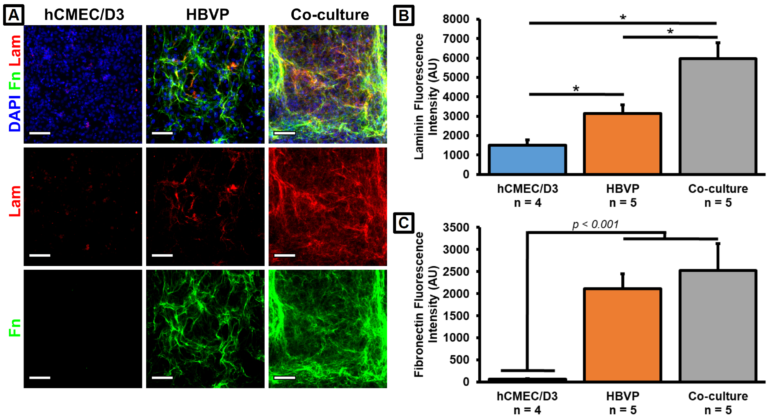
Introduction The blood-brain barrier (BBB) plays an important role in maintaining brain chemistry by restricting the permeability of small molecules and cells. Inflammatory diseases may disrupt the BBB and promote the development of neurological disorders [1]. One potential mechanism of BBB disruption is the degradation of the extracellular matrix proteins that make up the vascular…
A temperature series was performed last week over seven wafers annealed inside the susceptor (15 nm silicon). The objective was to determine if the current configuration of target materials would show pore tunability over the temperatures of interest (900 – 1100 C). Below is a series of TEM micrographs and their corresponding histograms. At the…
A second fibroblast (L1 3T3, P21) growth test was conducted on RTP treated samples from W510, tissue culture plastic (polystyrene), and glass cover slips. Fibroblasts were cultured in DMEM with media changed every 48 hours. Cells were imaged using the live/dead assay. Fibroblasts divided every 29.9, 35, and 37.7 hours when grown on pnc-Si, glass,…
What is the absorbance wavelength you are measuring?
The wavelength is measured at 530nm. I checked online and it said that the maximum absobtion of rhodamine is about 530nm.
This looks OK, but I’m still surprised that the data points are not tighter to the line (lower variance). This is close to an ideal system, so I would suggest trying to perfect your technique to get this rock-solid before advancing to more complicated experiments. If you try to measure the same sample multiple times, does the value jump up/down around the line? If so, maybe an averaging is needed?
If you think this is good enough for your purposes, that’s fine too, but you want to make sure that this measurement error is not a significant contributor to the overall experimental error. You should also consider the range of absorbance values that you will typically be using, and confirm accuracy in that regime.
I ran two measurements for each sample and then averaged the two measurements. I’ll run the experiment again on Monday and see if I can get a better fit.
How close were the two measurements for each sample? If each set of two is tight, then the variability is not in the measurement, but the prep. Once you isolate the source of variability, you will probably be able to get nice looking data with a few tweaks of procedure. Even if the variability is outside of your control, it’s still important to understand it for experimental design.