
Fibroblast Growth and Associated pnc-Si Discoloration
A second fibroblast (L1 3T3, P21) growth test was conducted on RTP treated samples from W510, tissue culture plastic (polystyrene), and glass cover slips. Fibroblasts were cultured in DMEM with media changed every 48 hours. Cells were imaged using the live/dead assay.
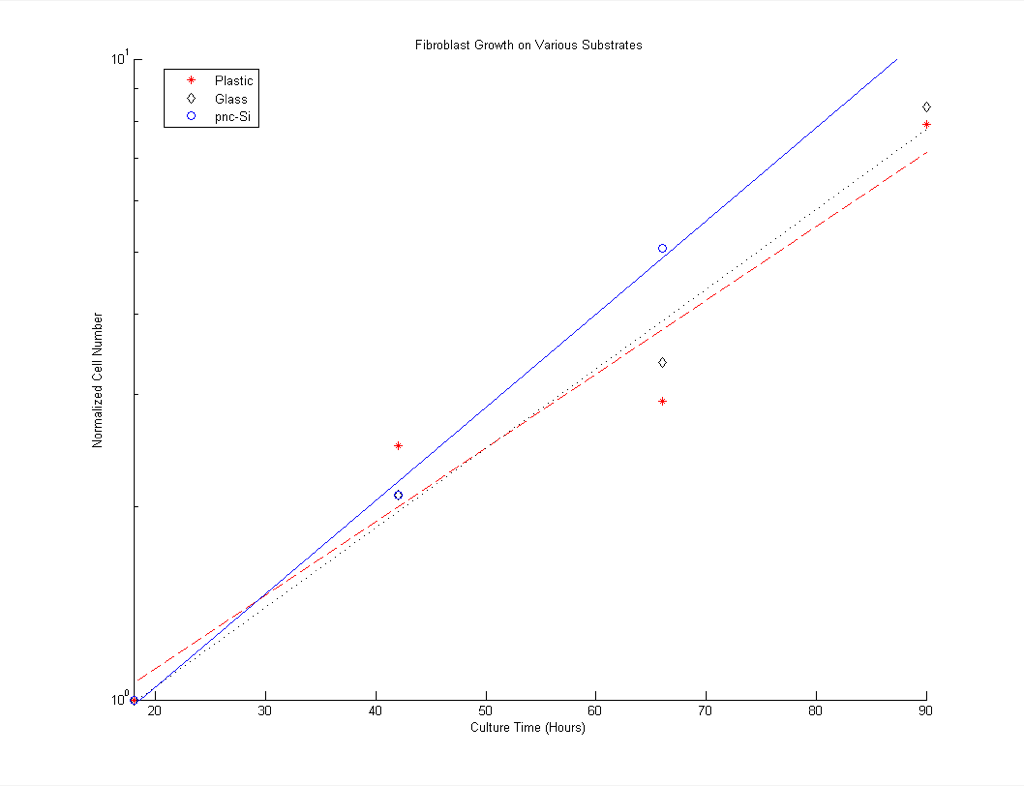
Fibroblasts divided every 29.9, 35, and 37.7 hours when grown on pnc-Si, glass, and plastic, respectively. According to Mike Bindschadler’s work fibroblasts (NIH 3T3) in sparse culture divided at a rate of once every 28 hours, this is in close agreement with what we have observed on the membranes for this experiment.
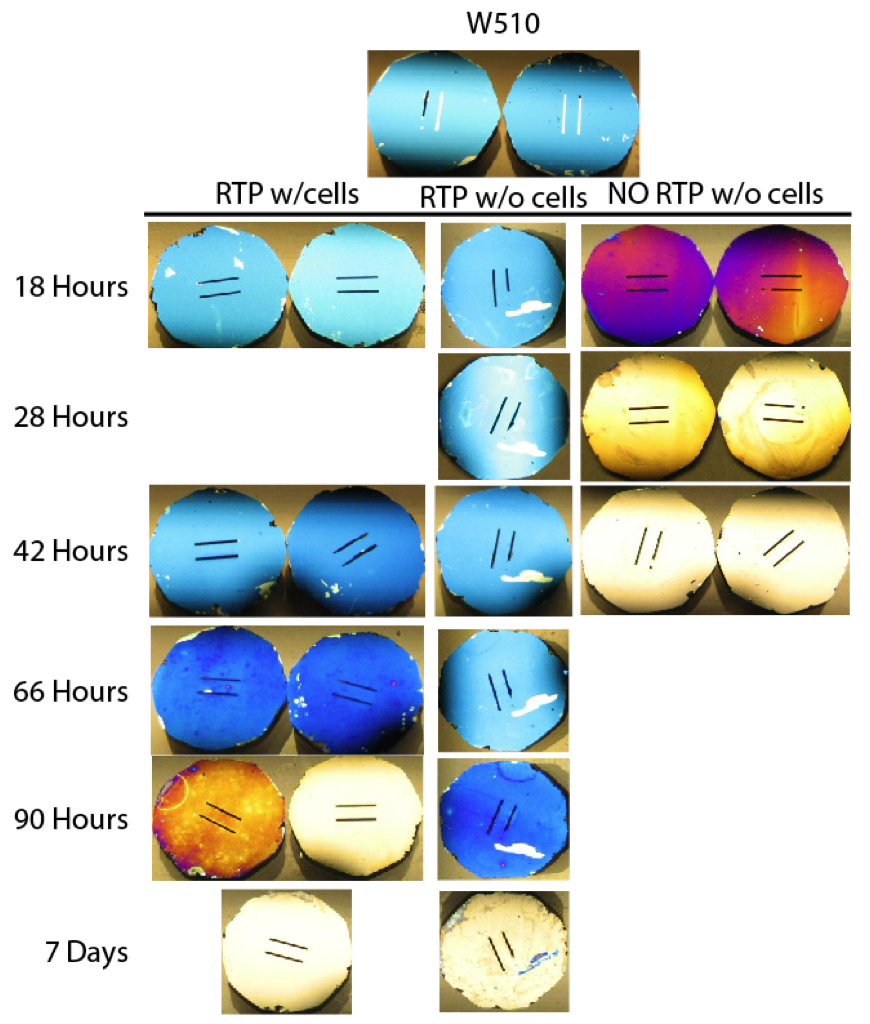
Discoloration was also assessed at each time point. RTP samples with cells discolored earlier than RTP samples without cells. This may be due to cells secreting waste products which accelerates discoloration.
FYI there was an error in the legend of the graph which is now fixed.
Have we made any progress in developing ways to study cell growth on the actual membranes? Or have we been seeing cells on the membranes all along? I can’t tell because all the images that I see are dried samples with broken membranes.
Do the membranes always break when the substrate reaches a certain color? Whether the membranes are intact is actually more important than the color. Didn’t we discuss getting reflective optics, so we can actually see the membranes when they are under water? I suppose Brian’s scope can be used, but it’s a little inconvenient…
Chris, we haven’t been growing cells on the actual membrane, considering the fact that they grow pretty well on the wafer chips and the surface is same as the membrane itself. We just wanted to make sure that the cells like the surface and now that its evident that they grow well, we could go ahead and grow cells on the actual membrane.
Yes, the membranes break when the substrate discolors to a yellowish looking color.
Till now we check the discoloration by taking the membranes out, washing and drying them with ethanol/water. Keeping the membranes intact while monitoring the discoloration is difficult.