Wetting Nanochannels
Jim’s post inspired me to think about wetting of nanochannels. We raised this question before – Do we wet the channel in our membrane when water is applied to only one side? My guess was yes because of our success in diffusion and convection when we expose both sides of the membrane to water.
The equation for pressure difference across a meniscus in a capillary is the familiar surface tension equation:
The radius of the “bubble” in a capillary is dependent on the contact angle theta:
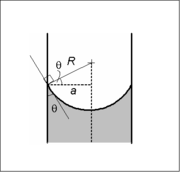
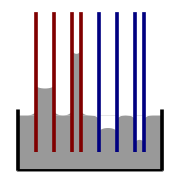
Capillary pressure is balanced by height or gravity. If the contact angle is less than 90 as shown in the above image, the water will be pulled upwards against gravity. If the contact angle is greater than 90 deg, then the water will go below the surrounding water height.
The equation for this is:
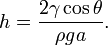
If we use a radius of 14nm (d=28nm) as Jim did, the water would be drawn up against gravity based on the contact angles as follows:
h=18 meters (89 deg)
h=721 meters (45 deg)
you get the idea…
If the radius was a more typical 1mm glass capillary:
h=0.01m (or 10mm) (45 deg)
This theory suggests that the degree of hydrophilicity does not matter as long as the contact angle is sufficiently below 90 deg.
If you want more details, check out the wiki page on the Young-Laplace equation
So … the last two posts fit together nicely. They suggest that in a wet/dry configuration we are filling the pores and then stopping even with pressure because it is too hard to blow bubbles out the other side. I’m still unclear why the water can’t simply spread along the backside to eliminate the bubble geometry. Hopefully our work with Alan Grossfield will yield some insights on that.