Phase Contrast Microscopy Image Correction for Neutrophil Transmigration Studies
Introduction
Selective leukocyte interactions with endothelial barriers are a characteristic component of the inflammatory response process. These spatio-temporal interactions can mechanically remodel local tissue, as well as damage healthy tissue with robust inflammation stemming from an over-reactive immune response. This is evident in many pathologies and can complicate severe conditions such as sepsis. Thus, it is paramount to understand how leukocytes interface with endothelium in the escalation of immune responses. To this end our lab continues to develop more physiological vascular barrier models, using phase-contrast microscopy as a means of analyzing leukocyte movement and transmigration on these systems.
Live phase-contrast microscopy can be subject to vignette effects (as well as variable brightness over time), however (Figure 1).
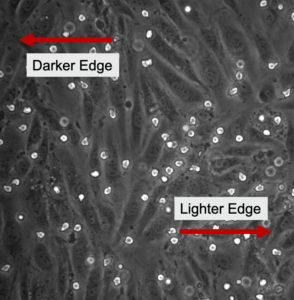
For casual observation this is a non issue but for automated analysis protocols these variabilities add a layer of uncertainty to the analysis. More specifically, contrast abnormalities make it difficult to utilize semantic segmentation techniques through machine learning and computer vision techniques, noting that a vignette effect solicits erroneous detections with machine learning models (described in another post).
Methods and Discussion
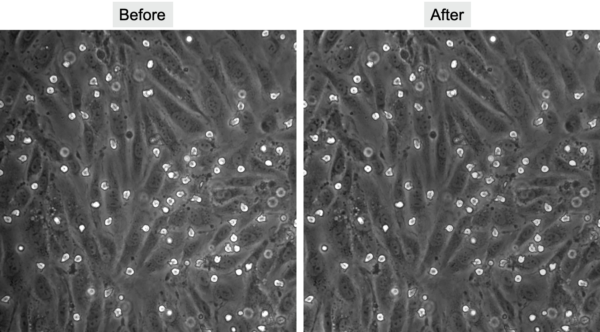
Correcting for overemphasized phase dark class predictions typically results in a loss of phase dark detections, necessitating a frame specific brightness equalization process before classifying a video (Figure 2). This was done with a built in function in Wolfram Mathematica.

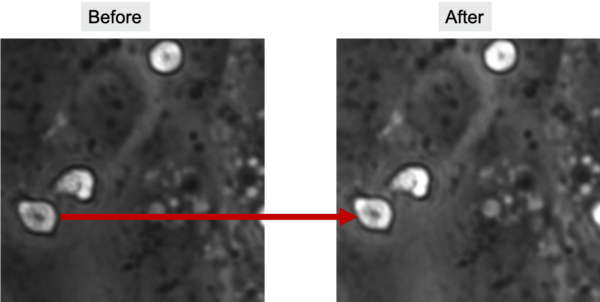
Brightness equalization fixes vignetting in a frame (Figure 3), allowing for proper assessment of cells that would have been misclassified otherwise (Figure 4).
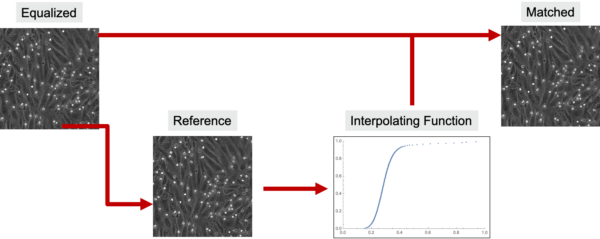
Variable brightness over time in a video can be corrected as well. Wolfram Mathematica has a built in histogram matching function that can be used to mitigate brightness shifts in a video, and this was used in order to account for this factor (Figure 5). Note: the first frame of each video was used as the brightness reference point.
The final result can be viewed here for the “Positive Control” condition: mod_PositiveControl_2
For reference, the original video can be viewed here: PositiveControl_2
Note: compression is used to make these videos fit on WordPress. At full resolution, the differences are more obvious.
Conclusion
Here we demonstrate a simple technique for video brightness correction on a per frame and per video basis. These corrections were necessary for increasing the accuracy of machine learning models applied to the video for semantic segmentation. There are some contrast aberrations created in the video that occur as a result of this process, however. These are rare, and may be corrected in the near future by usage of a new microscope.