
Soluble GO Hemolysis and NTA
For this post, Henry and I collected data for hemolysis and NTA sizing of soluble graphene oxide (GO).
Hemolysis–
prior work on the hemolysis testing of immobilized GO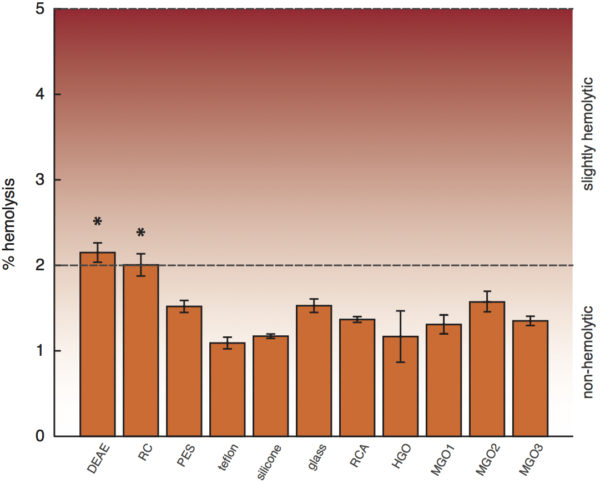
The purpose of the hemolysis experiment was to confirm that immobilized GO is the preferred from of GO for use in a portable hemodialysis machine. It is important that the GO does not cause cell lysis when coming into contact with a patient’s blood. Therefore, our goal was to determine how much lysis the soluble GO samples would cause. We achieved this by first finding the hemoglobin count (Hb) of our samples, and then plugging into the appropriate equation to solve for the percent hemolysis.
Our samples were as follows (in triplicate):
- 5 different GO/blood concentrations, starting at 100 ug/mL and decreasing by a factor of 10 (100, 10, 1.0, 0.1, 0.01 ug/mL)
- 5 background samples of GO and water matching the above concentrations
- 100% lysis
- no lysis
- vehicle control (1:10 water in blood)
The background samples were plated with the GO/blood samples to ensure that the GO/water solution did not have a lot of absorbance and was not affecting the spectrophotometer reading. Our vehicle control allowed us to see if the DI water that the GO was diluted with would cause significant lysis.
First, all of these samples were incubated at 37 degrees Celsius for an hour. Once removed, all of the samples were centrifuged at 500g for 20 minutes. This separated the red blood cells from the plasma. The top 200 uL of plasma was collected and placed in new tubes, being centrifuged again at 3,000g for 10 minutes. The top 100 uL was collected and placed in a 96-well plate. A spectrophotometer read the absorbance of each sample at three wavelengths: 576.5, 560, and 593. These values were plugged into the following equation to find Hb, where A is the absorbance at different wavelengths (as specified).
Hb = 177.6 * [A576.5-(A560+A593)/2]
These values were then plugged into the following equation to solve for percent hemolysis, where T is the average Hb of the 100% lysed sample, B is the average Hb of the no lysis sample, and S is the average Hb of our individual GO/blood concentrations. Our results can be seen in the first figure below.
% hemolysis = (S-B)/(T-B) * 100
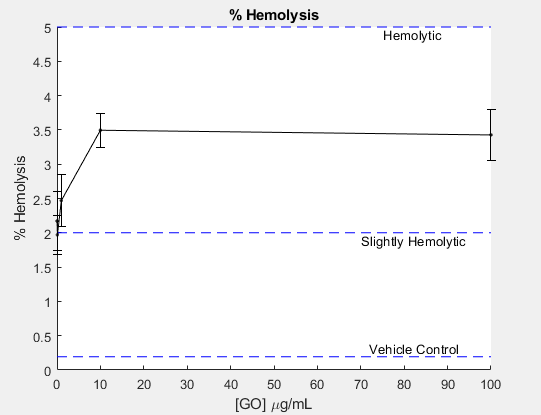
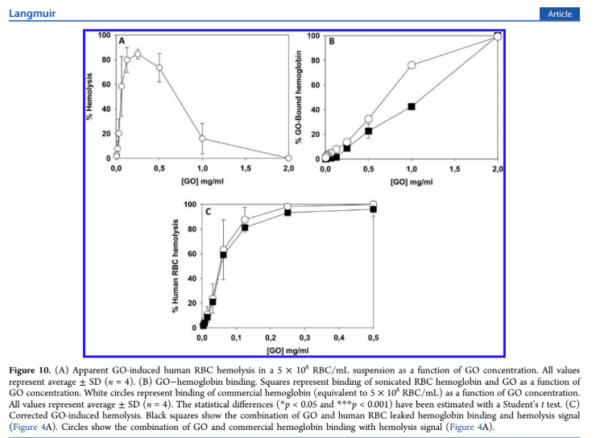
None of our samples were completely hemolytic, though higher concentrations were still above the slightly hemolytic line. From this we can conclude that higher concentrations of GO are more hemolytic than smaller concentrations. Our results do not match those done by Monasterio et al (third graph), as their results are overall much higher than ours (1). For example, they found a concentration of 0.1 mg/mL would result in roughly 60% hemolysis, whereas our results only show around 3.5% hemolysis for 0.1 mg/mL (100 ug/mL). We believe our percentages are lower because the “no lysis” sample had actually lysed a considerable amount, causing a shift.
NTA —
The initial purpose of the NTA experiment was to determine the size of GO particles in solution for different sonication times, as it was previously unknown. It was also used to study how different sonication times varied from each other by examining the particle counts for different concentrations. We tested three sonication times: 10 minutes, 60 minutes, and 4 hours.
Soluble GO was diluted 1:100 in PBS and then diluted further by factors of 10 for a total of four samples per sonication time (1:100, 1:1,000, 1:10,000, and 1:100,000). Each of these were analyzed using NTA. Particle sizes mostly ranged from about 180nm to 240nm. Due to the way the NTA collects it’s sizes, these numbers may not be accurate. More importantly, we gained information about the particle counts for each sonication time (below).
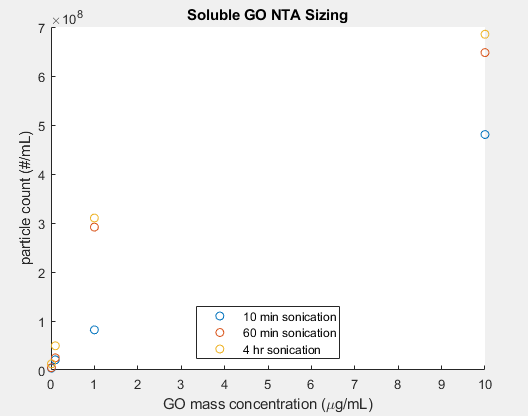
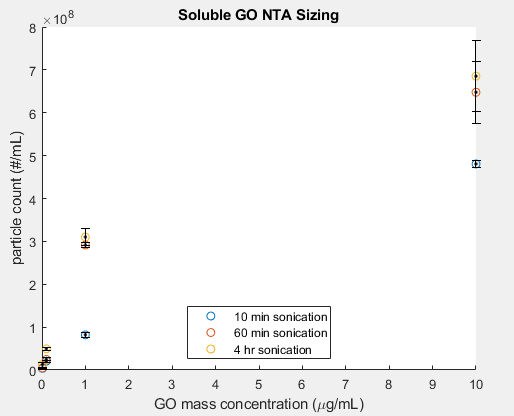
Our results show that longer sonication times (60 min and 4 hr) do not show a significant increase in particle counts. This makes sense, as sonication can only fraction the sample by so much. As time increases, the sound waves are only breaking remaining particles that have not yet been fractionated. Therefore, there will not be as drastic of an increase for larger blocks of time. This study was purely for exploratory reasons, but in the future we would like to focus on a smaller range and look at it more closely (perhaps a 1:2, 1:5, and 1:10 dilution).
Shear stress —
For our next post, we hope to create a device to test the effect of shear stress on our hemolysis study. The device would consist of different channels that we could pump blood through. The following equation was used to find the shear stress, where u = the viscosity of water, Q = flow rate, w = width of the channel, and h = height of the channel.
shear stress = (6*u*Q)/(w*h^2)
A flow rate of 1 uL/min will be used, as well as a width of 1mm and a height of 110 um. This will be conducted at room temperature with an approximate water viscosity of 8.9E-4 Pa*s. This results in a shear stress of 0.7355 Pa. This number is comparable to the human brachial and femoral arteries, which are roughly 0.5 Pa (2).
Our initial idea was to pump PBS through the system and then add it to blood to see how it affects lysis. After discussing further, we thought it may be worthwhile to simply pump blood through the system and test this blood directly. Another potential idea is creating four different channels and pumping blood through each of them at different flow rates. We are unsure of how feasible this is, as the pump may not be able to run all four channels at different flow rates.
References:
(1) Monasterio, B. G.; Alonso, B.; Sot, J.; García-Arribas, A. B.; Gil-Cartón, D.; Valle, M.; Zurutuza, A.; Goñi, F. M. Coating Graphene Oxide with Lipid Bilayers Greatly Decreases Its Hemolytic Properties. Langmuir 2017, 33 (33), 8181–8191 DOI: 10.1021/acs.langmuir.7b01552.
(2) Reneman, Robert S., and Arnold P. G. Hoeks. “Wall Shear Stress as Measured in Vivo: Consequences for the Design of the Arterial System.” Medical & Biological Engineering & Computing, vol. 46, no. 5, 2008, pp. 499–507., doi:10.1007/s11517-008-0330-2.