Optimizing Urea Clearance via Flow Rate
In my previous post, our urea clearance for the single pass experiments was found to be ~140 ml/min/m^2, which was similar to Fissell/Roy’s value except we used a flow rate of 1uL/min whereas they used a flow rate of 10 ml/min however. To show that we could achieve even greater clearance values than their group we performed our single pass experiments with increasing flow rates (10, 50, 100, 1000, 2000, 4000 uL/min). This was done initially without serum and then with serum (to be continued).
The same volume of analyte (360 uL) and dialysate (720 uL) was passed over the membrane in counterflow. The time of collection per sample changed from one hour, to 6 minutes, to 0.6 minutes, so on and so forth. The dialysate was always set at double the flow rate of the analyte to minimize ultrafiltration. As was done before for the single pass results, the sample corresponding to the last time point (S6) was normalized to the initial time point sample (S1) because this volume of fluid was not yet dialyzed. This normalized value was used as the fractional loss and the same formula (clearance = (flow rate*fractional loss)/membrane ) was used to find clearance (Figure 1).
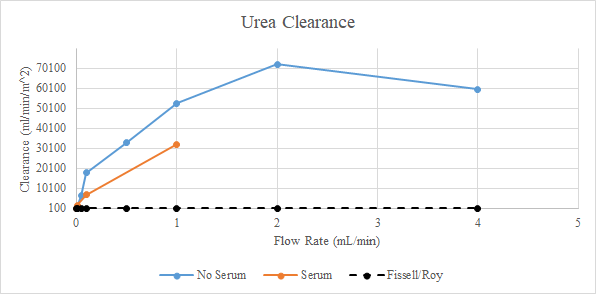 Figure 1.
Our levels of clearance are magnitudes larger than Fissell/Roy’s and seems to be optimized around 60,000 ml/min/m^2. Serum data is not quite finished but seems to follow the curve of the non-serum data.
In order to ensure that no ultrafiltration or backflow occurred, the dialysate was run at double the flow rate of the analyte and the samples were weighed after collection, including the centrifuge tubes in which they were collected (Figure 2).
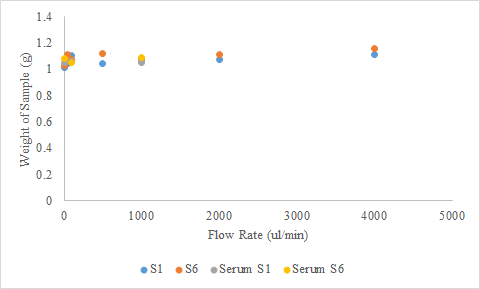 figure 2
The weight of the samples did not deviate as the flow rates increased, providing some evidence that backflow did not occur. Future studies will determine the pressure gradients across the membrane, on the analyte, and on the dialysate side to see if there could be any pressure effects causing ultrafiltration or backflow.
Can you update this post with protocol details. You are changing the time of collection with each flow rate to get the same volume, right? Do you clear the early volumes as these are not yet dialyzed (per the low flow rate curves you published last time)?
A mL of water weighs 1 g. Did you weight the test tube too?