Exosome Scale Experiments
Hello Everyone,
I have been working with Track Etched membranes since last year and we always had problems with leaking and also not being able to push the flow through the membrane. At the end of the summer, i decided to test my new idea for my devices and finally i have a system which is sealed and we are also able to push the flow through the membrane.
New Device:
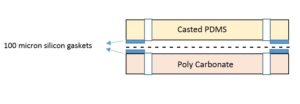
This device is reusable and i has basically 2 parts: first, the bottom piece which is a poly carbonate piece bonded to 100 micron silicon gasket as the channel and the second is the top piece which is a casted PDMS piece bonded to 100 micron gasket. You can see the schematic of my system in the figure 1 showing the membrane sandwiched between top and bottom parts. Here are some of important points about this design:
- Reusable, and easy to fabricate
- The system is clamped to be sealed.
- whole sheet of membrane is used to decrease the chance of leaking in z direction.
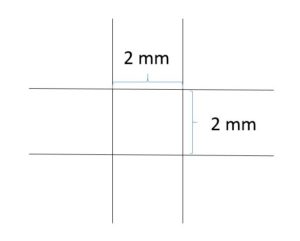
- Plus sign design in the system, so the interaction area would be defined by the width of the channels (2 mm * 2 mm)
- It is capable of pushing the flow through the membrane and pulling from the top channel.
- Pumping the flow to the bottom channel from bottom.
Experiments:
I have been running some experiments using 100 nm beads over 80 nm pore size of TC membranes. In this experiment, i imaged different stages of the interaction area but my focus was on edges and borders, because i wanted to have 2 regions in my image which one of them is inside the interaction are with the transmembrane pressure applied on it, and the other one was out of the interaction area with no transmembrane pressure which can be considered as the background signal and non-specific absorption of beads.
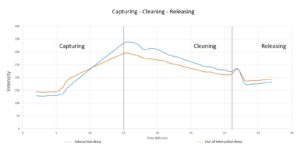
Capturing step: Pushing by 5 microliter/min in the bottom channel and pulling by 2 microliter/min from the top channel. in this step, an increase in the signal intensity over time is expected in this step. The signal is sum of captured beads on the pores, non-specific absorption of beads and floating beads. (Captured + Non-Specific + Floating)
Cleaning Step: Pushing DI water with 5 microliter/min in the bottom channel while the top channel is clamped, decreasing in the signal intensity is expected because all the floating or not captured beads are going to be washed away. (Captured + Non-Specific)
Releasing Step: Pushing the flow from the top channel through the membrane to the bottom channel by 4 microliter/min. In this step, all the captured beads would be released and after the releasing, the signal is from the beads that are non-specifically absorbed.
Results:
Here you see 2 different stages of the interaction area, the first one is at the beginning and the second one is the end of the interaction area.

Stage 1:
Stage 2:
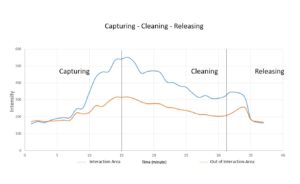
- Capturing of interaction area is with higher slope that out of interaction area meaning that transmembrane pressure would help us to capture beads.
- The signal in the capturing step: Captured + Floating + Non-Specific
- Cleaning step, gradual decrease in the intensity showing floating beads are washed away.
- After cleaning step, the signal: Captured + Non-specific
- Assuming that we are able to release all the captured beads, after releasing step, the signal is just from non-specific absorption.
- Table below shows the percentage of different signals including captured, floating and non-specific.

Thank you!