
Dead End Filtration of a Model Exosome System
In trying to determine the best conditions for capturing exosomes, one of the important questions that we have is what produces the case where exosomes are caught directly in the pores, not on top, but flush with the surface. This should be the size where the particles are almost exactly the size of the pores, as smaller particles will pass through and larger particles will be rejected. Additionally, we are interested if the particles will be captured with straight through pores or if the bowl with hole geometry is necessary for capture. What this experiment sought to ultimately show was that for a large range of particles, the bowl with hole structure was necessary to capture multiple sizes, while a straight through pore will only select for the particles closest in size to the pores.
I used dead end filtration in this experiment because it was the simplest system and might ultimately be a way in which we try to capture exosomes. (If we have a purified fraction, this would be a way to capture them on the membrane for further analysis, as it would be simpler than tangential flow.) For this analysis, I used SepCon 5 slit chips with 50.7 nm pores and 15% porosity. Then I chose 4 sizes of nanoparticles: 30 nm, 40 nm, 50 nm and 60 nm. The theory was that the smaller particles should pass through, and only the ones the size of the pores would be retained. The larger particles should be retained on the top of the pores. Figures 1-4 show the results of these spins.

Figure 1: 30 nm gold nanoparticles after spinning at 2500 rpm for 5 minutes.

Figure 2: 40 nm gold nanoparticles after spinning at 2500 rpm for 5 minutes

Figure 3: 50 nm gold nanoparticles after spinning at 2500 rpm for 5 minutes
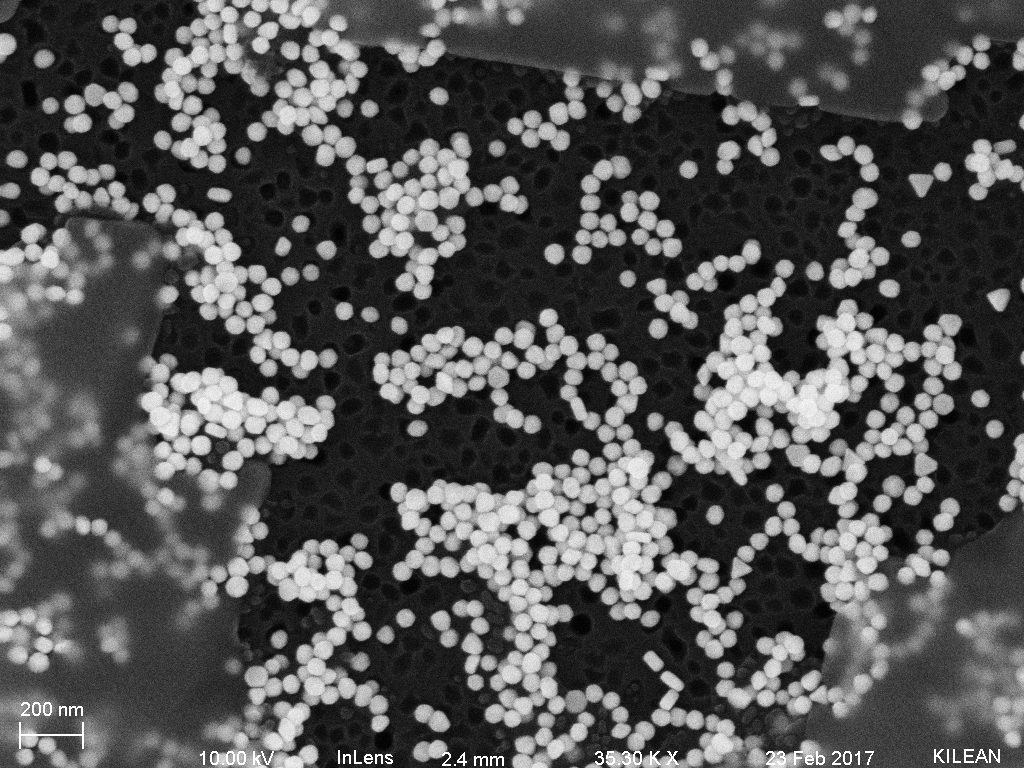
Figure 4: 60 nm gold nanoparticles after spinning at 2500 rpm for 5 minutes
As we can see, particles approaching the size of the pores are have the potential to be retained in the pores, but larger particles are rejected. Smaller particles pass through the pores, but there is some that are retained. The next set of experiments involve repeating this process in a tangential flow system.