Sacrificial releasing layer and SU-8, plans
This post summarizes a quick update on 2 different goals: 1) membrane releasing and 2) SU-8 strain reduction. Here you will find basic background on some of the work that has already been conducted and the planned experimental work that will be conducted in conjunction with Bob Carter and Cody Soule (Co-op student).
1. ZnO as sacrificial layer
As a background, described here are two reports from the literature.
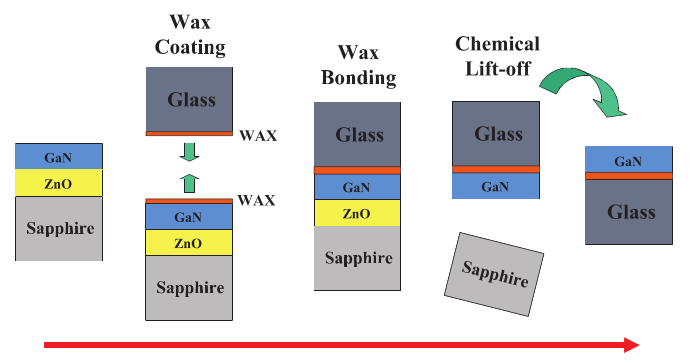
The figure below corresponds to he process developed by Rajan et al. and reported in 2016 (Journal of Physics D: Applied Physics) for the release and transfer of a gallium nitride (GaN) flm grown by metal organic vapor phase epitaxy. The ZnO film was deposited on a sapphire substrate by pulsed laser deposition. After GaN growth a wax layer was used to “sandwich” the GaN with a glass substrate. The chemical lift-off was conducted in a 0.1M HCl solution. Finally the GaN is released from the ZnO while still being attached to the glass substrate.
Another example is the work reported by Sang et al. in 2015 (Materials Letters), interestingly the ZnO is also deposited by PLD. An indium tin oxide (ITO) layer is deposited on top and then the ITO nanowires are grown by vapor transport method. The ZnO is etched in a NaOH solution and the ITO nanowires are released from the Si substrate and transferred on to a PET substrate.

In our lab, we started growing ZnO by the sol-gel route which is a very well studied and versatile method. We have successfully deposited films on glass from a ZnO sol-gel precursor solution. The precursor solution is prepared from Zinc acetate dihydrate, isopropyl alcohol and ethanolamine. The deposition method used was dip-coating with the following sophisticated tool:
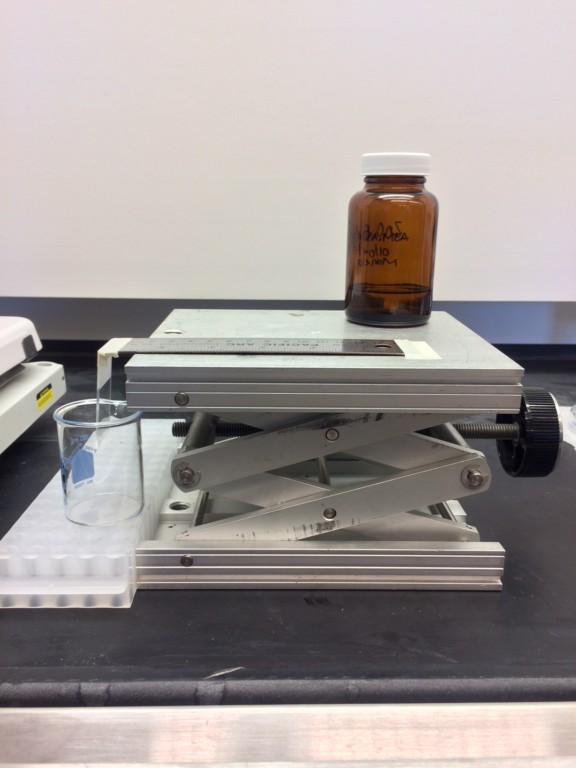
The total immersion time is 10 seconds with an extraction time of 45 seconds, resulting in a thin uniform film as seen in the picture (right side of the glass slide).
This very simple process allowed us to deposit some films to test the etch/release by using a piece of tape cut into a triangle. Three samples were evaluated: tape on glass/ZnO in 40umM HCL and tape on glass/ZnO in DIW. The exposed ZnO was completely etched in less than a 1min and after 7 hrs the tape on ZnO-side in HCl started showing very smalls signs of release. After 72hrs the samples were sonicated for 1min and the tape was finally released.
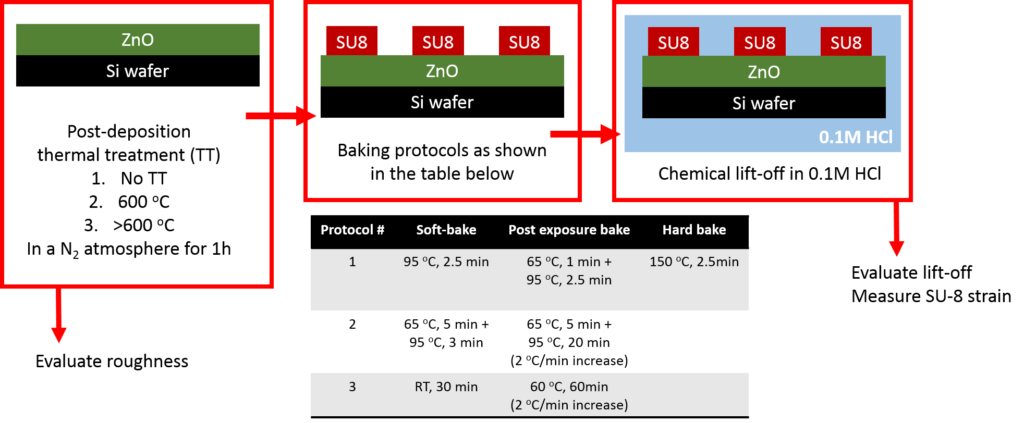
The next step is to transfer the ZnO deposition process to spin-coating (cleanroom) and deposit a film on top of the ZnO to better test the etch/release. Furthermore, the ZnO will be integrated as the sacrificial layer in the SiO2 microporous membrane process, hence it needs to be exposed to the same thermal budget including SiO2 deposition temperature and post-deposition annealing (600C in N2 for 1h). It is well known that crystalline ZnO, preferentially oriented along the c-axis exhibits higher roughness than amorphous or polycrystalline ZnO; hence the effect of the thermal budget over the roughness will be evaluated.
2. Reducing strain in SU-8 grid
It has been concluded that membrane wrinkling observed is partly caused by tensile stress in the SU-8 grid which causes it to shrink when released. Some efforts have already been conducted to minimize this effect by controlling the soft, post-exposure, and hard bake;we will continue this study.
Thermal treatment has a significant effect over the polymerization and ultimately the stress. Elevated temperatures (80-100C) after exposure (post-exposure bake) improves the cross-linking; the fast polymerization and solvent evaporation lead to densification which causes the SU-8 to shrink. This is also influenced by the coefficient of thermal expansion of the materials involved and their mismatch.
Several reports have studied the baking protocols used for SU-8, evaluating the lowest temperature possible for stress reduction. Three different baking protocols are described in the table below, #1 corresponds to the baseline already used and 2-3 have been reported in the literature to successfully minimize the SU-8 stress. Additionally, it has been reported by Jiguet et al. in 2006 (Microelectronic Engineering) the use of silica nanoparticles (12 nm) embedded in SU-8 to reduce the coefficient of thermal expansion from 50 to 25 ppm/C approximately. We will keep this as a future approach that could be implemented if needed.
The plan
We are planning an experiment that will allow the evaluation of ZnO as sacrificial layer by testing the release of an SU-8 grid. This experiment serves as a good test of the etching/releasing through the ZnO sacrificial layer since the SU-8 grid maximizes ZnO surface exposure to the etch. Furthermore, the baking steps in the SU-8 process will be varied as well and the strain will be evaluated.