
Ultrathin Freestanding Nafion Membrane
Utilizing a cation-exchange membrane like Nafion makes it possible to electrically induce the concentration difference across the membrane. The resulting osmosis of water augments the overall flowrate in addition to the electroosmosis. The thinner the membrane, the stronger the osmotic flow is induced electrically. This behavior can be predicted from the conventional transport model for cation-exchange membrane,
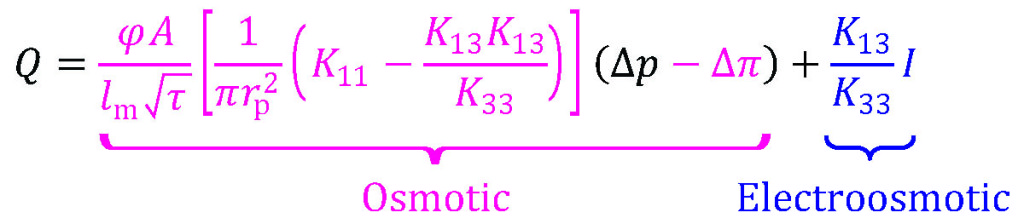
where K coefficients represents the transport properties of the Nafion and the other symbols are
| Q | Volumetric flowrate |
| Δp | Hydrostatic pressure differential |
| Δπ | Osmotic pressure differential |
| I | Current |
| A | Area of membrane |
| lm | Thickness of membrane |
| rp | Average pore radius |
| φ | Porosity |
| τ | Pore tortuosity |
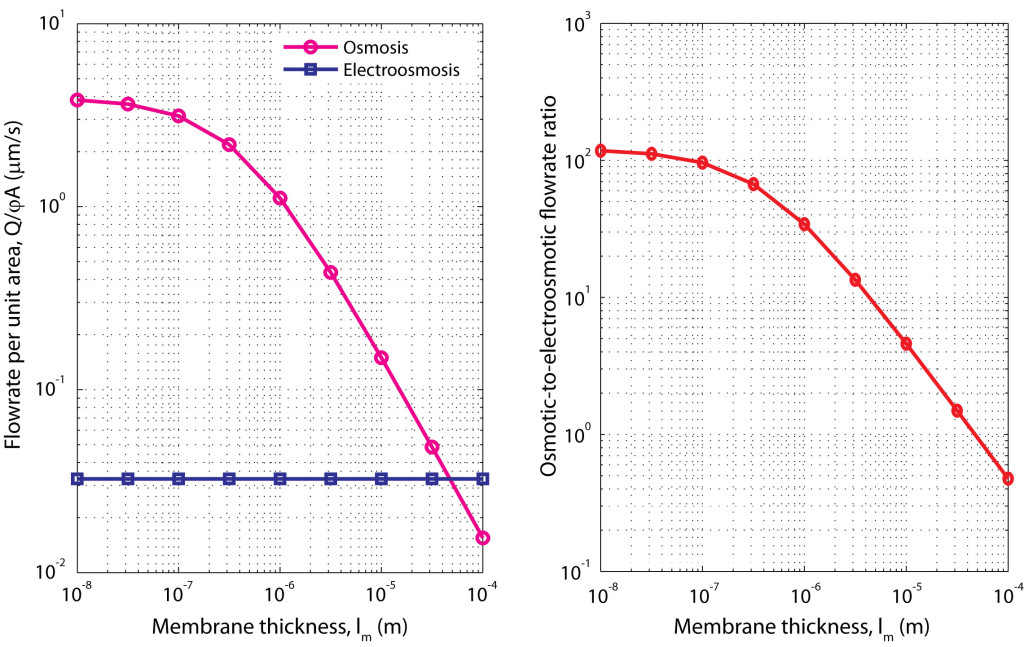
For a given applied current, the flowrate per unit area contributed by the osmosis is increasing as the membrane becomes thinner; the flowrate could be two orders of magnitude higher than that of the electroosmosis.
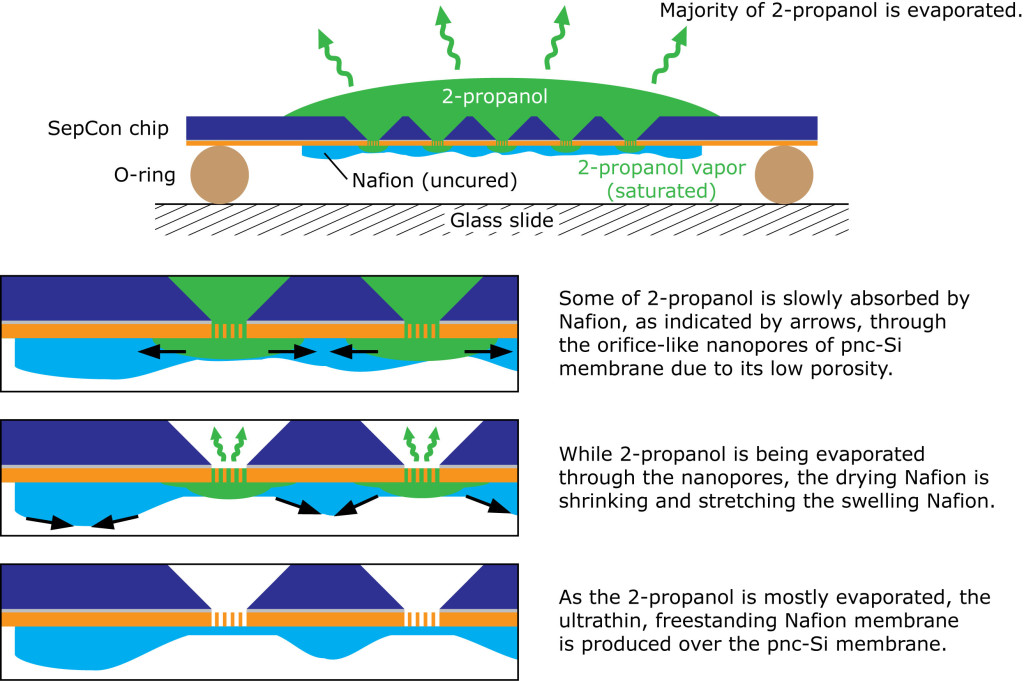
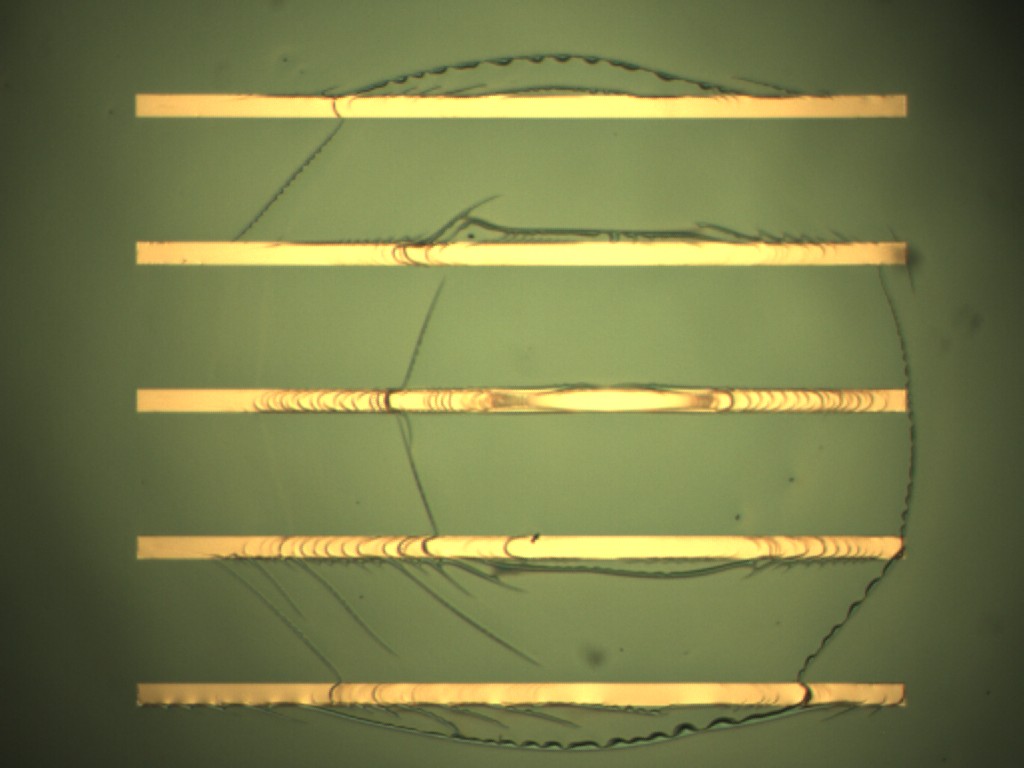
The ultrathin freestanding Nafion membrane can be made by the method called “localized stretch.” The process starts with puddle casting the dispersion of dissolved Nafion resin over an ultrathin porous support and then relaxing the Nafion membrane by adding the solvent from the other side of the support.
 |
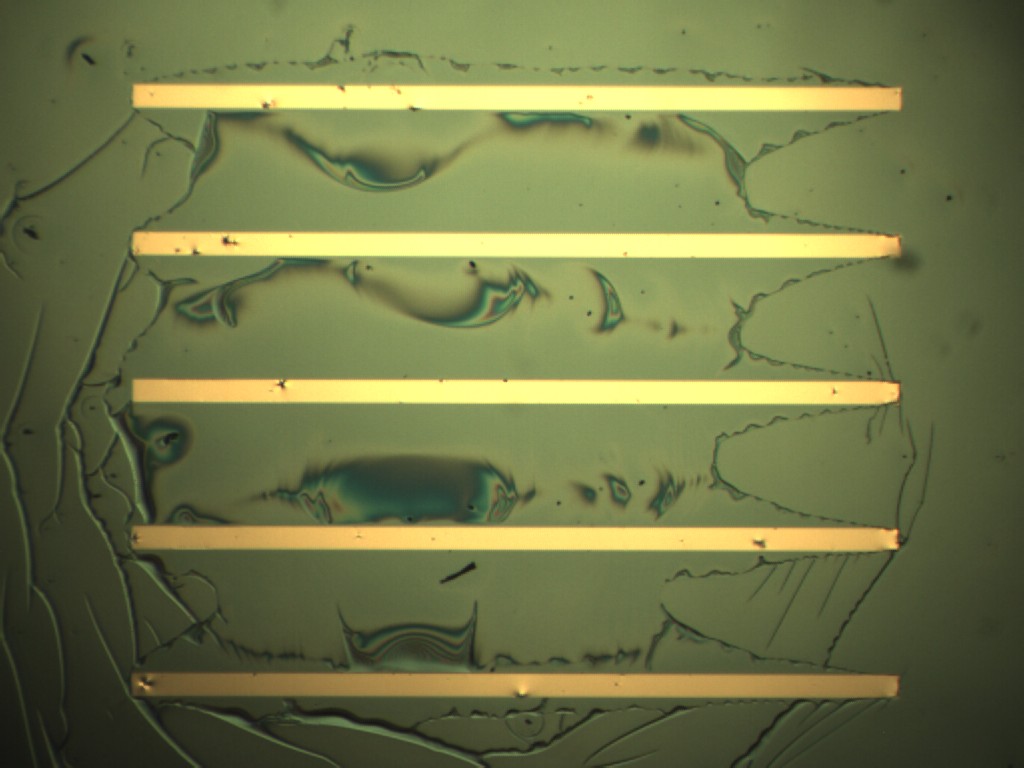 |
| Initially thick Nafion film by puddle cast | Stretched Nafion film after relaxing from the back side |
 |
 |
| Initially thin Nafion film by puddle cast | Stretched Nafion film after relaxing from the back side |
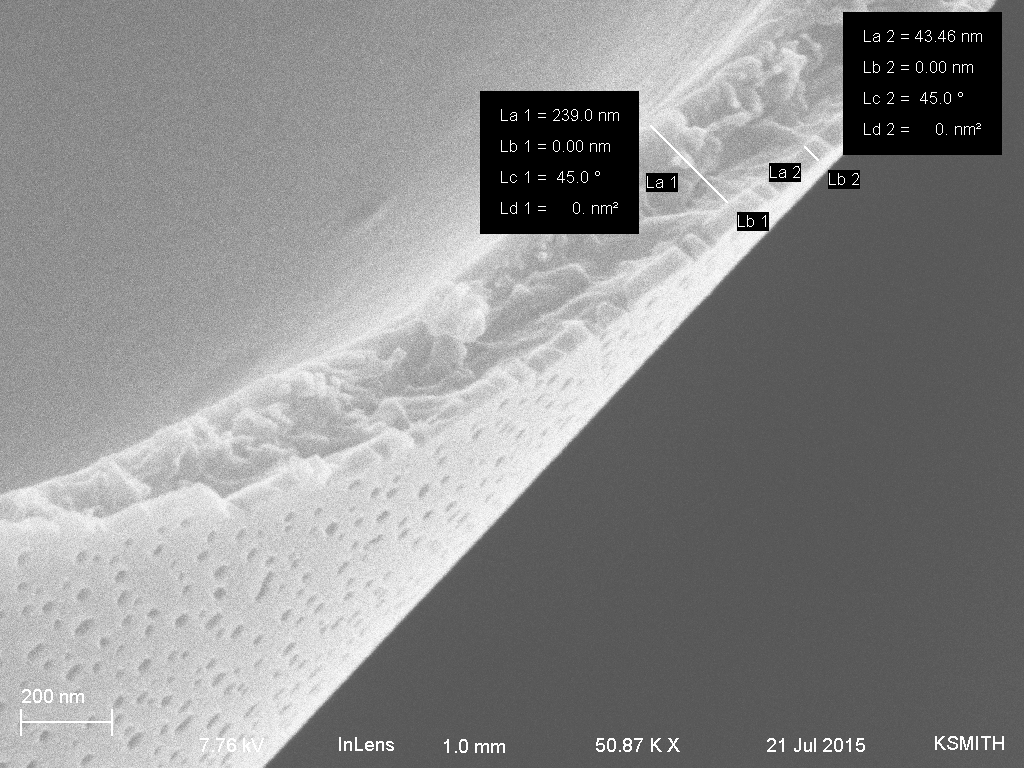 |
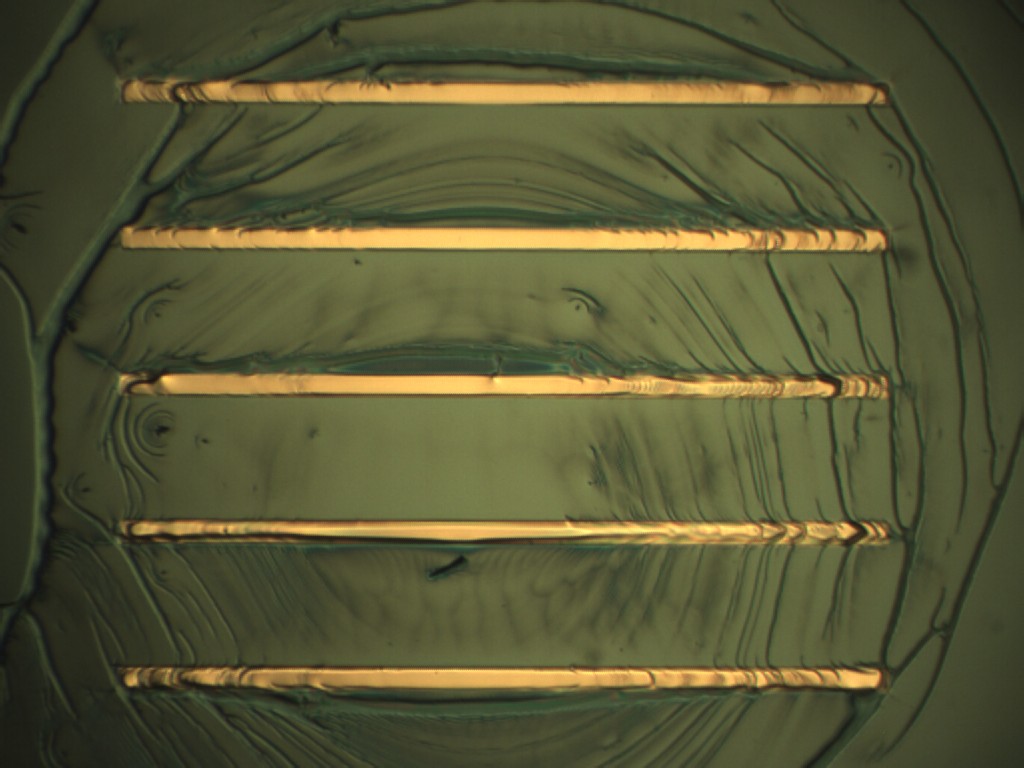
| SEM image of Nafion membrane made by the localized stretch method over a 40nm-thick porous SiN support (SEM image by Karl Smith) |
Comparing to the traditional method, the ultrathin freestanding membrane (30 – 200 nm) is synthesized using the in situ interfacial polymerization over a thick porous support (> 1 µm). This method is adopted for the synthesis of the reverse osmosis (RO) membrane from the aromatic polyamide. This method, however, is limited to the polymer that can be synthesized by cross-linking the monomers; it cannot be used for the dispersion of the dissolved resin like Nafion.

Interestingly, the interfacial polymerization could be beneficial for making the ultrathin membrane over the ultrathin support. It is promising that the cross-linked polymer could envelop the ultrathin support, using the support as its backbone to enhance its durability. The thinner and stronger could make the low-pressure RO feasible.
