
Biofiltration – The Stirred Cell Edition
Introduction:
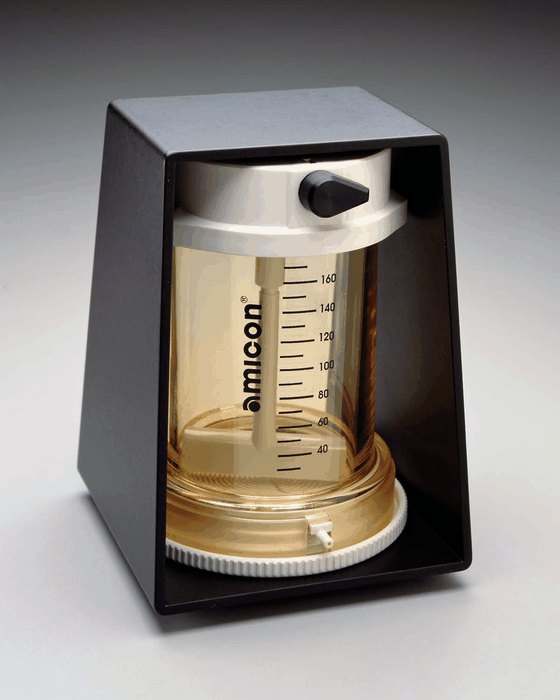
The lab purchased an Amicon 8010 Stirred Cell which has a 25mm diameter for membranes and holds 10mL of solution. The device works by placing the solution into the cell, pressurizing the system at 8-10 psi, and creates stirring via an elevated stir bar and the stir platform. This type of filtration system was chosen to compare the lift off membrane’s properties with those of commercially available filtration membranes. The advantage of this system is that the stirring should hypothetically prevent caking of proteins/nanoparticles/anything on the membrane. Preliminary studies have ensued.
Experiments:
To begin understanding the stirred cell, basic experiments were conducted with three different membranes and three gold nanoparticles sizes, as well as BSA. All concentrations were determined using spectrophotometry and calculations for previously for each of the solution types. Particles were run in order of each table for each experiment. BSA has an approximate size of 4nm x 15nm, the gold nanoparticles have stated diameters.
For experiment 1, I was still a new operator and am unsure as to if the membrane was placed into the system securely. It was noted that the flow rate of the system was much higher than those of experiments 2 and 3 which leads me to believe it was set up incorrectly. The largest particles were also run before the smallest and the membrane appeared to be clogged which may have led to the low sieving coefficient values for 5nm gold.
Experiments 2 and 3 appeared to run well. No clogging was noted with the membranes and flow rates appeared approximately the same for all trials.

Discussion & Next Steps:
The sieving coefficient appears to increase with pore size which was expected. The 15nm gold may have aggregated or been blocked from moving through the larger pore sizes, although the exact reason they did not move through is unknown.
Comparison of the lift off membranes with 100kDa ultrafiltration membranes will be carried out next using protocols similar to those of Andrew Zydney and his group who have characterized membrane flux using stirred cells and BSA.