
Simple Sieving Results
I used the following parameters in the Simple Sieving Model (pardon the MATLAB syntax)
- Am = 1; %cross sectional area in cm^2
- Do = 1*10^-7;% diffusion coefficient in the membrane in cm^2/sec
- P = .15;% membrane porosity;
- t = linspace(0,420,500); %time vector sec
- Qo = 1*0.00166; %militers per second (0.00166 = 10 ul/min)
- L = 15*10^-7; %membrane dimension in cm
- Starting volumes are 1 ml for top chamber and 0 for bottom chamber
- C* = 0.5; %(scaling concentration for flow rate decay)
first for a λ (molecule to pore size ratio) = 0.1 … 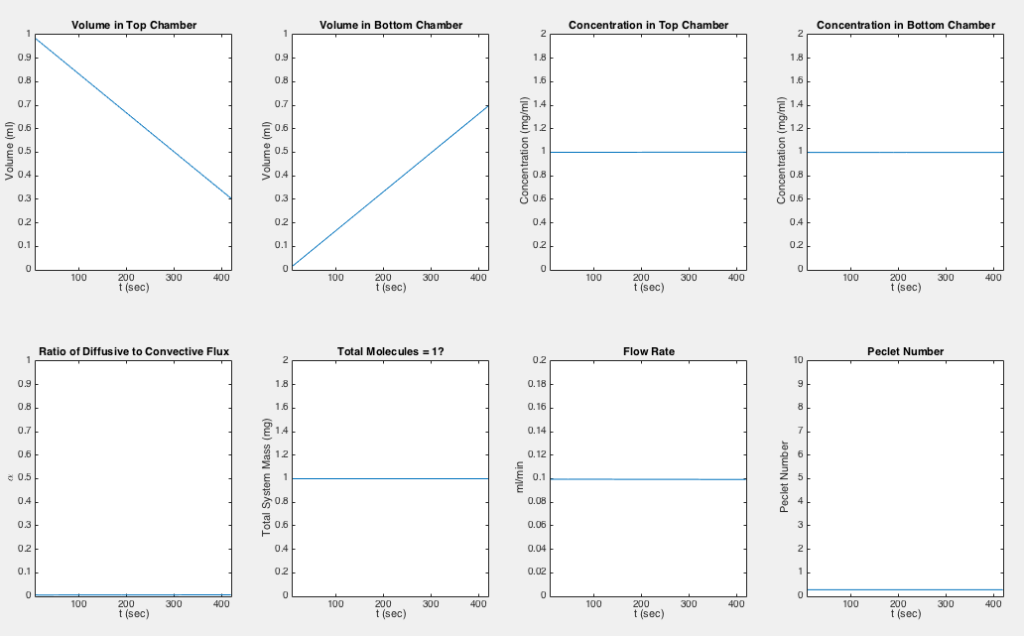
then for λ = 0.8 … 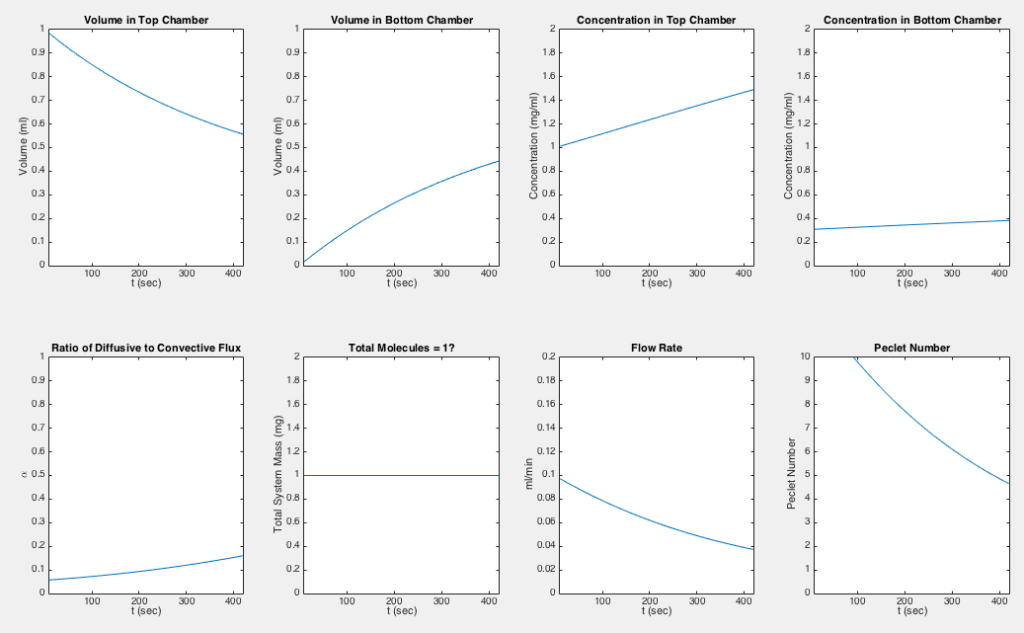
The first two panels of the top row shows the transfer of volume from the top to bottom chambers over about 5 minutes of flow, and the next two panels monitor the concentration in the top and bottom chamber. For the smaller molecule the volume transfer is steady and there is no build-up of species in the top chamber because there is no rejection at the membrane. For the larger molecule however, the flow is clearly slowing and as the solute builds up behind the membrane.
In the bottom row I’ve first plotted the ratio of transport by diffusion vs. convection. The figure shows that diffusion becomes important for the larger molecule as the slow flows. This makes sense because convection is slowed by the increased concentration behind the membrane while diffusion is actually boosted (due to a stronger gradient). This is the heart of the premise that thinner membranes should give a sharper cut-off: they promote diffusion and therefore fight the reduction in solute transfer very near the cut-off where convection takes a hit. The second panel on the bottom row is just a check on mass conservation.
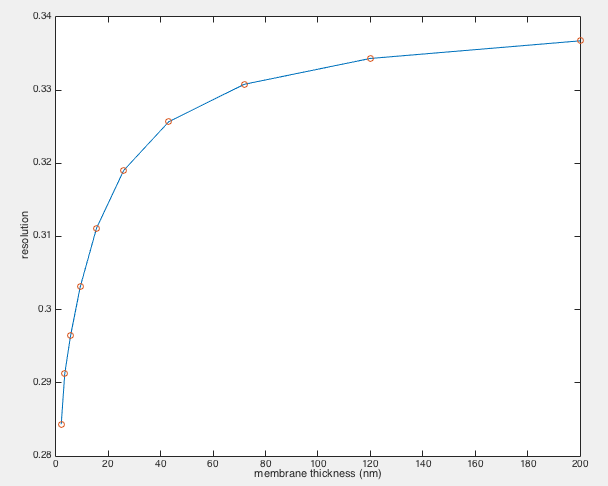
The ability of diffusion to boost transport near the membrane cut-off suggests that thinner membranes should have a steeper sieving curve. Simulations of separations with membranes ranging from 200 nm to 2 nm do show this trend …

Defining the ‘resolution’ as the difference in (normalized) size between 20% transmission and 80% transmission, we see the resolution improve for thinner membranes.
The effective membrane cut-off (the mid point between the 80% and 20% transmission) also inches closer to the true physical cut-off (= 1 in this model) as the membrane gets thinner.
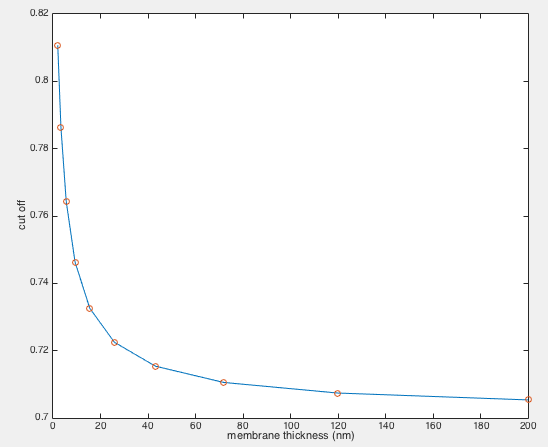
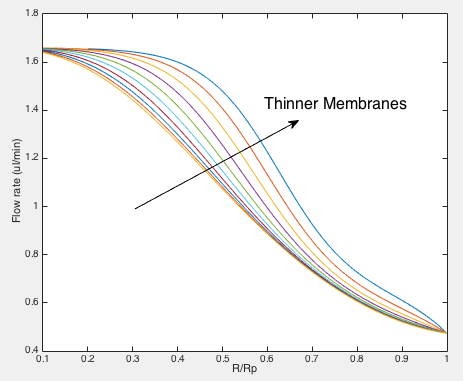
Finally, the improved transmission by diffusion helps prevent cake build up and helps maintain flow near the cut-off.
Why does the flux decline happen at such a faster rate when lambda = 0.8? I thought flux decline was based only on the concentration of the top chamber and the length of time the separation has been running.
Because the concentration build up happens faster the NP is larger.