
Co-Culture of ADSCs and HUVECs
Scope:
Adipose derived stem cells were seeded onto Corning 3um tracketch membranes, human endothelial derived stem cells were seeded onto the membranes approximately five hours later. Numerous control wells were also seeded with ADSCs both on membranes and on the bottom of the 24 well plate. Three days after being seeded, media in each of the wells was changed. On the sixth day after seeding the cells were fixed, permeablized, and stained with DAPI/phallodin. All images were taken in 20x.
Conclusion:
It appears that the addition of 50ng/mL of VEGF does not affect the morphology of the cells under these specific conditions. With the Medium 200 with and without VEGF, the cells appear to have a stringy morphology that has been exhibited in the past. The cells that had DMEM with and without VEGF appear to have wide spread actin and little morphological change. Adipose cells alone grown in a dish and on a membrane appeared to have show no difference when cultured in DMEM, both with and without VEGF. In co-culture, it appears that the adipose cells are more spread with DMEM, adipose cells cultured in Medium 200 appear to be more stringy and less dense than the cells with DMEM.
Take away:
- Adipose cells treated with VEGF appeared very similar to those not treated with VEGF in both DMEM and Medium 200
- Adipose cells in a dish and on a membrane appear the same when cultured in DMEM, the vegf
- Adipose cells in a dish appear different from those grown on a membrane when cultured in Medium 200, the addition of VEGF did not have an effect
- Adipose cells in co-culture with HUVECs in DMEM appeared dense and wide spread
- Adipose cells in co-culture with HUVECs in Medium 200 appeared stringy and less dense in comparison to those cultured in DMEM
| Media Condition | Co-Culture Images | ADSC on Membrane Images | ADSC on Plate Images |
| DMEM+10% FBS+1% PenStrep | Adipose  HUVEC HUVEC |
 |
 |
| Medium 200+LVES+1% PenStrep | Adipose  HUVEC HUVEC 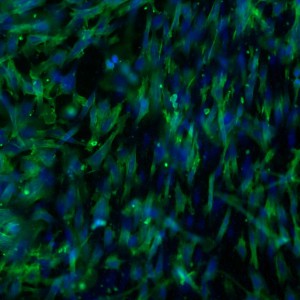 |
 |
 |
| DMEM+10% FBS+1% PenStrep+50ng/mL VEGF |  |
 |
|
| Medium 200+LVES+1% PenStrep+50ng/mL VEGF |  |
 |