
Bonding PDMS to PET films
PET is a very common material used in various cell culture applications. Unfortunately it’s chemical inertness makes it immune to plasma activation, and we can’t bond PDMS devices to PET. I am working with a PET films coated with Indium Tin Oxide (ITO) on one side of the film. The film, in terms of texture, resembles the backing plastic of the silicone gaskets that we usually discard away. The way to make PET chemically more reactive is by grafting APTES on the surface, which is then amenable to plasma treatment. I developed two different sets of protocols for grafting APTES on PET.
Liquid based treatment:
Thanks to Henry, I came across this paper
The protocol is fairly straight forward as explained in this figure.
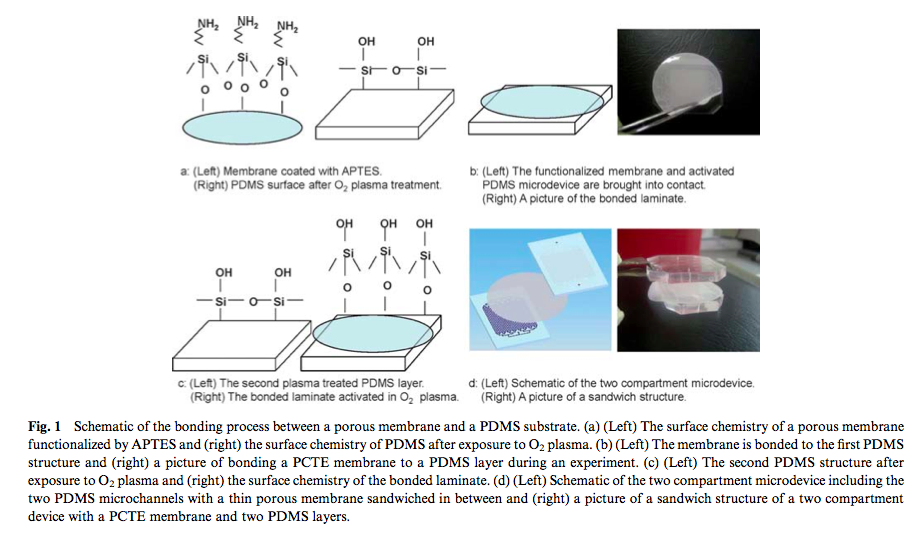
With this method, I was able to bond PDMS with PET. Unfortunately, since it’s a liquid based method, drying is problematic, since it leaves contours upon drying, and also creates non-uniform patches of material deposited on the surface. Also the thickness of graft is variable and drying patterns are not conducive for imaging. This method might be useful for bulk surfaces like PET transwells, or plastic dishes, although I didn’t try those substrates.
Gas based treatment:
Jess made a small PVD in her lab for silane deposition. It consists of a heating plate, a vacuum pump, a evaporation flask and a deposition chamber. The heating plate is set to ~230C, since the BP for APTES is around 220C, and the APTES is continuously stirred using a stir bar. APTES is purchased from Sigma. The PET samples is treated with UV Ozone light for 5 mins (I am not sure if this is exactly needed; I just do it!). The pump is connected to the deposition unit (where we keep our samples), which is then connected to the evaporation unit (where APTES is present). I let the pump on for ~45-50 mins, with vacuum of -0.8 bar. After deposition, the sample is kept in oven at 70C for an hour. The APTES grafting is complete. The PDMS device is treated with UV Ozone for 5 mins, and bought immediately in contact with APTES grafted PET. Ensure that both the surfaces are in 100% contact with no air pockets left at the interface. Put your PET-PDMS device in the oven for another hour. The bond should be irreversible.
Just to add-on, this procedure might even be useful to functionalize polycarbonate with APTES, and make it amenable for PDMS bonding. Further trials need to be done to prove that.