Silicon Nanomembranes for Efficient and Precise Macromolecule Separations (book chapter)
Sometime in September, the group received the following invitation to write a book chapter:
We, John Rogers from the University of Illinois at Urbana-Champaign and Jong-Hyun Ahn from Yonsei University, are editing a book that will be published by Wiley-VCH in 2015 on “Silicon Nanomembranes: Fundamental Science and Applications”.
We would like to kindly invite you to contribute with a chapter on “Silicon nanomembranes for Efficient and Precise Molecular Separations” (or similar subject to be agreed).
This book focuses on essential basic and applied aspects of Si nanomembranes, ranging from synthesis and manipulation, to fundamental properties, to manufacturing, device integration and system level application. The scope captures the most recent developments, including uses in bio-integrated electronics, 3D integrated photonics, solar cells and transient electronics. The book is intended as a reference for advanced students and researchers with backgrounds in nanomaterials and nanotechnology. The content is split into two parts to make the book approachable to readers of various backgrounds and interests. The first provides detailed descriptions of fundamental physics and materials science, synthetic approaches and assembly/manufacturing strategies, designed to target readers who seek an understanding of the foundational aspects. The second provides a detailed, comprehensive coverage of the wide range of device applications and system level demonstrators that have been achieved, as a precise account of the various ways that Si nanomembranes can be applied, with examples in fields ranging from electronics to photonics, biomedicine and energy.
Jim asked me to write the chapter, and though we had to push back the deadline to early December, it’s now complete. All of the files (including pdfs of the majority of the sources I used, a bibliography file (using the free and awesome bibtex), the latex component files, and jpg and illustrator versions of the figures used, are now on the cloud under the following path:
shared/nrg/manuscripts/Silicon Nitride Nanomembranes Chapter
The abstract of the paper was as follows:
Nanoporous silicon membranes are capable of making molecularly thin sieves, which are useful for macromolecule separations. Here we discuss what makes the thinness of silicon nanomembranes important for sieving, the various techniques being explored to patterning pores into them, and the areas where these membranes could see immediate application.
Here’s a pdf of the nearly final version (we’re missing a high res version of the last figure): Chapter Better
Here are the figures I generated:
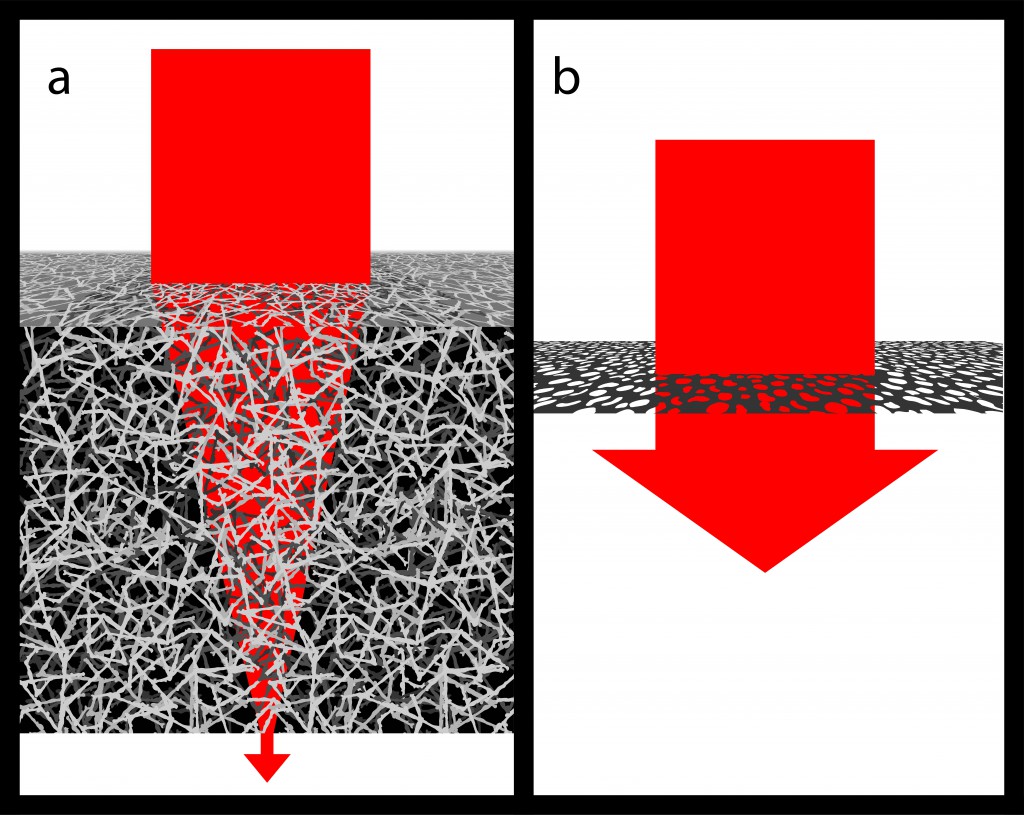
The figure on the left is an updated version of the nature figure on the right. I have not uploaded the .ai file for this image to the cloud because it is more than 2 GB. I have the files on my computer, and if you want them I can give them to you, but manipulating the image is a real chore – my computer was lagging heavily even with simple operations like dragging components to new locations.

The NPN image in the upper left hand corner has not been published anywhere. We have published images of NPN, but they tend to be TEM or STEM images, and I needed an SEM image for a better comparison. It’s from wafer 1132.
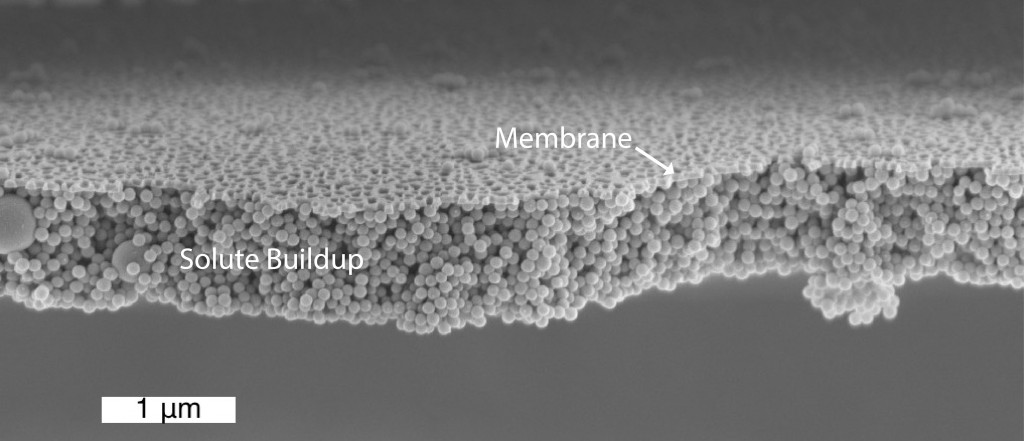
Josh’s cake cake image (not a typo) with labels:
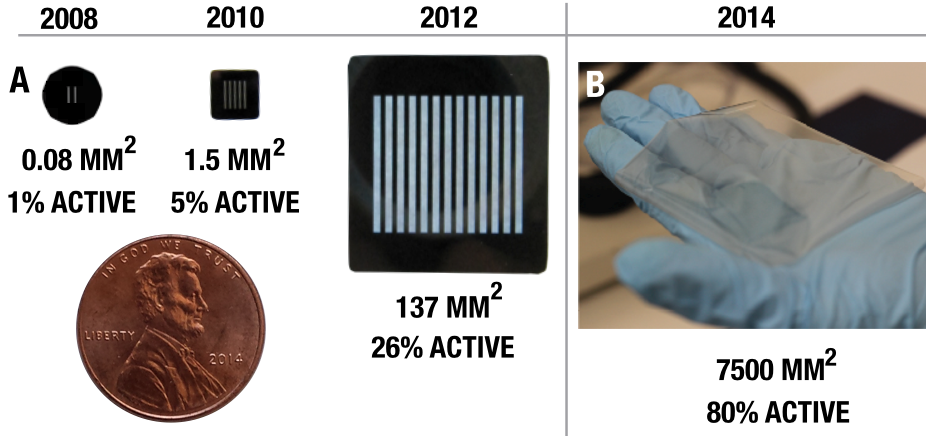
Showing how active area has increased over time:
And here’s a figure that was originally from a textbook that Dean updated in Illustrator that I also added:

We have not yet submitted the chapter, but we will do so as soon as I get the okay from Jim.
Also, Congratulations to Dr. Chung!