
Optimization of HUVEC Network Formation in Geltrex On and Off Membranes
Our motivation was to look into how ADSC influence HUVEC network formation. My first objective was to investigate the optimal cell count, the best volume of Geltrex and if it was better to use M200 media with or without growth supplements. I then looked into seeding HUVEC on a nonporous membrane. At the same time, I considered the optimal seeding ratio for ADSC:HUVEC co-culturing in complete M200 media and Complete M200 media +50 ng/mL VEGF. Then I studied the difference between indirect and direct co-culture on different pore-sized membranes.
The first parameters we looked to optimize were media type, cell count and Geltrex volume. We tried 10,000 and 20,000 cells, complete and basal M200 media, and 35 and 50 uL Geltrex. We coated wells in a 96 well plate with the prescribed amount of Geltrex, placed them in the incubator to set for 30 minutes and then seeded 10,000 or 20,000 cells in M200 media with or without growth supplements. We did this experiment once with expired Geltrex, and the cells formed no networks, and we did this once with incorrectly calibrated micropipettors, so there was not enough Geltrex to cover the bottom of the plate. In our experiment, 10,000 cells seemed to be too few, the basal media without growth supplements did not help the HUVEC networks sustain for as long as the other conditions, and 35 uL Geltrex seemed to be enough to coat the wells and promote angiogenesis. Following the manufacturer’s recommendation and the results from our experiments, we will continue using 35 uL Geltrex and 20,000 cells in M200 media with growth supplements for future experimentation.
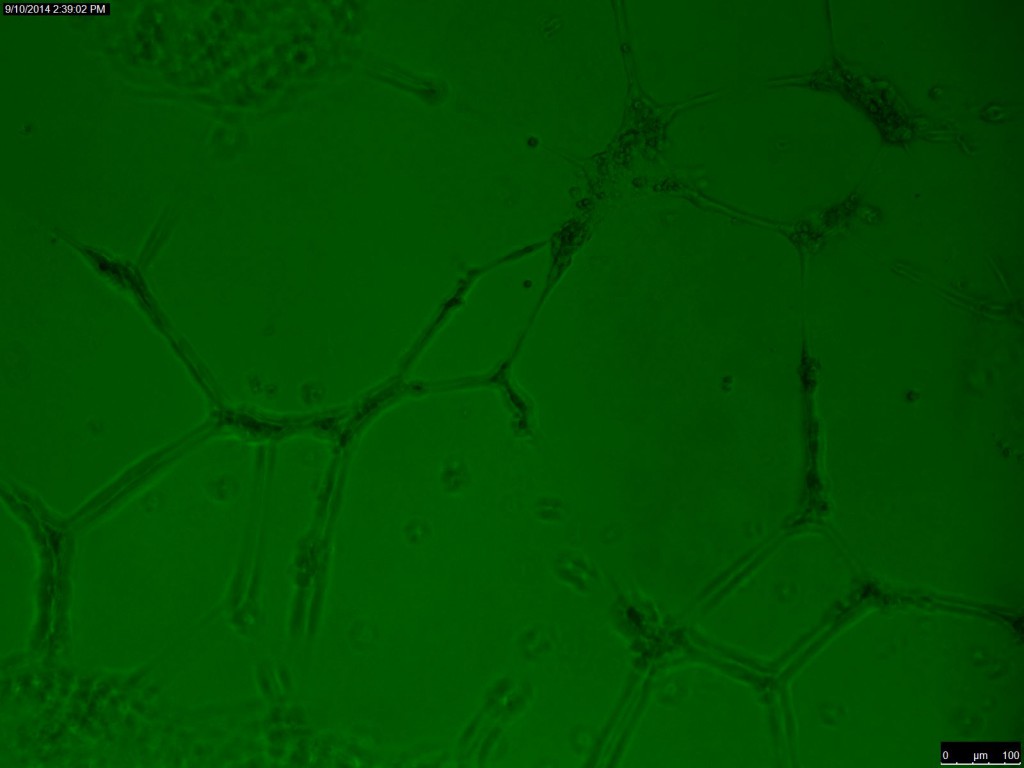
After optimizing these parameters, we looked into seeding the HUVEC cells onto nonporous membranes. After experimentation, we discovered that in order to coat the membrane with Geltrex, it is best to keep the membrane well-side up and use 10 uL Geltrex. After deciding this, we seeded the membranes with 5,000, 10,000 and 20,000 cells. 5,000 cells seemed to be the optimal number, as 10,000 and 20,000 seemed to be overcrowded and formed very thick networks, as opposed the the 1 or 2 cell wide networks we are aiming for. For future experiments we will use approximately 5,000 cells on a membrane in 10 uL Geltrex.

While we were looking into cell count on a membrane, we were also trying to establish the best ratio for ADSC:HUVEC co-culturing. We coated 8 wells in 2 96 well plates with 35 uL Geltrex. We added 20,000 HUVEC cells to each well in one plate with complete media and 20,000 HUVEC cells to the each well in the other plate with complete media +50 ng/mL VEGF. We then immediately added 0, 1,000, 2,000, and 4,000 ADSC cells to each respective well. After 24 hours, the HUVEC alone condition showed the best networking. The higher ADSC densities showed little to no networking. We discovered that increasing the concentration of ADSC decreased the HUVEC network formation.
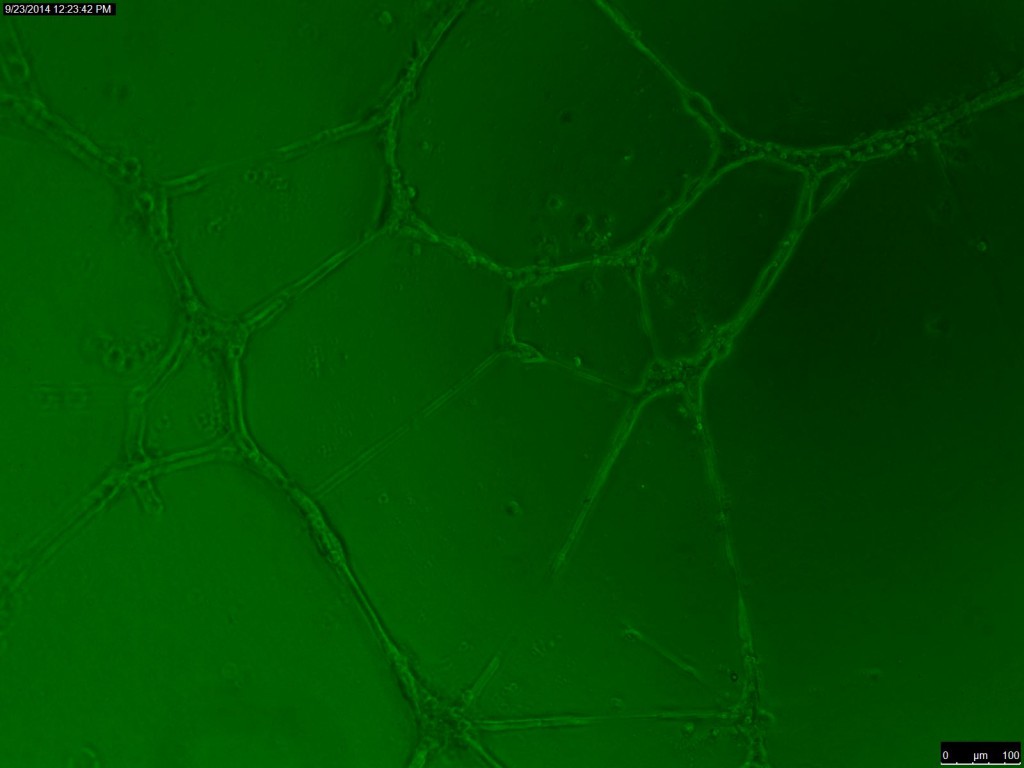


We then wanted to experiment with the amount of time in between seeding the HUVEC and the ADSC cells. We believed that maybe, if the HUVEC were allowed to first form networks, the ADSC could later come in to work like pericytes and stabilize the networks, instead of hindering network formation like they had previously. We stained the ADSC with 1 uM CMFDA and then seeded the ADSC:HUVEC at a 1:10 ratio on Geltrex coated, nonporous membranes. We had one membrane with 4,000 HUVEC and 400 ADSC and one with 6,000 HUVEC and 600 ADSC. We seeded the HUVEC and then waited 18 hours to seed the ADSC. This seemed to work, since the HUVEC networks were preserved beyond 72 hours. In the 4,000 HUVEC and 400 ADSC condition, the networks covered the membrane and persisted over 3 days time. This is longer than any HUVEC alone had sustained networks. Moving forward, we will use a 1:10 ADSC:HUVEC ratio and delayed co-culturing to allow HUVEC to form networks before adding ADSC.

CMFDA)


After learning that we could sustain networks on a co-cultured membrane, we wanted to see if just having the ADSC near the HUVEC, as opposed to touching them would help the networks more than they had previously. Six 0.5 um high porosity and six 3.0 um high porosity membranes in cytovu gaskets were coated with 10 uL Geltrex. I then seeded 5,000 ADSC in 30 uL media into the wells of Plate B and the bottom row of Plate A. Plate B was placed into the incubator inverted, Plate A was placed in normally. I waited an hour and then seeded 5,000 HUVEC into the Geltrex of every well, waited 15 minutes and then flooded all wells with media. It seemed that we seeded with too many HUVEC. The networks were very thick, probably 5 cells wide, and we are looking for networks of 1 cell thickness. The ADSC seemed to hinder HUVEC network formation instead of helping. The HUVEC networks alone, without any ADSC interaction were better established than any of the conditions with interaction. On the 3.0 um membrane with ADSC seeded onto the membrane, the cells seemed to migrate through the pores toward the HUVEC cells, but were mostly in a clump, rather than network. There were a few ADSC on the top of some membranes, possibly from flooding the wells but this seemed to be a more significant amount than that. We discovered that in bot direct and indirect co-cultures, ADSC interfere with the formation of HUVEC networks.
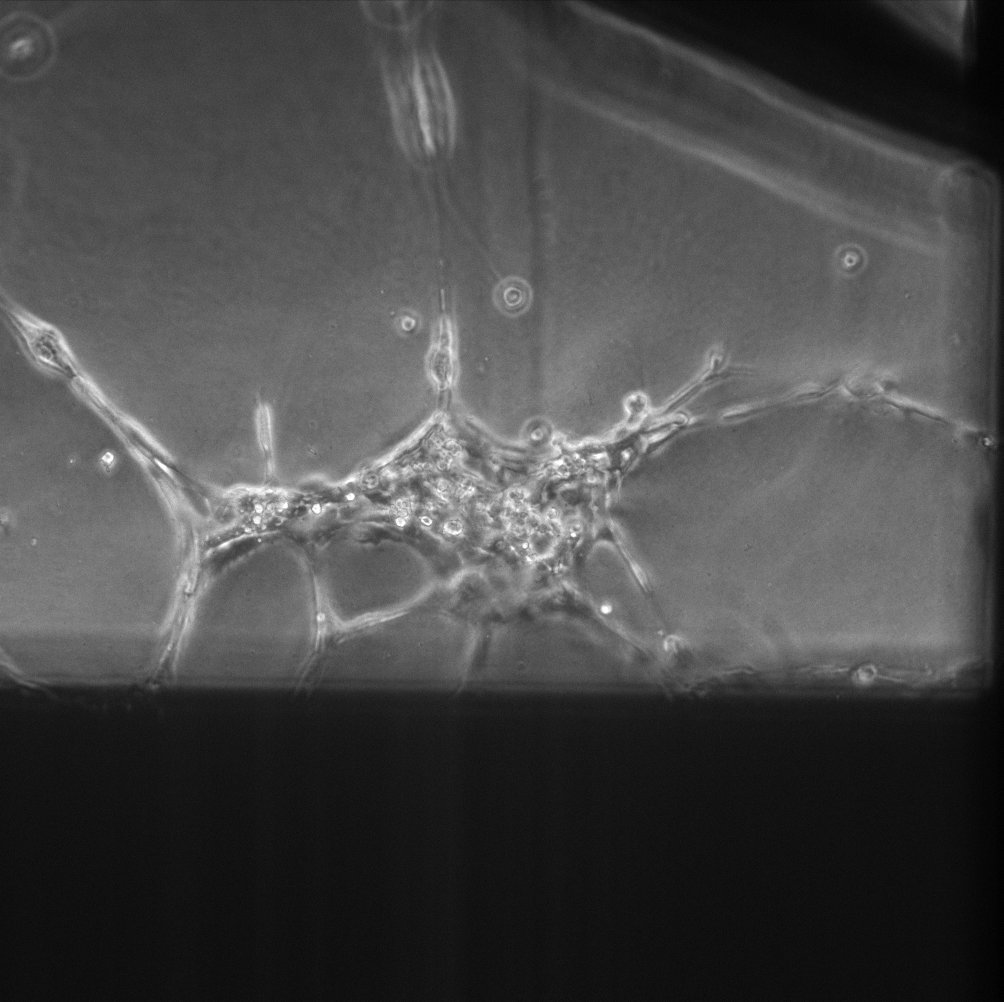

We believe that if we let ADSC differentiate before co-culturing them with HUVEC there is a possibility that there will be more pericyte-like ADSC and this will help HUVEC network formation unlike many of our other experiments. We are currently differentiating ADSC in a 24 well plate for future experimentation.