
40nm Gold Passes Through 40 nm pnc-Si Sepcon Chips; 100nm Fluorospheres Do Not.
On Friday Josh and I assembled Sepcon chips with calculated porosity of ~6.5 %, and avg. pore diameter of ~40 nm into Sepcons. I was able to pass 40nm gold through the pores (we don’t have any gold larger than that). 
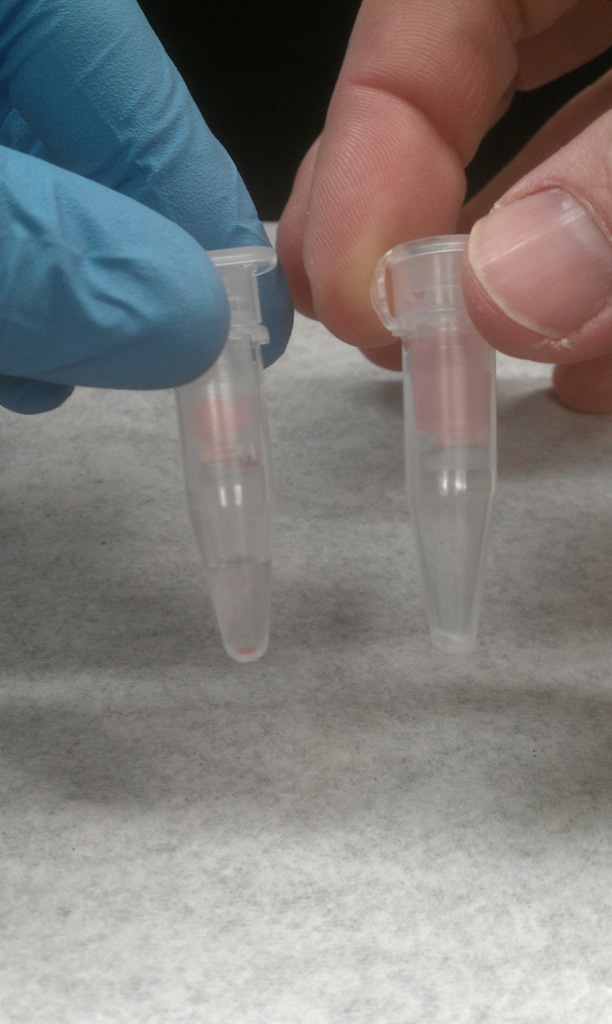
Note the “Bad” retentate – for some reason one of the sepcons didn’t filter anything. On the off chance it was a problem with the gold, we took a TECAN scan of the retentate (since there was no filtrate):
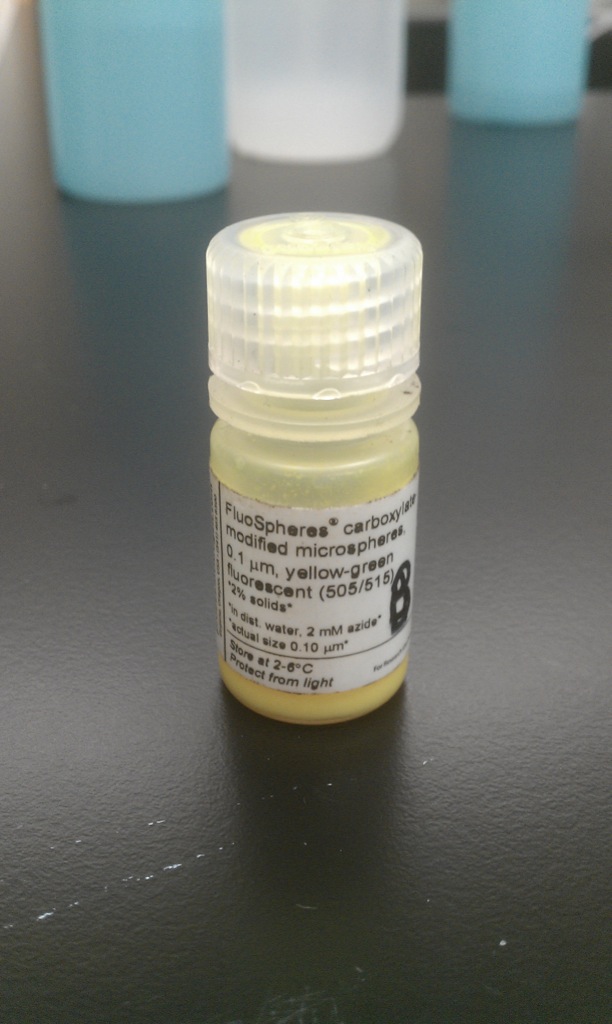
Next, we dug some old flurospheres out of the fridge. They had a nominal size of 100nm:
Flux through the membrane was low: after a spin at 2000rpm for 5 minutes we got 14uL. Buffer did continue to go through, and after spinning for 15 more minutes at 2000rpm we got a total of 24uL, and after another half hour spin this went up to a total of ~41uL.
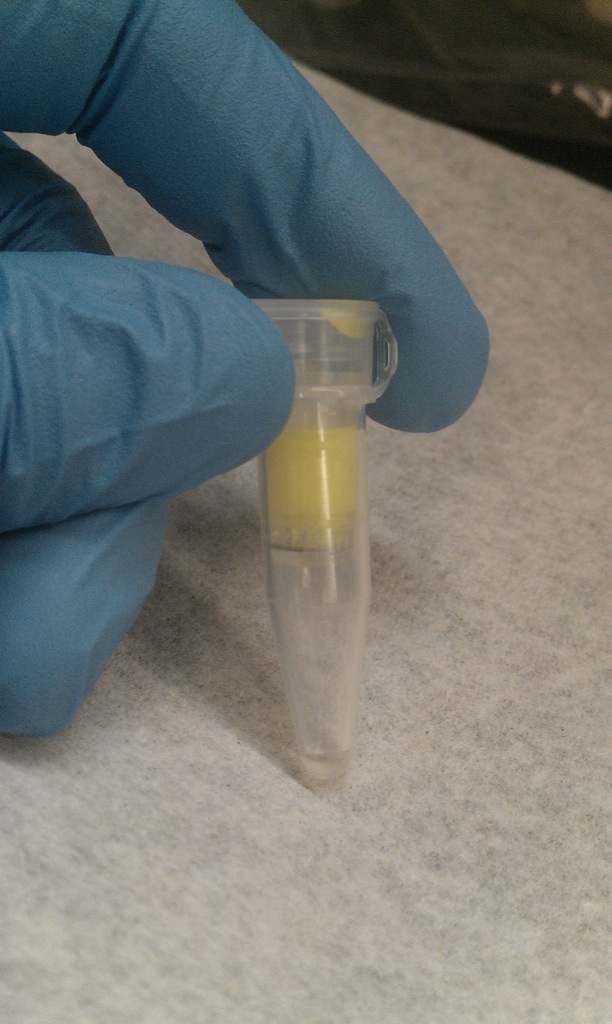
A fluorescent scan of buffer, filtrate, and pure fluorosphere revealed that no fluorosphere was going through the membrane:
Specie: Raw Fluorescence (505/515)
Buffer 18494
Filtrate 18176
Fluorosphere 44604
We’re pretty sure the Fluorospheres, despite being very old, are still in good shape. Below are three DLS scans (size by number, intensity, and volume)
I’m not sure why we’re getting a peak at 30nm for the size by number graph, but the intensity graph seems to show that things are alright.
With this, we can say that the cutoff for the new larger pore Sepcons are somewhere in the range of 40-100nm, with the caveat that the zetapotential and salt environment of the two species are probably different, making a direct comparison a little shaky. In the future, we’re going to purchase some 100nm gold from the same company that makes our current gold nanoparticle library (BBI international).
It would be nice to put pore size histogram data in this post.
Whenever working with old microspheres from the fridge, do a DLS measurement to be sure they look like the nominal size. These things can clump over time. Result makes sense here, but it is still good practice.
Also, was this the new SiN material? What pressure is 2000 RPM?
I updated the post to include the porosity (~6.5 %) and avg. dia. (~40 nm) of the 40 nm pnc-Si. These samples were not SiN.
Posts of this type should include pore histograms, material data, the flow rate, and the theoretical flow rate.