A New Measure of Roundness
As we make larger and larger pores, we see that they are becoming more convoluted and have stopped looking like circles or ellipse. In order to try describing these shapes, they were given a “roundness” number which was calculated by taking the minor axis and dividing it by the major axis. However this often fails to give us an accurate representation of the pore especially as pores become more irregular. We decided to try to find a better way of describing these shapes, so instead we used and perimeter ratio to give the pores a more accurate description. This ratio is calculated by taking the actual perimeter and dividing it by the ideal perimeter. This ideal perimeter is the perimeter of a circle with the same area. By taking the square root of the area divided by pi and multiplying that number by 2 pi, we can calculate this ideal perimeter. The equation looks like

or can be simplified to

Since the ideal perimeter is always less than or equal to the real perimeter, the quotient of the real perimeter divided by the ideal will always be greater than or equal to one. The result describes the pores better because a result of 1 mean the pore is a circle and the bigger it gets, the more convoluted the pore is.
|
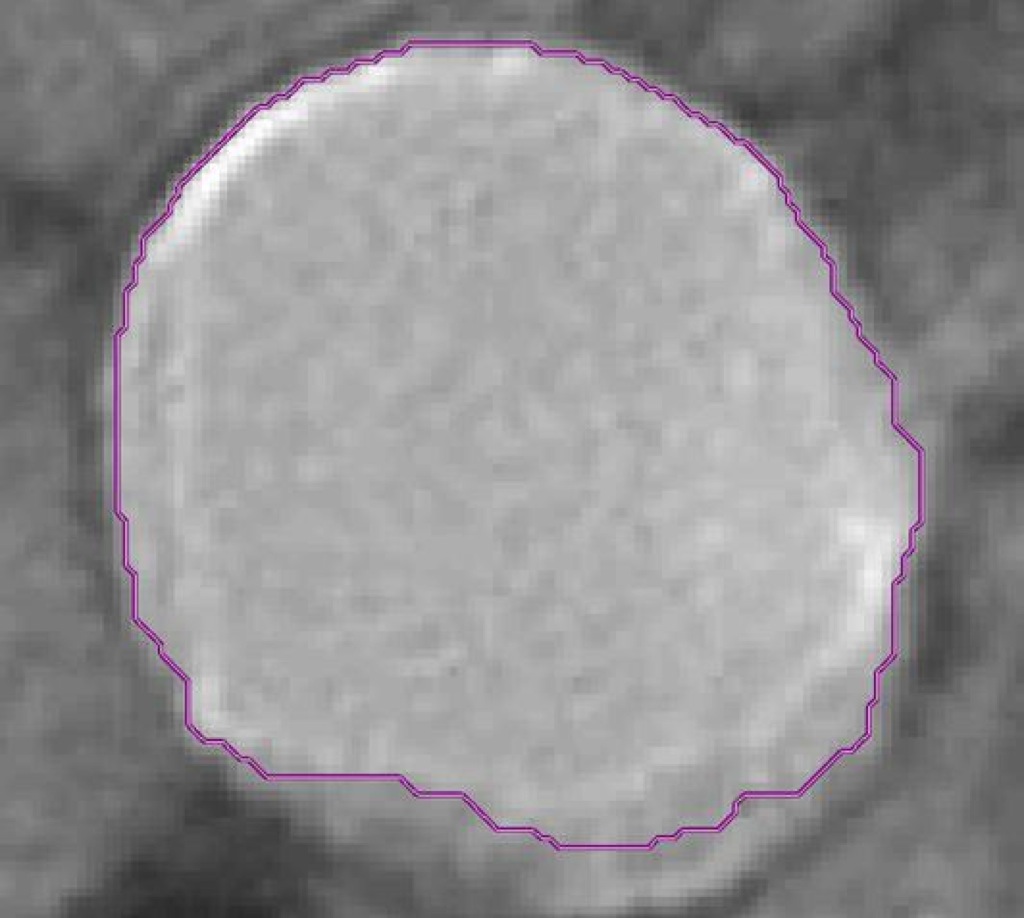
This pore has a very circular shape and both ratios prove it. But as the pores become less circular and more irregular, the axis ratio breaks down and fails to describe the image while the new perimeter ratio provides a more accurate description as we can see in the following images.
|
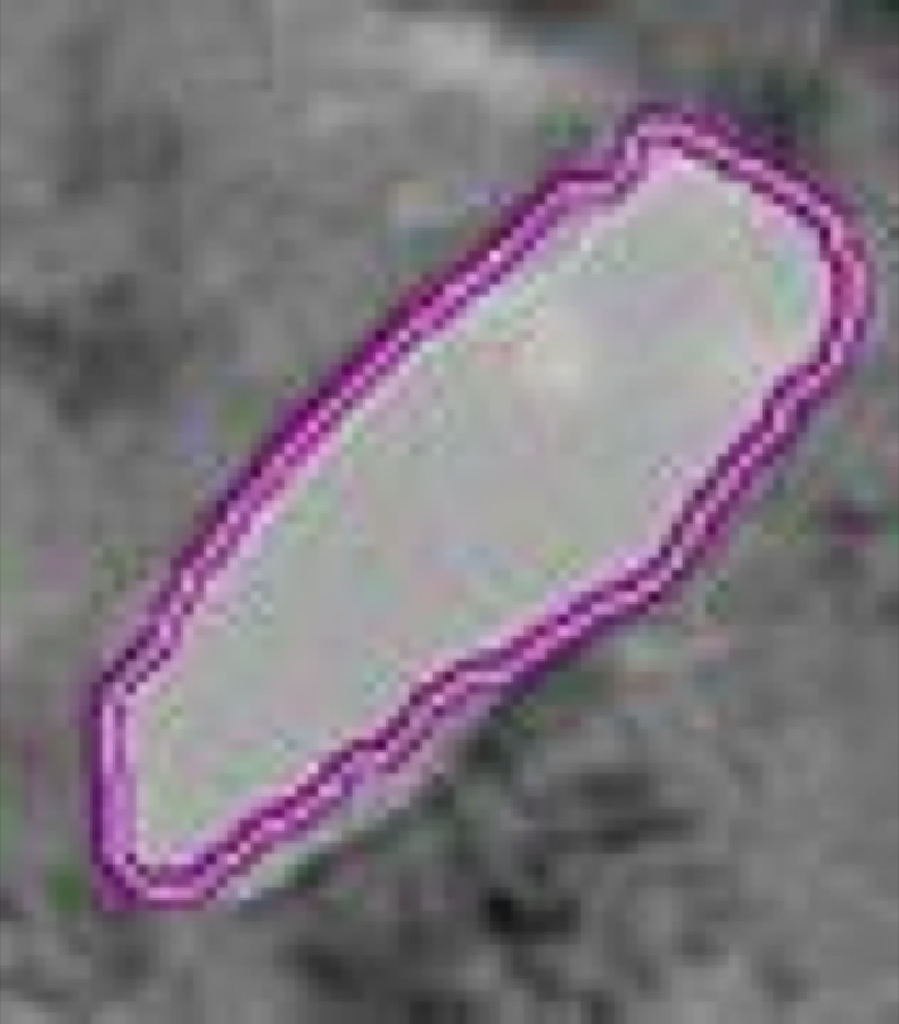
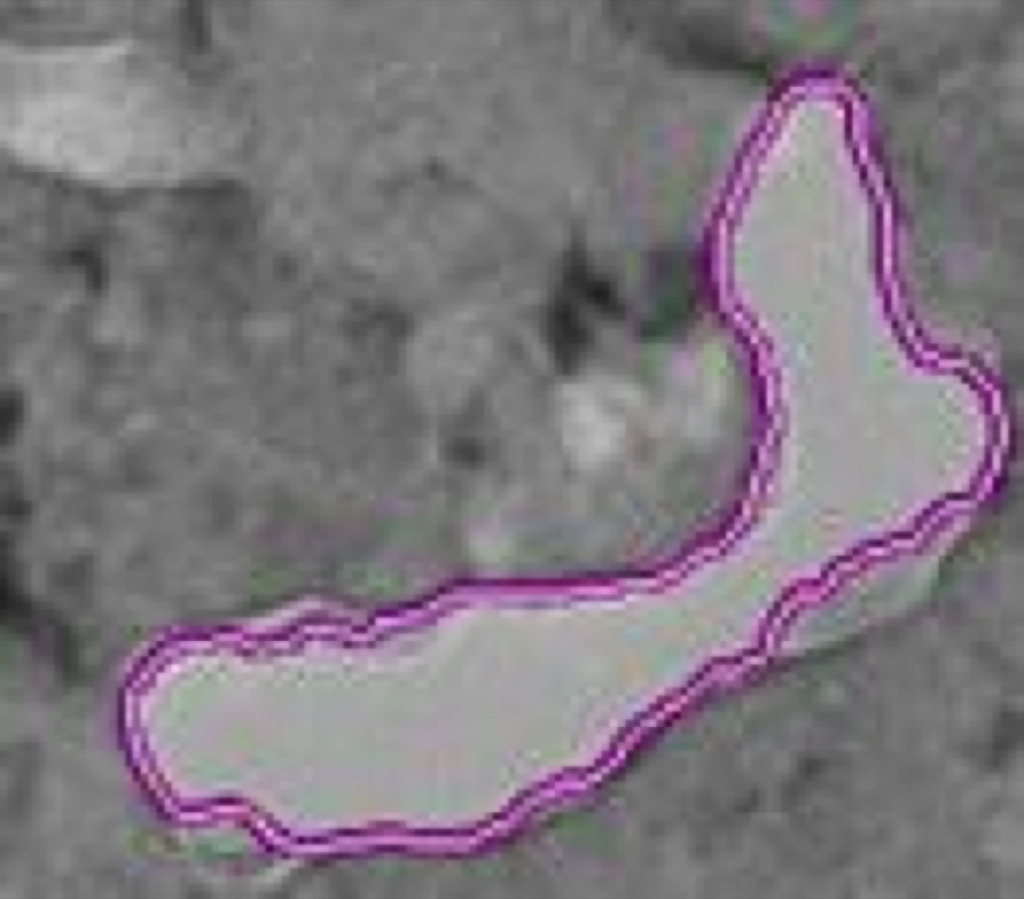
For example using the axis ratio, one would assume that the pores are similar in their “roundness” but by the images prove otherwise. This is where our perimeter ratio is a better indicator of the pore’s shape. The perimeter and area both use the whole pore where as the major or minor axis might encompass the whole pore like the second example above because no straight line can connect the two furthest points. Here are three more examples of different pores.


|
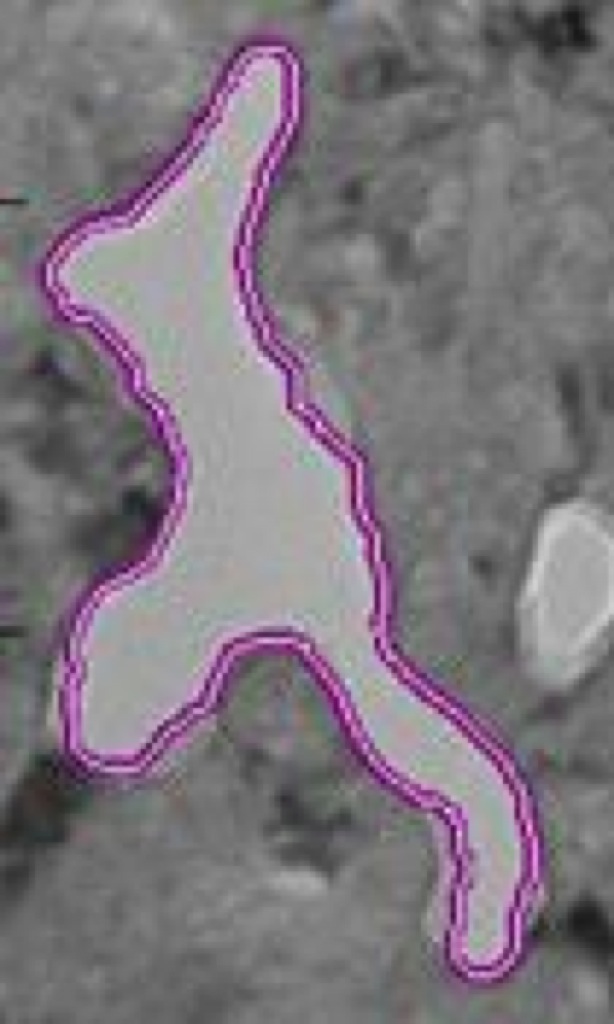
From left to right, the pores become more complex and less circular; the last one being very irregular. Using the old method of using minor over major axis to determine roundness would give results that only varied .086 despite the very different shapes of each pore. These numbers don’t accurately describe the shapes of the pore because they are fairly close despite the pore being of drastically different “roundness”. However using the perimeter ratio described above, reflects the different shapes each pore have. Using these number, one can clear tell that the first pore is close to being an ellipse while the third pore is very irregular and the second pore is somewhere between the other. Using this ratio, we can get a better depiction of the pore and can use it to see how different processes create more irregular pores. Using this new way of finding roundness, we looked to relationships between how pores are made and how irregular they are. Using the data from an experiment titled Intermediate state morphology investigation, in which the time the pore was held at 700C was varied before increasing the temperature to 800C. The results look like this with A being 10 seconds, B being 60, C being 120 and D being 300 seconds at 700C.

| Name | A | B | C | D |
| Time(seconds) | 10 | 60 | 120 | 300 |
| Average Perimeter ratio | 1.15 | 1.18 | 1.21 | 1.26 |
| Average Axis ratio | .628 | .530 | .562 | .481 |
Both roundness values show that as the time increases, the pores become less round and more convoluted. By running more experiments and determining the patter of how the roundness changes, we will be better able to control the shapes of pores that are made.
Nicely done guys.
This makes the case that the Perimeter Ratio is sensitive to convoluted shapes. So what does it mean when the Axis ratio changes faster than the Perimeter Ratio as it does for Joe’s image? I think it means that – although the pores are clearly convoluted – they are not getting more convoluted with time as much as they are getting longer. In other words they are becoming more elliptical.
Very nice!
One question, I would expect larger Average Perimeter ratio from image D due to lots of elongated pores. It seems that this perimeter ratio is quite efficient to describe single irregular pore. However it becomes less effective when average with lots of small round pores, right??
That is true Joe. I guess we might need to look at histograms to capture the whole story.