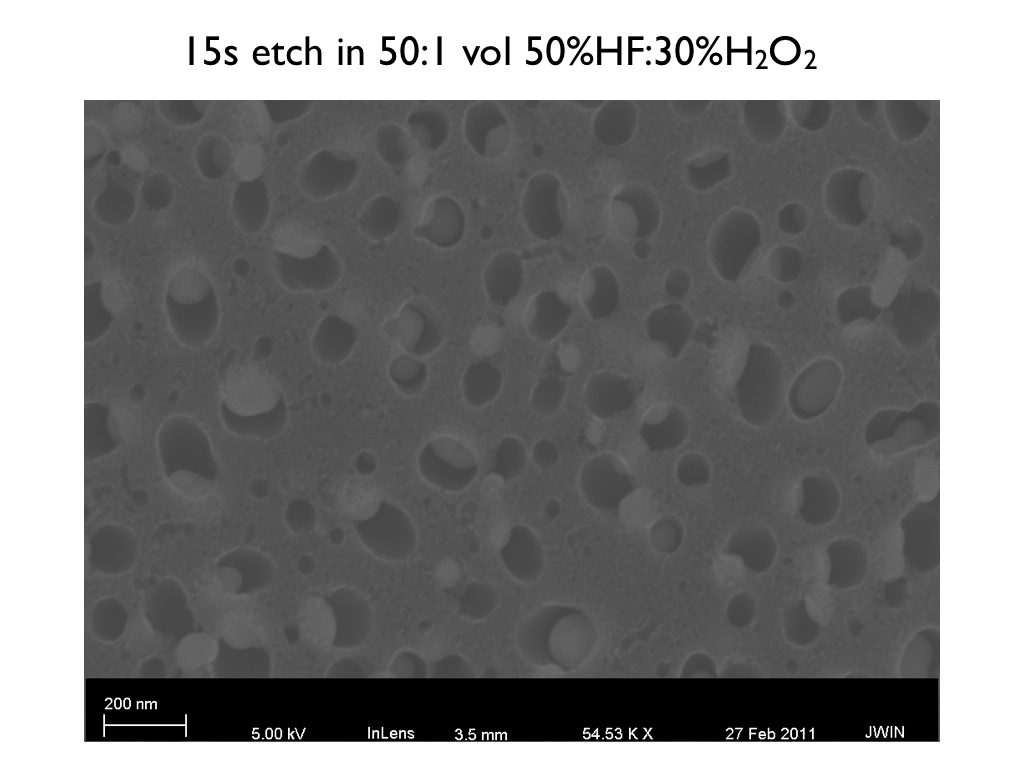
Alternate method of ‘nanomembrane’ fabrication
We are proposing a novel method for the fabrication of porous thin-film silicon membranes. It has been shown that metallic nanoparticles on the surface of silicon submerged in a solution of hydrofluoric acid and hydrogen peroxide will bore holes into the silicon. This selective etching occurs because the metal acts as a catalyst in the oxidation reaction between H2O2 and silicon. The HF present in the solution immediately removes any oxide and thus the silicon is removed more quickly below the metal particles than at the exposed Si surface.

This technique offers some promising possibilities in that the size of the pores is only limited by the size of the nanoparticles introduced to the surface, the thickness of the silicon can be whatever is necessary, and the silicon can be a-Si or mono-crystalline.
At least one drawback may be the introduction of metal to the silicon. The silver can be removed chemically, but depending on the application of the membrane this may leave an unacceptable level of contamination. (Although, one potential benefit from the Ag could be its antimicrobial properties.)