microEO: bead pumping
Charles developed a new microEO chamber, and I did some quick particle tracking experiments. The fluid in front of the membrane was filled with 200nm fluorescent polymer beads, and the power supply was used to cause the fluid to flow within the chamber. Bead speed was measured with Henry’s particle tracking programs.
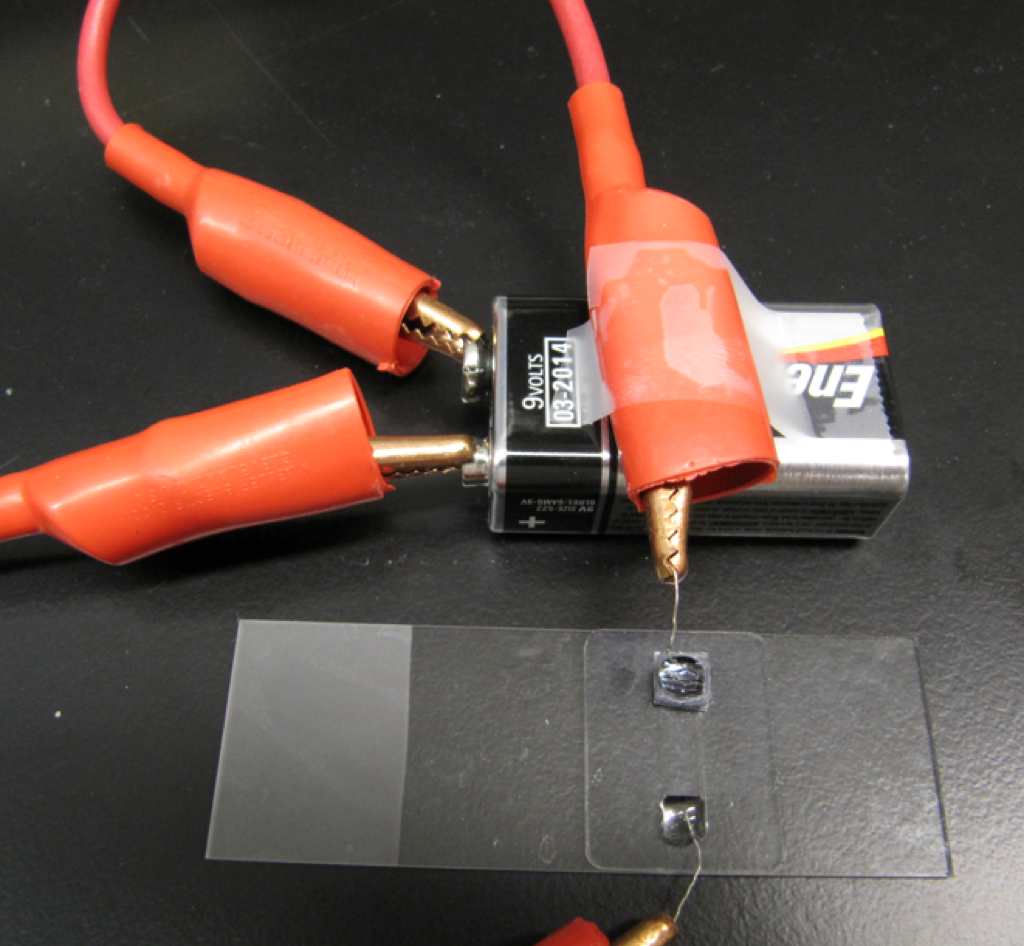
Picture of microEO:
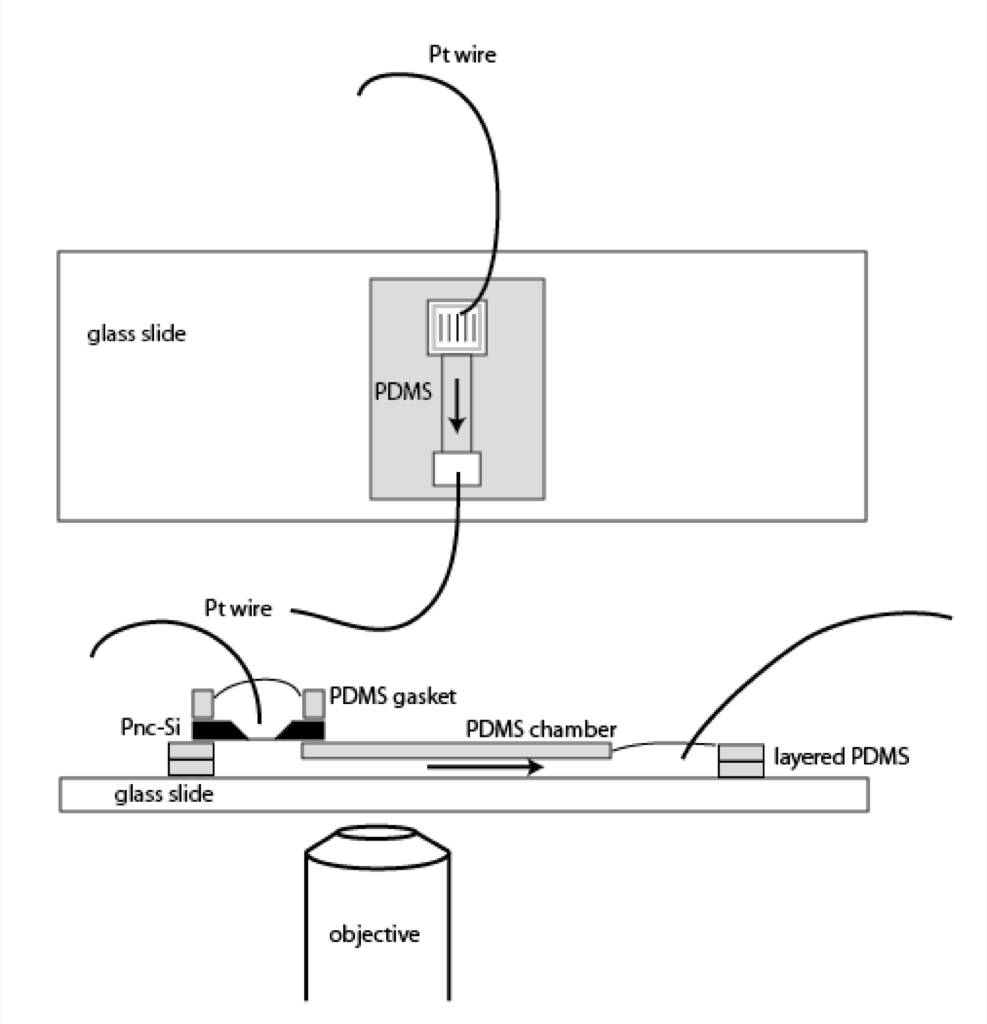
Schematic of device:
Here is an image of particle trajectories in the 10V experiment:

This is my first attempt at particle speeds in the microEO device:

Note the speed in the -10V sample is negative because it is flowing in the opposite direction through the chamber. There are currently difficulties in detecting the electrophoretic movement of the beads (without the membrane pumping them), however the beads are moving with the flow and not with the direction predicted by their charge.
UPDATE:
I’ve performed another trial of the bead pumping, and to compare with the first trial I’ve exchanged Applied Voltage for Effective Voltage. This is because the channels have slightly different resistances, and 10V applied at one time may not have the same effect on the membrane for the next trial. The conversion from Applied to Effective voltage uses knowledge of the membrane area, thickness, experimental current, and conductivity of the solution and assumes Ohmic behavior within the pores. Here is the comparison:

I cannot explain the obvious saturation feature in this curve. For some reason as voltage/current goes up, the beads don’t start to move any faster. These experiments may have some parabolic flow in the chamber, and bubbling/heating or bead electrophoresis could have an effect.