
Membrane deflection revisited
In my initial report on the Young’s modulus of pnc-Si, I used the generalized pressure-displacement equation to fit my experimental data to extract a Young’s modulus of around 100 GPa (Polysilicon is ~150 GPa). Unfortunately, there was quite a bit of variability in the residual stress in these experiments. I believe this variability was due to several factors: 1) Each measurement was made on a single window from a single chip. Each chip came from a different part of the wafer, which may have a different residual stress. 2) I did not account for the “skew” in deflection profile caused by the Veeco Wyko interferometric measurement.
In this experiment, I wanted to re-try the pressure-displacement measurements with a setup that would address these problems. First, I made SepCon chips with different square and rectangle geometries on the same chip. Because each window geometry is within microns of each other, the residual stress in these films should be very similar. The rectangular membrane dimensions are 100 x 400, 500, 700, and 800 um. The square membrane dimensions are 100, 200, 300, and 400 um.

Next, I wrote a MATLAB script to remove any skew and offset artificially induced by the Wyko measurement. Here is a before and after line scan in the x and y direction.

Here is an animation showing the 400 um square deflection behavior:
The Veeco is unable to measure large changes of height over short x-y distances, which is why some of the data is missing around the clamped membrane edges.
I tested four different square geometries and one rectangular geometry. Here are the pressure-displacement plots:
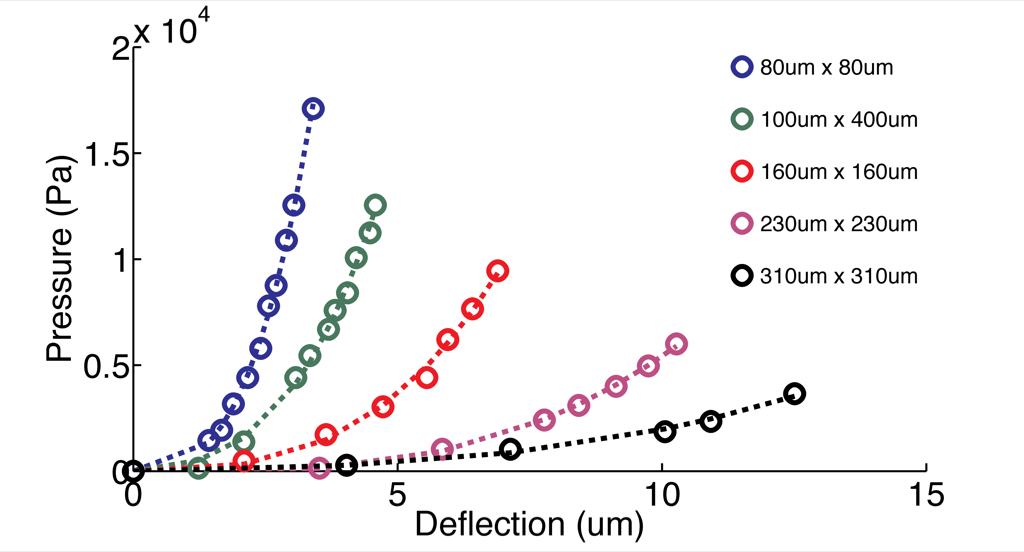
Since the fit is very sensitive to membrane geometry, I measured the actual dimensions using the light microscope and used those for the calculation. The square geometry fit is based on the Vlassak/Timoshenko model which I outlined in my last post. The rectangular fit is based on the analytical solution for the displacement of an infinitely long membrane in one direction. Update: I am now fitting for both the Young’s modulus and residual stress simultaneously. Here is a table of the calculated Young’s moduli and residual stress:
| Geometry | Young’s Modulus (GPa) | Residual Stress (MPa) |
| 80 um SQ | 30 | 1.8 |
| 160 um SQ | 31 | 4.6 |
| 230 um SQ | 30 | -9.6 |
| 310 um SQ | 26 | 22 |
| 100 um x 400 um RECT | 34 | 20 |
| Average | 30.2 | 7.76 |
| Std. Dev. | 2.86 | 13.2 |
The first thing you will notice is that these measurements are 3-fold lower than my initial report. I believe that these values are more accurate due to the improvements I have made to the experimental setup. Additionally, we have calculated a similar value for two different geometries using two different models.
The next step is to confirm our measurement and modeling by testing a film of known modulus, such as Nitride.
I would also like to explore the effect of porosity on moduli. For reference, the membranes I tested had an average pore size of 18.2 nm and porosity of 2.59%.
Can you create a version of the movie with all the axis scaled the same so that we can get a more intuitive picture of the deformation? Perhaps link it as a downloadable file.
Do you mean a movie with each frame representing a pressure in equal increments?
The scale on the axes are the same.
The movie of deflection has mm in the plane and um on the vertical. The deflection is greatly exaggerated. I want a uniformly scaled version showing a 10 um deflection over what looks like a 200 x 200 um square.
I just realized the calculated values for residual stress are much too small.
Looking at the bulge equation: the cubic portion of the deflection curve is dominated by residual stress, while young’s modulus dominates the linear portion. Our deflection curves are significantly cubic (especially for smaller geometry), meaning the residual stress should dominate.
JP – Maybe this plot will help answer your question:
The residual stress is a coefficient to the linear height term. The modulus is a coefficient to the cubic height term.
I think from experience, we have observed that pnc-Si is teetering on the edge of zero residual stress since slight changes in composition will make a flat (tensile) membrane wrinkled (compressive).
My apologies, I had it mixed up. Indeed, the young’s mod is determined by the cubic portion.