
H2O2 also passes 'non-porous' SC348
In order to validate the salt diffusion test I just posted, I’ve been measuring H2O2 diffusion with SC348 and the Amplex Red Assay from Invitrogen. I first showed that H2O2 (=34 Da) passed SC348 in this experiment. Here, I just repeated with slightly different standard curves and positive (‘regular’ Sepcon, SC195 = 4% and 13.9nm) and negative (solid chips) controls. Specifically, I added 200uL of 0.3mM H2O2 (in DIH2O) to the apical well of transwells, added the transwells to a 24-well plate with 1mL DIH2O and incubated the samples at room temperature overnight on the orbital shaker (@ 100rpm). I then measured the apical (retentate) and basolateral (diffusate) volumes for H2O2 with Amplex Red but I’m just showing the basolateral values here:
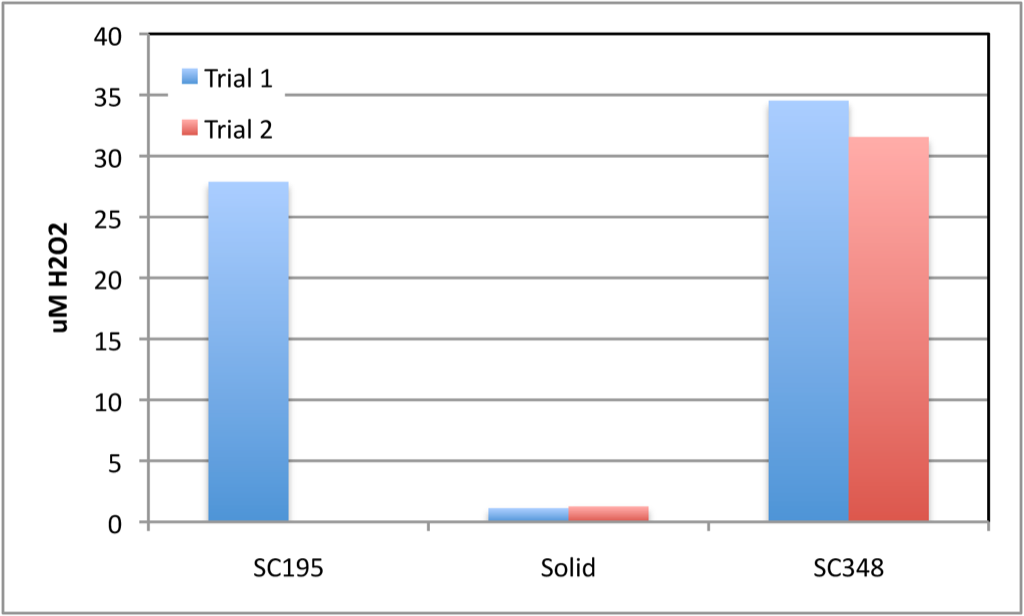
This graph shows that H2O2 can not diffuse through solid chips (n=2) and that it passes easily through both regular (SC195, n=2) and SC348 (n=2). I’m surprised that H2O2 concentrations are similar for SC195 and SC348 since SC195 is much more porous than SC348 (and the salt diffusion data show a large difference between these samples). However, these 2 experiments and the 1 from December show that H2O2 passes these ‘non-porous’ SC348 chips.
So, does SC348 contain many ~0.5-2nm pores that are hard to distinguish by TEM, or are the TEM images not representative of the entire pnc-Si membrane area (basically a sampling error)?