
Ar sputt. 15 nm temperature series
Recently, I have been exploring the temperature dependence of post-Si deposition Ar sputtered films (15 nm thick). Below is a comparison of the average pore size, porosity, and density of pores of Ar and non-Ar sputtered films annealed between 800 C and 1100 C.
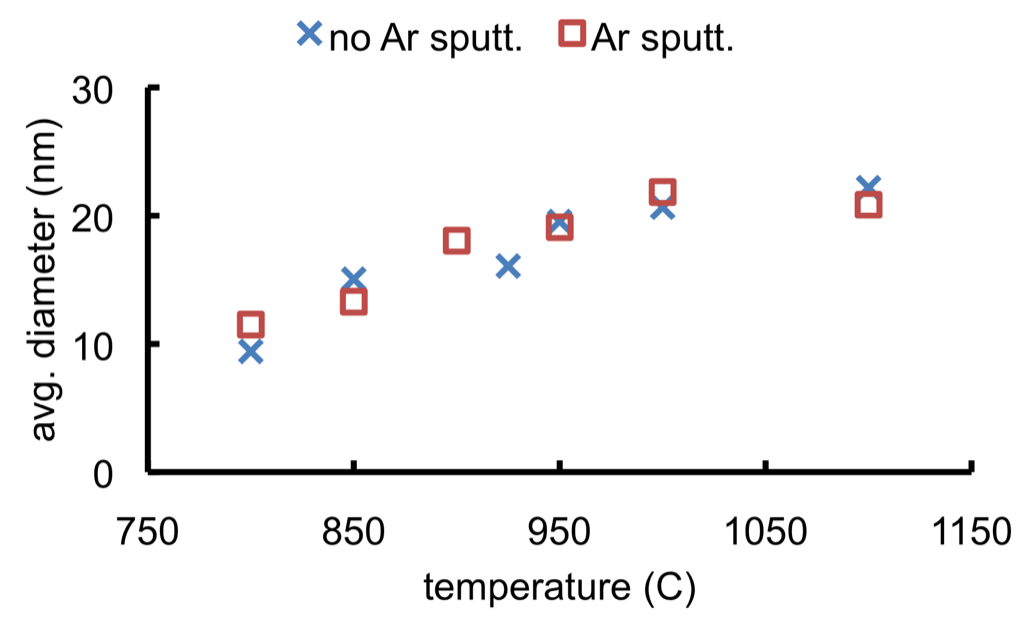
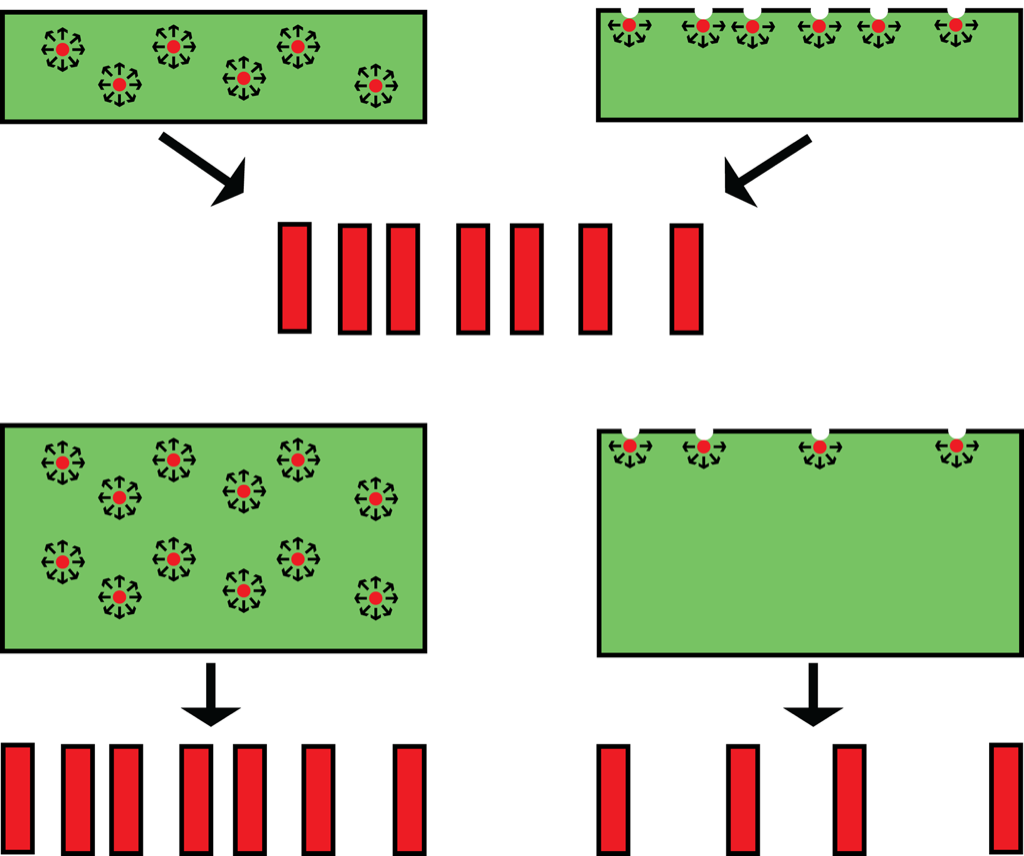
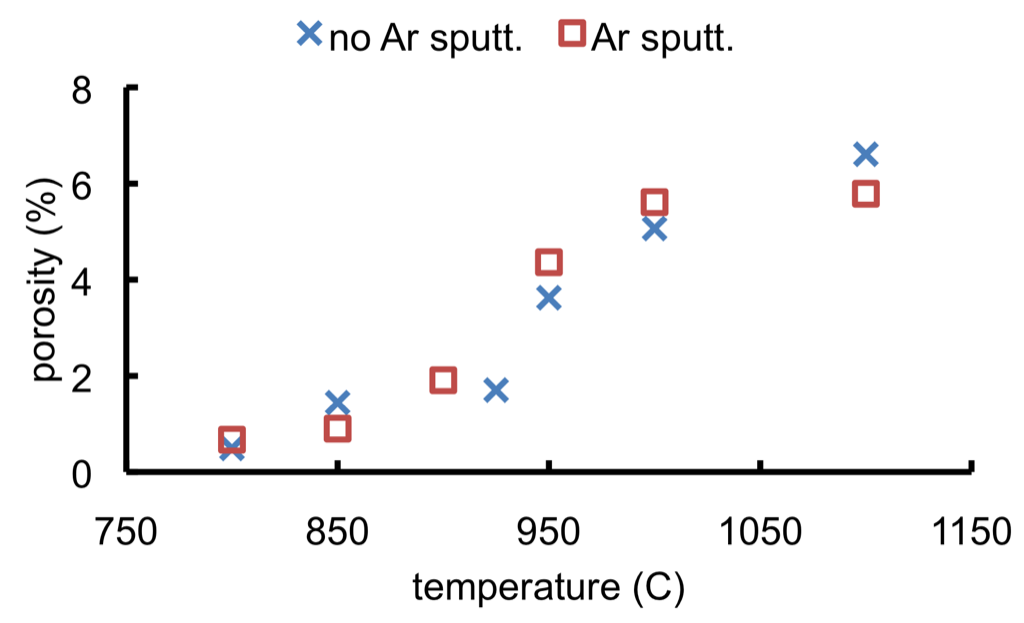

It appears that Ar sputtering increases the avg. diameter and porosity at certain temperatures (950 C, 1000 C) while at others it is the same or lower. I believe that the reason for this is because in a 15 nm thick film, the advantage of pre-seeding crystal nucleation on the surface is minimized due to the fact that the film is so thin and the crystal/pore growth front does not have much volume to consume before it hits an interface. If this were true, we would see a larger difference between an Ar/non-Ar sputtered 30 nm film. Here is a schematic of what I am thinking:


The green is the amorphous silicon and the red dots are nucleation sites. In a non-Ar sputtered film, the nucleation occurs randomly. With the Ar sputter, we seed nucleation sites on the surface. In a 15 nm thick film, the crystals do not have much volume to grow until they reach the bottom interface or another nanocrystal. In a 30 nm thick film, there is twice the thickness so the nanocrystals and pores can grow larger before they hit the interface.
Indeed, we observe a large gain in porosity comparing a Ar sputtered 30 nm film with a non-Ar sputtered film.

Next, I will look at a temperature series with 30 nm thick Si films and compare it to the non-Ar sputtered films.