Active Area EO
Here is an attempt at the active area figure using the “newer” EO membranes (SC172). Here is the raw flow data for the three membrane sizes:
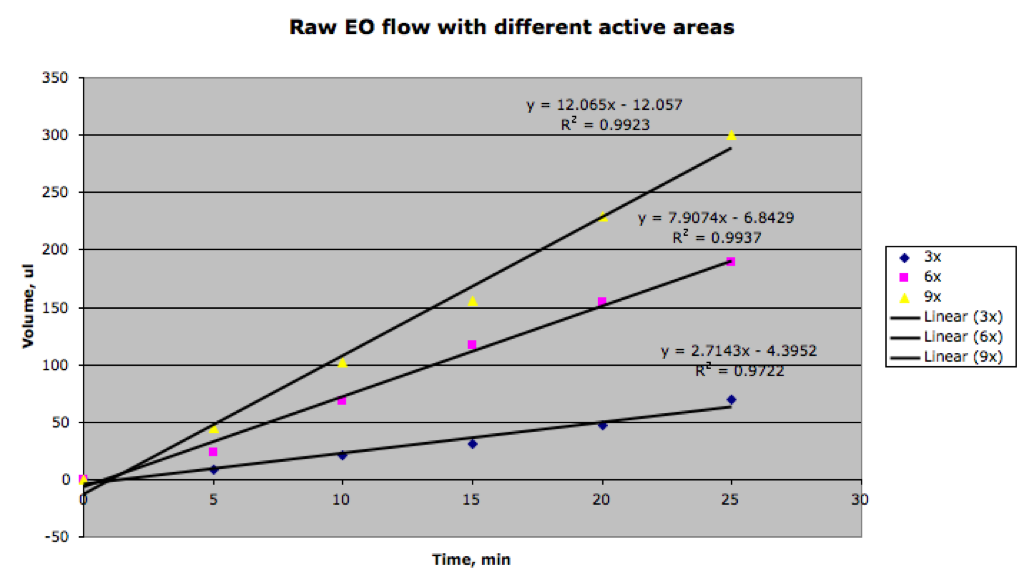
If we take the slopes from this figure, we get the flow rates in uL/min. We can then plot against active area:
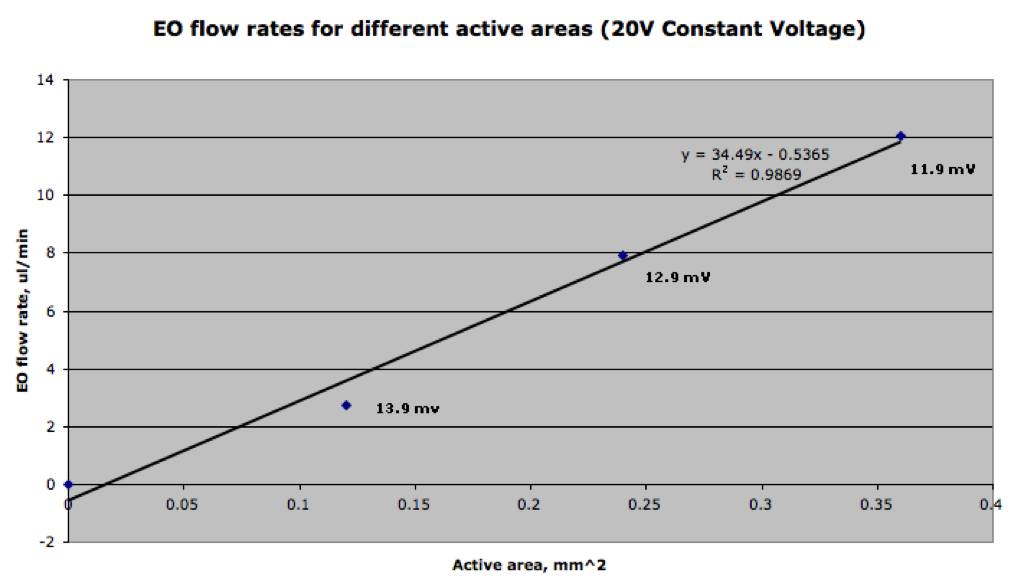
We get a pretty nice fit here, and we’re closer to the zero point unlike the older figure. Notice that all experiments were performed at an applied constant voltage of 20V. I then went back and calculated the effective voltage across the membrane for each membrane type and I wrote that in bold next to each point. Since the current drops along with active area, we’re pretty close in effective voltages when we use the same applied voltage.
Here’s some additional resistance stuff I’ve been doing lately. I went and looked at the resistance of the a chamber with no chip at all (100% active area), and added it to the previous resistance plot:
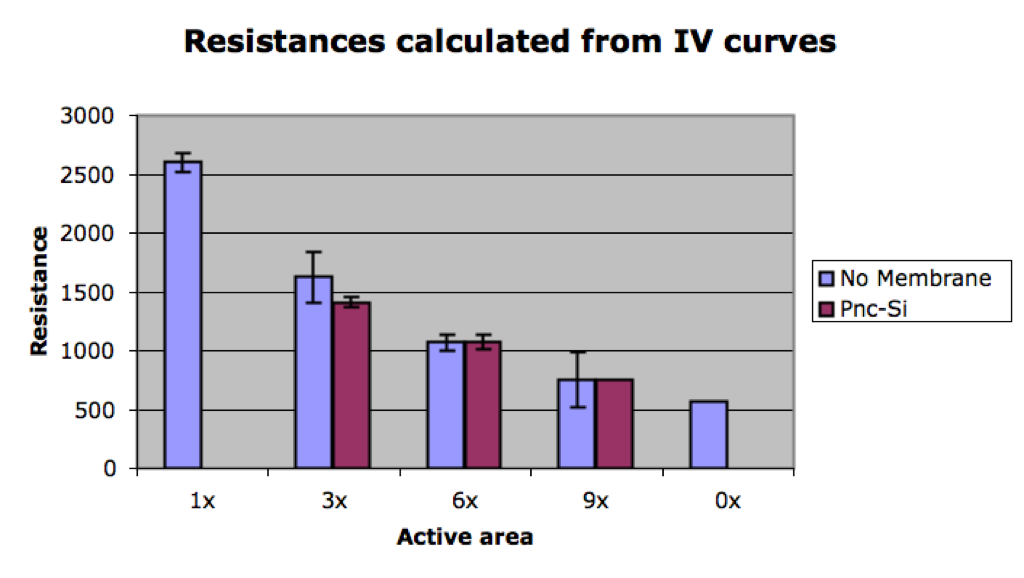
When you’re dealing with resistances in series, the total resistance is the sum of the parts. That means R(total)=R(buffer)+R(chip geometry)+R(membrane). I then subtracted out the 0x case (which is just R(buffer)) from each of the total resistances to find the contribution of the chip geometries (R(membrane) is pretty much zero). Here’s a plot of geometry vs. resistance:
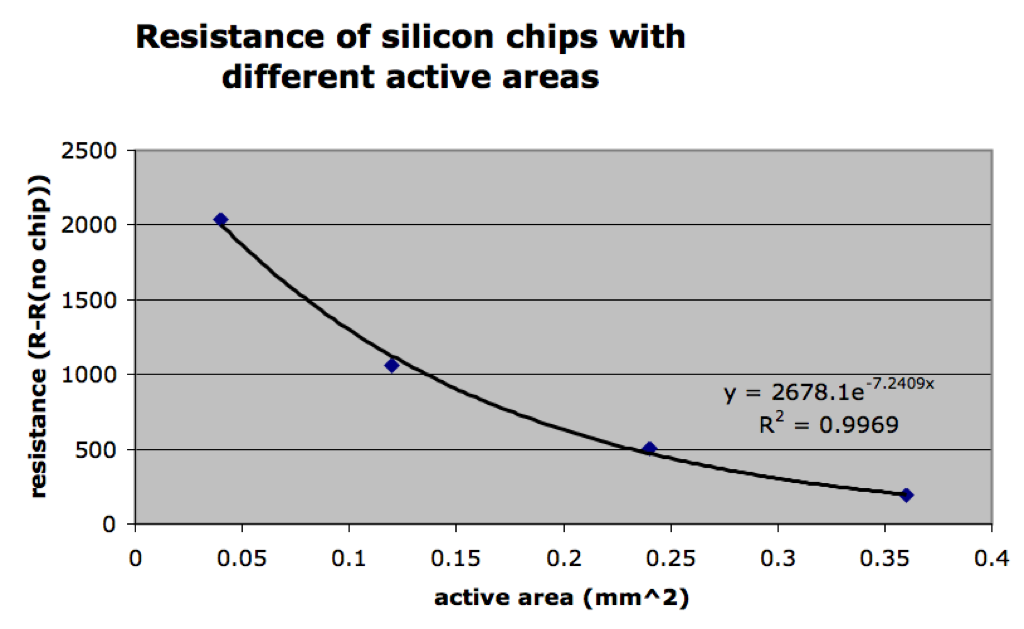
Looks like there’s still an exponential decay here. So apparently the resistance decreases non-linearly as active area increase, but number of pores should increase linearly with active area.
The EO results look very good to me.
The resistance graphs are unexpected, but it must be something that was observed long ago, and should be quite well understood – putting different sized apertures between two tanks and observing resistance. It seems so basic. You must be perturbing the flow of current in the open chambers, forcing more current though smaller cross-sections (even at some distance from the membranes), and kicking up the effective resistance. Essentially, it would be like using a narrower and narrower wire. IT’s surprising that the effect would be this large, but maybe salt water is not as conductive as I had assumed it would be. IF this is the case, subtracting off the “0X” resistance may not be appropriate, since the effect is more of a perturbation of the “0X” resistance than an addition to it. There must be someone out there that can confirm this…